
Short answer: Specify a one-piece or a seal-welded two-piece body, which has no body joint open to atmosphere, and have the supplier confirm that construction for every size on the order. Then write the three leak paths every ball valve keeps on the request for quotation (RFQ): stem seal material and peak temperature, with a blowout-proof stem; the thread standard (PT, NPT or PF) or flange class; and seat material, with the pressure test method.
Every industrial ball valve can leak in four places: around the stem, at the two end connections, at any joint in the body, and across the seats when the valve is closed. No design removes all four. Each one, though, is governed by a line you can write into the purchase specification.
This guide goes through industrial ball valves one leak path at a time, from the buyer’s side: what to put on the request for quotation (RFQ), and which document or standard to ask the supplier for. If a valve in your plant is already leaking, our guide to a leaking ball valve covers how to find the leak point and what each fix involves.
Leak Paths on an Industrial Ball Valve and What to Specify
The stem seal, the end connections and the body joints leak to atmosphere. The seats leak internally, past the closed ball. On the order, each path maps to one line of the specification and one document you can ask for.
| Leak path | Line to write on the RFQ | Document or standard to ask for |
|---|---|---|
| Stem seal | Stem seal and packing material, peak line temperature, expected cycles per day | Written confirmation, on the datasheet or the quote, that the stem is blowout-proof |
| End connections | Connection type, and the thread standard: PT (taper), NPT (National Pipe Taper) or PF (parallel); or the flange standard and class | Dimension sheet showing the end connection and thread |
| Body joints | Body construction (one-piece, two-piece, seal-welded two-piece or three-piece), confirmed for each size on the order | Dimension sheet or drawing showing how the body is joined; material test report for the body |
| Seats | Seat material and maximum temperature; on/off or throttling duty | Pressure test method, such as API 598 from the American Petroleum Institute, and whether every valve is tested |
The sections below cover the lines that are easiest to get wrong.
Body Construction: Confirm It Size by Size
Of the four leak paths, the body joint is the only one the valve’s construction settles by itself. A one-piece body and a seal-welded two-piece body have no body joint open to atmosphere. A conventional two-piece has one, and a three-piece has two bolted joints, which are there so the center section can come out. Choose the construction by whether your plant rebuilds valves in the line or replaces them; our guide to ball valve body types compares them side by side.
One of our customers runs ball valves on a diesel line. Their previous valves leaked at the joint between the body and the end cap, and they replaced them with our V-2B.
Construction can change inside one product series, and our own seal-welded V-2B shows how. The threaded V-2B is seal-welded from 1/4″ to 3″, but the 4″ size uses a bolted end cap. The socket-weld V-2B-SW, by contrast, is welded across the whole 1/4″ to 4″ range. If the welded body is why you chose a series, ask the supplier to confirm the construction for every size you order. It takes one email.

For a three-piece valve, the line that matters is spares. Its center section can come out without cutting the pipe, so before you choose one for in-line service, ask whether seat and seal kits are sold for that exact model. For our V-3A, seat and seal repair kits are sold separately, and our guide to installing and maintaining three-piece ball valves covers the rebuild.
Stem Seals: The Leak Path Every Ball Valve Keeps
The stem has to pass through the pressure boundary and turn, so no ball valve design removes this leak path. The U.S. Environmental Protection Agency’s leak detection and repair guide states that “leaks from valves usually occur at the stem or gland area of the valve body and are commonly caused by a failure of the valve packing or O-ring.” The stem lines on your order are about that seal surviving your temperature and your duty.
- Write the stem seal and packing material on the RFQ, together with the peak line temperature. PTFE (polytetrafluoroethylene) and graphite seals suit different services, and the peak temperature is the one that decides.
- Give the expected number of cycles. A valve operated several times a shift wears its stem seal faster than one opened twice a year.
- Confirm the stem is blowout-proof. The design is explained in the FAQ below, and every ball valve in our range uses one.
End Connections: Leak Paths You Create on Site
Your installer makes these two joints, not the valve factory, so specify the connection your piping and maintenance practice call for. Tapered threads (PT and NPT) are quick to make up and to remove, but they rely on thread sealant. Welded ends remove the threads and make the valve part of the pipe. Flanged ends move the seal to a gasket and bolts that can be opened again.
- Threaded ends: state the thread standard on the order. Our threaded ball valves are made with PT, NPT or PF threads, and the valve thread has to match the pipe thread. Sealant questions are answered in the FAQ.
- Socket weld and butt weld ends: these suit lines where threaded joints keep weeping, and the valve becomes permanent once welded. A seal-welded valve must stay assembled while it is welded into the line and be cooled promptly afterwards to protect its PTFE seats. Our V-2B-SW is the socket weld version of the seal-welded body. Our V-3A three-piece takes socket weld or butt weld ends, and once the line has been isolated, depressurized and drained, its center section can still be removed with the ends welded in.
- Flanged ends: the valve seals to the pipe through gaskets and bolts, so it comes out without cutting or unthreading the line. Gasket choice and bolt-up practice then control the leak. Our flanged ball valves are offered in Class 150 and 300 and in JIS (Japanese Industrial Standards) 10K and 20K.
Our guide to valve end connections compares threaded, socket weld and butt weld ends in more depth.
Seats: The Internal Leak Path
Seat leakage is the leak you cannot see. With the valve closed, flow gets past the ball and nothing drips outside. Seat material, the condition of the ball and the way the valve is operated decide how long the seats hold.
- Match the seat to temperature and media. Our threaded series use PTFE seats rated −20 °C to +180 °C (−4 °F to 356 °F). For low-pressure steam we make a graphite-seated V-2B, and its limits are set out in our guide to ball valves for steam.
- Keep soft-seated ball valves on on/off duty. MSS SP-110, the Manufacturers Standardization Society practice for threaded and socket-weld ball valves, says these valves are intended for on/off operation and should be used for throttling only when the manufacturer recommends it. Our article on the graduated handle explains what partial opening does to the seats.
- Ask about testing before you order. Every valve we ship is leak tested before it leaves the factory, with API 598 as our test method, and is checked dimensionally before packing.
How to Match Industrial Ball Valves to Your Line
Every construction keeps the stem seal, the seats and the two joints your installer makes. What changes from one to the next is the body joint, and what you get in exchange for it. Read the list below as a trade: which leak path each valve removes or adds, and what that buys you.
- V-2B seal-welded two-piece: no body joint open to atmosphere, with a full-port bore. It fits isolation duty where valves are replaced at end of life. The V-2C is its standard-grade version for plumbing and building services.
- V-3A three-piece: two bolted body joints, which is the price of a center section that comes out without cutting the pipe. It fits seats that are serviced on a schedule, and weld ends where you want to keep that access.
- R-1B one-piece: no body joint, in a reduced-port body. It suits small lines where a reduced port is acceptable, such as instrument connections and OEM (original equipment manufacturer) machinery.
- V-2NF two-piece, up to 2″: rated 2000 WOG, a cold working pressure rating for water, oil and gas, for threaded service above 1000 psi. A higher pressure rating does not change the leak-path count, so confirm its body construction on the dimension sheet as you would for any other size.
- Flanged ball valves: the end joints move to gaskets and bolts that can be opened again, for flanged piping where the valve has to come out whole.
WOG is measured cold. For the pressure a valve holds at your operating temperature, check pressure-temperature ratings in standards such as ASME B16.34 from the American Society of Mechanical Engineers, and see our article on WOG pressure ratings for how to read the marking. The threaded valves above are offered for water, oil and compressed air service.
Specification Mistakes That Add Leak Paths
Several avoidable leaks start on the order sheet. Check for these three.
- Choosing three-piece for serviceability on a line that is never serviced. You pay for two extra body joints and never use the access.
- Choosing three-piece without asking about kits. The joints are there so the valve can be rebuilt. If seat and seal kits are not sold for that exact model, you have the joints without the benefit.
- Ordering a series by name and assuming one construction for every size. Within one series the body joint can change with size, as the V-2B example above shows. Ask for the construction size by size.
Thread standards, WOG read as a temperature rating, and taking a seal-welded valve apart before it is welded in are covered in the five specification mistakes in our guide to how we manufacture ball valves.
What to Send a Supplier
Send the service conditions plus one line for each leak path from the table above. In practice that means the medium and its concentration, normal and peak pressure and temperature, pipe size and port, and the stem, end, body and seat lines.
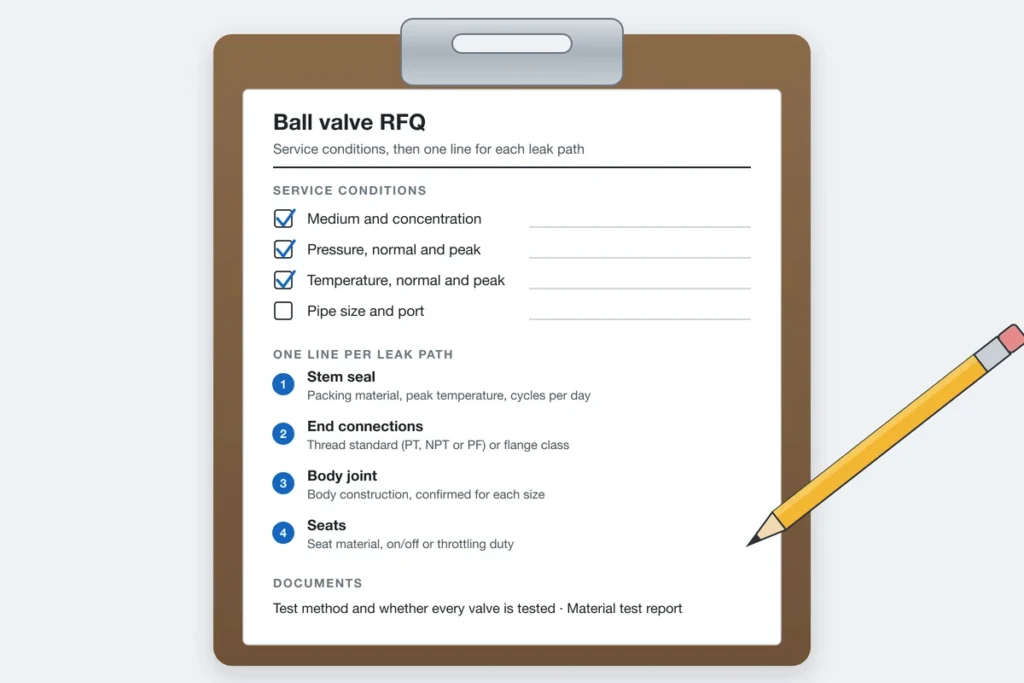
Our valve RFQ guide has a full checklist. On our side, regular items ship from stock, everything else is made to order, and material test reports are available on request.
Frequently Asked Questions
Are PT and NPT threads the same?
No, and they should not be mixed. Both are tapered pipe threads that seal with sealant, but NPT follows the American standard ASME B1.20.1, and PT is the older JIS name for the taper thread now covered by ISO 7-1, so the thread angle and, in many sizes, the threads per inch differ. Swagelok’s pipe thread guide states that ISO and NPT threads should not be intermixed. Put the thread standard on the order and confirm it on the quote, especially when buying from an Asian supplier whose standard thread may be PT. Our guide to valve end connections compares NPT, PT and PF.
Do NPT threads on a ball valve need thread sealant?
Standard NPT threads do. Tapered pipe threads seal by interference fit, and a Swagelok technical article on basic pipe threads notes that they need a sealant to make a leak-tight joint. The same applies to PT, which is also a tapered thread. PF is different: it is a parallel thread, and the same article notes that parallel threads are normally sealed with a gasket or O-ring, with no tape or sealant on the threads. If a threaded joint weeps after installation, remake it with fresh sealant instead of adding torque, because over-tightening creates leaks of its own.
What is a blowout-proof stem, and do I need one?
A blowout-proof stem has a shoulder or collar at its lower end that the valve body holds in, so internal pressure pushes the stem against the body instead of out through the packing. The stem is retained by the body, not by the packing nut. Treat that as a safety margin, not as permission to work on packing under pressure: isolate and depressurize the line first. For pressurized industrial service it is a sensible baseline, and one line on a datasheet confirms it. All ball valves in our range use a blowout-proof stem.
Which documents should I ask a ball valve supplier for?
Ask for one document per leak path, and ask for them with the quote so the answers are in writing before you place the order. For the stem, written confirmation on the datasheet or the quote that the stem is blowout-proof. For the end connections, a dimension sheet that shows the connection and the thread standard. For the body, a dimension sheet or drawing that shows how the body is joined, plus a material test report for the body. For the seats, the pressure test method, which the next question covers. On our side, material test reports are available on request.
What leak test should I ask a ball valve supplier for?
Ask which test standard the supplier uses and whether every valve is tested or only a sample from each batch. API 598 is the API standard for valve inspection and testing, and it sets inspection and pressure test requirements for ball valves and other valve types, including soft-seated designs. Testing every valve and testing a sample give you different assurance, so get the answer in writing with the quote. Ask the supplier to state what the test checks on each valve.
Summary
An industrial ball valve has four leak paths, and each one maps to a line on your specification. Body construction settles the body joint by itself, so choose it by whether you rebuild valves or replace them, and confirm it for every size. The other three depend on what you write down: stem seal and temperature, thread standard or flange class, seat material, duty and testing. Fill in those lines and your supplier has far less to guess.
Send us your service conditions and the lines from the table above, and we will propose a valve for each position. We have shipped valves to the United States, and export orders travel by sea freight.