
Product Name
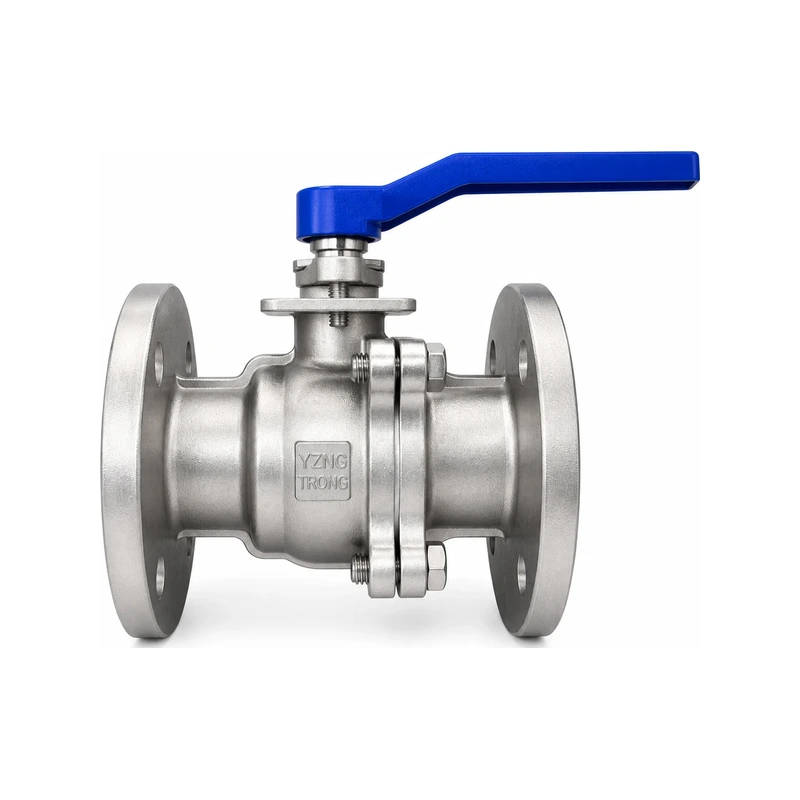
Stainless Steel Flanged Ball Valve – 304/316, Full Port, Class 150/300, JIS 10K/20K
Product Summary
A stainless steel flanged ball valve in 304 or 316, lever operated, full port, sizes 1/2″ to 8″. Four flange standards — JIS 10K/20K and ASME Class 150/300 — with a PTFE seat and raised-face flanges, -20 °C to +180 °C. Built for process, utility and isolation lines that need a flanged, easily serviced shut-off.
ISO 9001 · CE · Manufacturer since 1999
Product Description
Flanged ball valves are preferred in industry because they are easy to install and remove from
the line without disturbing the pipe alignment. This series features a full port (full bore) design
for unimpeded flow and a robust floating ball mechanism. The wide range of pressure ratings allows
engineers to select the exact specification needed for water, low-pressure steam and gas
lines.
Key Technical Specifications
- Body Material: ASTM 304 or 316 Stainless Steel
- Size Range: 1/2″ ~ 8″ for JIS 10K & ANSI Class 150 / 1/2″ ~ 4″ for JIS 20K
& ANSI Class 300 - Standards: JIS 10K, 20K / ANSI Class 150 (150#), Class 300 (300#)
- Connection: Flanged (RF – Raised Face)
- Seat Material: PTFE
- Working Temperature: -20°C to +180°C
- Operation: Manual Lever Handle
Common sizes include 1-inch, 2-inch, 3-inch and 4-inch flanged ball valves, with 6-inch and
8-inch options available in JIS 10K and ANSI Class 150.
Pressure Rating Comparison
| Rating | Standard | Max. Working Pressure (ambient) | Size Range |
|---|---|---|---|
| JIS 10K | JIS B 2220 | 1.0 MPa (approx. 145 psi) | 1/2″ ~ 8″ |
| ANSI Class 150 (150#) | ASME B16.5 | 275 psi (approx. 19 bar) | 1/2″ ~ 8″ |
| JIS 20K | JIS B 2220 | 2.0 MPa (approx. 290 psi) | 1/2″ ~ 4″ |
| ANSI Class 300 (300#) | ASME B16.5 | 720 psi (approx. 49.6 bar) | 1/2″ ~ 4″ |
Note: Values above are flange-class ratings at ambient temperature. Actual working pressure
decreases as service temperature rises, and the PTFE seat governs the practical limit in service.
Contact us with your line conditions for a suitable recommendation.
Advantages & Benefits
- Secure Connection: Flanges provide the strongest joint for industrial piping,
minimizing leak risks. - Broad Pressure Range: Available options for standard (Class 150 / JIS 10K) and
high pressure (Class 300 / JIS 20K) needs. - Ease of Service: The entire valve body can be unbolted and removed for
maintenance. - Material Choice: Choose 316SS for chloride-bearing or corrosive media (added
molybdenum resists pitting), or 304SS for general utility.
Applications
- Chemical processing — process and utility line isolation. CF8M (316) resists chloride pitting; PTFE seats handle most chemicals.
- Water treatment plants — isolation at pump stations, filtration skids and utility piping.
- HVAC chilled and hot water — equipment isolation at points that are opened a few times a year.
- Power plant auxiliary lines — low-pressure cooling water and treated water (not main steam or condenser water).
- Marine and shipboard piping — grey water, deck utility and general service lines.
- Pulp and paper mills — general process and utility isolation.
- Low-pressure saturated steam — isolation lines up to 180 °C.
Lever operated: for isolation points that are cycled only occasionally, a manual valve saves the actuator and the air or power supply it needs. For remote or frequent operation, see the pneumatic flanged ball valve.
FAQ
Which flange standards and pressure ratings are available? Four standards: JIS 10K (1.0 MPa, about 145 psi) and ANSI Class 150 (275 psi) both in 1/2″–8″; JIS 20K (2.0 MPa, about 290 psi) and ANSI Class 300 (720 psi) in 1/2″–4″. All are raised-face (RF) flanges. Match the standard your piping already uses.
Should I choose 304 or 316 stainless steel? 304 (CF8) suits general water, air and process lines. 316 (CF8M) adds molybdenum for better resistance to pitting from chlorides — the safer choice for coastal, marine and chemical service.
Is it full port? Yes. The bore matches the pipe inside diameter, so the open valve adds almost no flow restriction.
What is the operating temperature? -20 °C to +180 °C. The flange class sets the pressure ceiling, but the PTFE seat governs the practical limit in service — pressure derates as temperature rises.
How do I pick the right pressure rating? Start from the flange standard your counter-flanges use (ANSI or JIS), then confirm the class covers your line pressure at its working temperature. Tell us your line conditions and we will recommend a suitable rating.
What is the minimum order? No minimum order quantity — we accept orders of any size, including small trial orders. For small orders, freight is arranged and paid by the buyer. Payment is by T/T — 30% on order confirmation, 70% before shipment.
Sample Policy
We are happy to provide product samples for customers to evaluate quality or conduct testing. The
process typically begins with a quotation based on the customer’s specifications.
If the pricing is acceptable, we can offer samples either free of charge or at a cost depending
on the product type and availability. Shipping fees are borne by the customer.
Order Process
After confirming the product requirements and other details with the customer, we will issue a
Sales Confirmation for approval. Once confirmed, the customer is required to pay a 30% deposit to
proceed with production.
When mass production is completed and the goods pass inspection, the customer must pay the
remaining 70% balance before shipment is arranged.
Sample Policy
We are happy to provide product samples for customers to evaluate quality or conduct testing. The process typically begins with a quotation based on the customer’s specifications.
If the pricing is acceptable, we can offer samples either free of charge or at a cost depending on the product type and availability.
Shipping fees are borne by the customer.
Order Process
After confirming the product requirements and other details with the customer, we will issue a Sales Confirmation for approval. Once confirmed, the customer is required to pay a 30% deposit to proceed with production.
When mass production is completed and the goods pass inspection, the customer must pay the remaining 70% balance before shipment is arranged.
Related Products
FAQ
A. How can I request a quote?
Please provide a detailed inquiry sheet including product specifications, materials, quantities, and any special requirements. We will offer a quotation based on your request.
B. What are your quotation terms?
Our quotations are typically based on FOB terms. However, we can also offer CFR, CIF, or other Incoterms upon request.
C. What is your Minimum Order Quantity (MOQ)?
MOQ depends on the product. We operate on a made-to-order basis, and trial orders are welcome. For smaller orders, freight is arranged and borne by the buyer.
D. What are your payment terms?
By T/T – 30% down payment upon order confirmation, and 70% balance before shipment.
E. What is your lead time?
Lead time depends on order quantity and specifications. We will confirm the exact schedule when you request a quote.
Want to know more?
If you’re interested in any of our products or services, simply fill out the form below. Our team will get in touch with you as soon as possible to provide the information you need.