Author name: ballvalves.tw

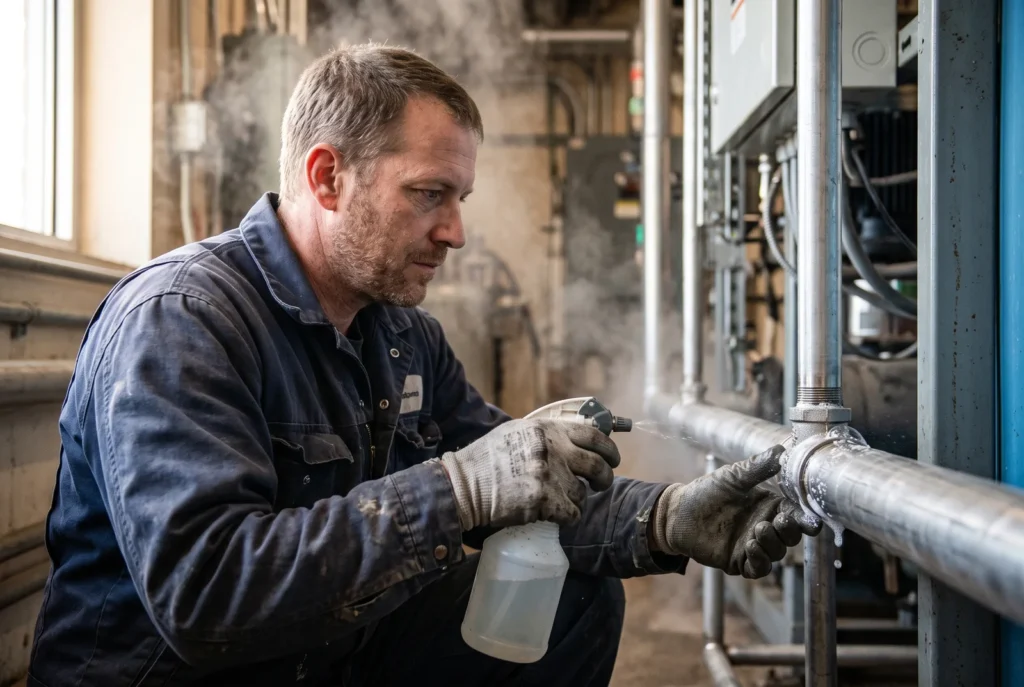
Stainless steel ball valves on a coolant manifold serving liquid-cooled server racks in a data center

Stainless Steel Ball Valves for Data Center Liquid Cooling & CDU Systems

Every liquid-cooled data center is, underneath the servers, a piping project. Coolant has to be distributed, isolated, balanced, drained, and serviced, and the components that make that possible are valves. This guide explains where ball valves sit in a data center liquid cooling loop, why stainless steel is the default body material for coolant service, […]

Stainless Steel Ball Valves for Data Center Liquid Cooling & CDU Systems Read More »

Exploded view of an ISO-KF flange connection showing two KF flanges, centering ring with O-ring, and aluminum hinged clamp with wing nut

KF Flange vs NW Flange: Differences and Size Chart (ISO-KF)

By the Yzng Trong International engineering team — we design and manufacture 316 stainless steel vacuum ball valves and KF-flanged components in Taiwan, and we answer these sizing questions from buyers every week. Last updated: 2026-07-03 Key Takeaways What Is a KF Flange? A KF flange is a quick-release vacuum flange that seals with an

KF Flange vs NW Flange: Differences and Size Chart (ISO-KF) Read More »

Assortment of 316 stainless steel pipe fittings including elbows, tees, couplings and hex nipples

316 Stainless Fittings: A Buyer’s Guide to Specs, Grades and Cost

Last updated: 2026-06-19 · By the Yzng Trong International sales and engineering team — a Taiwan-based manufacturer of stainless steel ball valves and pipe fittings, exporting to water treatment, marine and OEM customers worldwide. Key Takeaways A 316 stainless fitting is a threaded or welded pipe connector made from grade 316 austenitic stainless steel —

316 Stainless Fittings: A Buyer’s Guide to Specs, Grades and Cost Read More »

3-way ball valve flow path diagram in industrial piping system

3-Way Ball Valve Selection: Match L-Port or T-Port to Your Flow Path

Choosing a 3-way ball valve by its port name alone is a common source of piping mistakes. Two valves can both be sold as “L-port,” yet connect their ports differently at each handle position. Before you compare prices or materials, get two documents for the exact model you are considering: the port diagram and the

3-Way Ball Valve Selection: Match L-Port or T-Port to Your Flow Path Read More »

Y strainer cutaway showing the wire-mesh screen and typical openings for 20, 60 and 100 mesh

Y Strainer Mesh Size Guide: Microns, Flow and Pressure Drop

TL;DR / Quick Reference Summary Screen Nominal opening Millimetres Inches First engineering check 20 mesh ≈840 µm ≈0.840 mm ≈0.0331 in Coarse debris capture with more open area and lower clogging tendency 60 mesh ≈250 µm ≈0.250 mm ≈0.0098 in Medium capture where downstream passages require finer protection 100 mesh ≈150 µm ≈0.150 mm ≈0.0059

Y Strainer Mesh Size Guide: Microns, Flow and Pressure Drop Read More »

stainless steel ball valve and gate valve side by side comparison

Ball Valve vs Gate Valve: Which One I Actually Spec (2026 Guide)

Short answer: pick a ball valve when you need fast quarter-turn shutoff and a bubble-tight seal on small to mid-size lines; pick a gate valve for large-diameter isolation that operates infrequently, where slow closing prevents water hammer and lower per-inch cost matters. Decide by duty, not price — the two valves do not do the

Ball Valve vs Gate Valve: Which One I Actually Spec (2026 Guide) Read More »

Stainless steel YZNGTRONG ball valve in an industrial plant, illustrating ball valve leaking prevention

Ball Valve Leaking? Find the Leak Point First (4 Types, 4 Different Fixes)

“Ball valve leaking” describes at least four different problems, and they have four different fixes. Before you compare valve designs, name the leak: This article is about the third one. A welded-body 2-piece ball valve has no bolted body joint, so it reduces one potential external leak path. That is a genuine structural difference. It

Ball Valve Leaking? Find the Leak Point First (4 Types, 4 Different Fixes) Read More »

Stainless steel battery-powered electric ball valve installed on flanged piping at a water treatment plant

Valve Actuator Selection: Start with Torque and Fail Position

Do not start actuator selection by debating pneumatic versus electric. That question comes last. Before any brand or model enters the discussion, three things have to be confirmed: Until all three are confirmed, no actuator can be selected reliably. An actuator that matches the pipe size but not the torque will stall on a sticky

Valve Actuator Selection: Start with Torque and Fail Position Read More »

Scroll to Top