
On most compressed air lines, a brass ball valve and a stainless steel ball valve will both hold the pressure. The choice comes down to what else travels through the pipe. On dry, clean, treated air, a brass compressed air ball valve is the lower-cost choice. Where condensate collects, compressor oil carries over, or the outside of the valve sees washdown, salt air or chemicals, stainless steel is the safer pick, and 316 is the grade to choose when chlorides are involved.
This guide is for maintenance teams, plant engineers and buyers who specify shut-off valves for shop and plant air. We are YZNG TRONG, a stainless steel ball valve manufacturer in Taiwan. We have made ball valves since 1999, and our threaded ball valves are made for water, oil and compressed air service, so we have a stake in the answer. The sections below show where each material fits, including the spots where brass does the job.
Key takeaways
- Compressed air carries water and often oil. The U.S. Department of Energy (DOE) notes that air leaving an aftercooler is typically saturated, so more water condenses as it cools in the piping, and oil-lubricated compressors can carry lubricant into the line.
- Pressure is seldom the deciding factor. Many plant compressors run at about 100 psig (pounds per square inch, gauge) at full load. The two-piece brass ball valves we checked from U.S. makers are rated 600 WOG (a cold, non-shock pressure rating in psi for water, oil and gas) in most sizes; our stainless threaded ball valves are rated 1000 WOG, or 2000 WOG for the V-2NF.
- Brass can lose zinc (dezincification) in slightly acidic, low-flow water. The published sources cover water systems; in our reading, condensate collects in the same kind of still pockets: low points, drain legs and receiver tanks.
- Every 2 psi of extra discharge pressure raises compressor energy use by about 1% of connected power, according to the Compressed Air Challenge, and pressure drop is what forces that extra pressure. A full-port valve keeps its own share of the drop small.
- For lockout, the U.S. Occupational Safety and Health Administration (OSHA) counts pneumatic energy as an energy source. On new or modified equipment the isolating valve must be able to take a lock, and once it is locked, the stored air downstream must be released and the isolation verified.
Stainless or brass: the short answer
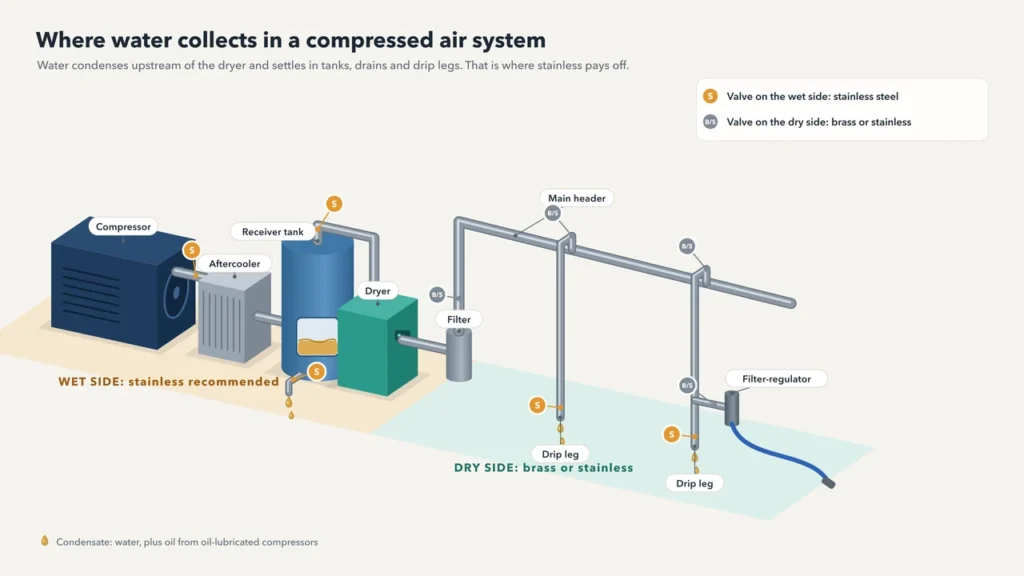
Brass is adequate on dry, filtered, indoor air lines where cost matters most and nothing corrosive reaches the valve. Stainless steel belongs on the wet side of the system: near the compressor and receiver, on drain legs and low points, on oil-laced air, and anywhere the outside of the valve sees washdown, coastal air or chemicals. Where chlorides are present, pick 316.
The quickest way to decide is to look at where the valve will sit. The table follows the air from the compressor to the tool.
| Where the valve sits | What the valve sees | Brass | Stainless steel |
|---|---|---|---|
| Compressor discharge, before the aftercooler | Hot air carrying its moisture as vapor; lubricant on oil-lubricated machines | Check the maker’s temperature rating | Preferred |
| Receiver tank outlet and tank drain | Condensate, oil and particles that settle in the tank | Risky where water stands | Preferred |
| Main header after the dryer and filters | Dry, clean air | Lower cost; fits dry air | Works; matches stainless piping |
| Branch drops to machines | Mostly dry air; water if a drop has no drip leg | Fine on dry drops | Better where water collects |
| Point of use, ahead of the filter-regulator | Dry air at reduced flow | Lower cost; fits dry air | Works, at higher cost |
| Washdown, coastal or chemical areas | External corrosion; chlorides | Not recommended | 316 recommended |
What a ball valve does in a compressed air system
In a compressed air system, a ball valve is a shut-off valve. A quarter turn of the handle rotates a drilled ball to open or close the line, so you can shut off a tool, a machine, a branch or the whole header for maintenance. It is an on/off valve. Line pressure for tools is set by a regulator, not by leaving a ball valve half open.
These terms come up in almost every ball valve specification:
- WOG stands for water, oil and gas. It is a cold, non-shock working pressure. Our 1000 WOG valves, for example, are rated for 1000 psi cold, non-shock. Our guide to 1000 and 2000 WOG ratings explains how to read the number.
- CWP means cold working pressure. Some makers print CWP instead of WOG; both are cold, non-shock ratings.
- Full port means the bore through the ball is about the same as the inside diameter of the pipe. Reduced port (also called standard port) means the bore is smaller than the pipe.
- Two-piece and one-piece describe how the body is built. A two-piece body is made of two parts joined by a thread or, on seal-welded designs such as ours, a weld. A one-piece body has no separate body sections, so it is compact, but it cannot be opened for repair and usually has a reduced port.
- NPT, PT and PF are thread standards. NPT is the tapered pipe thread used in the United States. PT is the ISO 7 tapered thread (also sold as BSPT), common outside North America. PF is the ISO 228 thread (BSPP), which is not tapered and seals on a gasket or O-ring rather than on the thread.
On a typical system, you will find ball valves at the compressor outlet, at the receiver, at the start of the main header, at the top of each branch drop and just before each point of use. Each of those spots sees a different mix of air, water and oil, which is why one material doesn’t fit them all equally well.
What travels through an air line: water, oil and heat
Compressed air carries water vapor, and often compressor lubricant and fine particles as well. As the air cools in the piping, the vapor turns into liquid condensate. The valve sees whatever the air treatment hasn’t removed: dry air downstream of a working dryer and filters, and water mixed with oil and dirt upstream or anywhere condensate pools.
Water: condensate keeps forming as the air cools
The DOE’s compressed air sourcebook for industry explains that air leaving an aftercooler and moisture separator is typically saturated. Any further cooling in the distribution piping condenses more water, which the sourcebook links to corrosion and to contamination at the point of use. The same book notes that cooling saturated compressed air by 20 °F cuts its moisture content by roughly half, which is why air that keeps cooling in the pipe keeps dropping water.
Atlas Copco, the compressor manufacturer, describes compressed air as carrying water vapor, oil (unless the compressor is oil-free) and solid particles. In its condensate literature it calls the mix an abrasive, often acidic, oily sludge. That is a manufacturer’s description rather than a measured value. We have not found a published pH figure for compressed air condensate, so treat “acidic” as a warning sign, not a number.
Oil: lubricant carryover from oil-lubricated compressors
Oil-lubricated compressors can pass oil into the delivered air. The DOE sourcebook notes that lubricant carryover from rotary screw machines depends on how well the air/lubricant separator and the lubricant are maintained, and that reciprocating machines carry over more lubricant as piston rings wear. Oil-free compressors are the exception. Oil itself is a normal service medium for ball valves (ours are made for water, oil and compressed air service). The bigger effect of oil is that it mixes with water and dirt into a sludge.
Heat: hottest at the compressor, cooler downstream
Air is hottest where it leaves the compressor. The DOE sourcebook gives two working figures: normal operation of an oil-lubricated rotary compressor requires discharge temperatures below 200 °F (93 °C), and dryers are normally designed for a maximum inlet air temperature of 100 °F (38 °C). A valve near the compressor needs a temperature rating that covers the discharge air. Further down the line the air is cooler, but check the temperature rating at each location.
Air purity classes: ISO 8573-1
If your plant specifies air quality, check whether the specification uses ISO 8573-1:2010, the international standard that grades compressed air purity by solid particles, water and oil. A purity class tells you how dry and clean the air should be at a given point. It also hints at valve material: the drier and cleaner the air at a valve’s location, the less that valve depends on corrosion resistance.
Brass ball valves on air lines: where they fit
Brass ball valves cost less than stainless and handle typical air pressures with room to spare. They work well on dry, clean air. Their weak point is water: brass can suffer dezincification where water is slightly acidic and slow-moving, which matters at receivers, drain legs and low points where condensate collects.
Cost and pressure
Pumps & Systems magazine describes stainless steel valves as a more expensive option than brass valves. Tameson, a valve distributor, describes brass as working well with water, compressed air and oils in neutral, non-corrosive service. On pressure, U.S. makers’ product pages for two-piece brass ball valves show ratings well above plant air: the two models we checked are rated 600 WOG, and one of them is rated 400 WOG at 4″.
Compare that with the air itself. The Compressed Air Challenge’s fact sheet on pressure drop and system pressure says many plant air compressors run at a full-load discharge pressure of 100 psig and unload at 110 psig or higher. A 600 WOG brass valve covers that with a wide margin, so pressure alone rarely rules brass out.
Dezincification: why brass and wet air don’t mix well
Brass is an alloy of copper and zinc. In dezincification, the zinc is selectively removed and leaves behind a porous, copper-rich structure with very little strength. The materials association AMPP explains that dezincification mainly affects alloys with more than about 15% zinc, and that slightly acidic or alkaline water that is not highly aerated, low flow, relatively high wall temperatures and permeable deposits all favor it. One form, plug-type attack, can penetrate deep into the walls of valves and fittings.
The published sources on dezincification deal with water systems. None of them tested brass valves in compressed air condensate. Our reading is this: a receiver drain, a low point or a drop without a drip leg holds standing water that may be mildly acidic and carries oily deposits, close to the conditions the corrosion literature warns about. Treat brass in those spots as a risk to manage, not a certain failure. Some makers offer dezincification-resistant alloys for wet service, so check the alloy on the data sheet.
A note on lead-free brass
In the United States, the federal lead-free rule for plumbing parts comes from the Reduction of Lead in Drinking Water Act, and NSF/ANSI 372 sets the same 0.25% weighted-average lead limit for drinking water components. Both are written for parts that carry water for human consumption, and the Act exempts parts used only for non-potable services such as manufacturing and industrial processing. As we read them, neither mentions compressed air. A brass valve marked “not intended for potable water” is not ruled out for an air line by that label alone, but check any state or local rules that apply to your site.
Stainless steel ball valves: what you get for the extra cost
A stainless steel ball valve buys corrosion resistance in the places brass struggles: standing condensate, oily sludge, washdown and corrosive surroundings. The main trade-off is purchase price.
Why stainless resists corrosion
Stainless steel protects itself with a thin chromium oxide film. The design guidelines of the Specialty Steel Industry of North America (SSINA) note that molybdenum and chromium increase resistance to chloride penetration of that film, and the same guidelines warn that stainless steels are not immune to every environment. Stainless is the better choice for wet and corrosive spots, but it is not a reason to stop draining condensate.
304 or 316 for compressed air
The difference between the two grades is molybdenum. The International Molybdenum Association’s 304 vs 316 FAQ says molybdenum gives Type 316 resistance to chlorides and improved resistance to urban and industrial pollution. Unless chlorides reach the valve, 304 (cast form CF8) covers most air lines. Choose 316 (cast form CF8M) for coastal plants, washdown areas, food and beverage processing areas and chemical sites, where salt air or cleaning chemicals bring chlorides to the valve. Our guide to CF8M material explains what the cast 316 designation means on a valve.
Pressure, temperature and stem design
Our stainless threaded ball valves are rated 1000 WOG, and the V-2NF is rated 2000 WOG. All of them have a published working temperature of −20 °C to +180 °C (−4 °F to 356 °F), well above the 200 °F (93 °C) discharge figure the DOE gives for oil-lubricated rotary compressors. All of the models in this guide use a blowout-proof stem: the stem is inserted from inside the body and has a shoulder wider than the stem bore, so line pressure cannot push it out even if the stem packing fails.
The trade-offs
Stainless valves cost more than brass. Tameson also describes them in its material guides as heavier and as needing more torque to operate; both depend on the design, so compare data sheets. On a header with dozens of drops, the price difference adds up, which is why a mixed approach often works: stainless on the wet side and in corrosive areas, brass on dry branches where cost matters most.
Stainless vs brass for compressed air, side by side
Brass wins on purchase price and is adequate on dry, treated air. Stainless wins on corrosion resistance and on service in wet or corrosive locations.
| Factor | Brass ball valve | Stainless steel ball valve |
|---|---|---|
| Purchase price | Lower | Higher |
| Dry, filtered air | Works well | Works well |
| Standing condensate, drains, low points | Dezincification risk where water is acidic and slow-moving | Resists corrosion; keep draining condensate |
| Oil-laced air | Handles oil; sludge collects where water stands | Handles oil and the wet sludge better |
| Washdown, coastal or chemical surroundings | Not recommended | 316 recommended where chlorides are present |
| Pressure rating, examples | 600 WOG on the two-piece models we checked (check each size) | 1000 WOG on our threaded valves; 2000 WOG on the V-2NF |
| Temperature near the compressor | Check the maker’s rating | Our valves: −20 °C to +180 °C |
| Best fit | Dry branches and points of use | Wet side, corrosive areas, stainless piping systems |
How to choose a compressed air ball valve
Work through six questions: the highest pressure the line can see, whether the valve sits on the wet or the dry side, which port size the location needs, which thread your piping uses, whether the valve must be locked out or automated later, and whether you need to shut off or to switch flow. The answers point to a material and a valve type.
1. Start from the highest pressure the system can reach
Use the highest pressure the system can reach, not the regulator setting at the tool. In normal running that is the compressor’s unload pressure; the upper bound is the set pressure of the safety relief valve on the receiver. If the compressor unloads at 110 psig, every valve between the compressor and the regulator sees about 110 psig. Compare the relief valve setting with the valve’s WOG or CWP rating. WOG is a cold, non-shock figure, so give yourself margin on lines near the compressor where the air is hot.
2. Decide whether the valve is on the wet side or the dry side
Anything upstream of the dryer, plus receiver drains, drip legs and low points, is the wet side. Put stainless there. Downstream of a working dryer and filters, the air is dry, and brass or stainless will both serve. If your dryer is undersized or often bypassed, treat the whole system as wet.
3. Match the port size to the location
Use full-port valves on the main header and on large drops. The Compressed Air Challenge says flow restrictions of any type force higher operating pressure, and each 2 psi of extra pressure raises compressor drive energy by about 1% of connected power. Port size makes a measurable difference to how freely a valve flows. One U.S. maker’s data sheets for two of its bronze two-piece ball valves, one standard port and one full port, list a flow coefficient (Cv) of 43 for the 1″ standard-port model and 68 for the 1″ full-port model.
Keep the scale in mind. The Compressed Air Challenge fact sheet puts the biggest pressure drops at the point of use, in hoses, quick couplers and filter-regulator-lubricator (FRL) units, and on the supply side in aftercoolers, separators, dryers and filters. Our reading: a single shut-off valve is rarely the main culprit, so a full-port valve keeps the valve’s own share small rather than fixing a system-wide problem. A reduced-port valve is fine where flow is small, such as gauge and instrument taps.
4. Get the thread standard right
In the United States, NPT is the thread standard; PT and PF threads are common outside North America. As our guide to valve end connections notes, mixing incompatible threads is a frequent cause of leaks, and on an air line a small thread leak runs all day. Tell your supplier which standard your piping uses before you order.
5. Plan for lockout and automation now
If a valve will isolate equipment for maintenance, it needs a way to be locked out, which the next section covers. If you may automate the valve later, choose a body with an actuator mounting pad now. Adding a pad later usually means replacing the valve.
6. Use a three-way valve only to switch flow
A three-way ball valve switches air between two paths. An L-port ball sends flow from one inlet to either of two outlets. A T-port ball always keeps at least two ports connected in every position, so it cannot shut off flow. If the unused branch must hold back pressure, as it would when you switch between two live supplies, confirm the seat design with the maker first. For shut-off, use a two-way valve. Our article on L-port and T-port selection shows the flow paths.
| Job on the air line | What to look for | Our model |
|---|---|---|
| Main header and large drops | Full port, 1000 WOG, two-piece | V-2B |
| Branch drops | Full port, 1000 WOG, two-piece | V-2C (same page as the V-2B) |
| Gauge and instrument taps, OEM (original equipment manufacturer) machines, tight spaces | Compact one-piece body, reduced port | R-1B |
| Lines that need more pressure margin, or a handle with a locking plate | 2000 WOG, full port | V-2NF |
| Sending air from one line to either of two lines | Three-way, L-port | 3L (MV-3M series) |
| Valves you may automate later | Actuator mounting pad on the body | V-2NF (drilled pad) or 3L / 3T (ISO-style pad) |
Isolating compressed air for lockout
Under OSHA’s lockout/tagout standard, pneumatic energy is an energy source, and a line valve is one of the energy isolating devices the standard names. Where the valve can take a lock, the employer has to use lockout unless it can show that a tag gives the same protection, and new or modified equipment must have isolating devices that accept a lock. Closing the valve is only half the job. The stored air downstream has to be released, and the isolation verified, before anyone starts work.
The standard, 29 CFR (Code of Federal Regulations) 1910.147, lists pneumatic energy among energy sources and names a line valve as an example of an energy isolating device. A device counts as capable of being locked out when it has a hasp or other attachment for a lock, or a built-in locking mechanism. Since January 2, 1990, equipment that is newly installed, replaced or given a major repair, renovation or modification must have energy isolating devices designed to accept a lockout device. Once locks are on, stored or residual energy must be relieved or otherwise made safe, and the isolation must be verified. In a 2021 interpretation letter, OSHA stated that a pneumatic valve which could not be locked did not meet the definition of an energy isolating device, and that simply disconnecting the air line was not lockout.
The standard does not say the isolating valve itself has to vent; it says the stored energy must be relieved and the isolation verified. A vented lockout valve combines the shut-off and the bleed in one step, but the verification is still a separate check. As a Parker Transair business development manager explains in Plant Services on pneumatic lockout valves, such a valve shuts off the flow and vents downstream pressure out of an exhaust port, and the lockout valve itself is defined in ANSI B11.0 and PMMI B155.1. With a standard ball valve, plan a separate way to bleed the downstream line and confirm it is at zero.
On our side, the V-2NF comes with a stainless lever that has a locking plate. Whatever valve you use, the lockout procedure, the lock and the verification step belong to your energy control program.
Common mistakes with compressed air ball valves
Most problems come from a handful of repeat errors: the wrong valve type for the job, mismatched threads, restrictions on the header, brass sitting in standing water, and treating a shut-off valve as a pressure control. Each is easy to avoid at the specification stage.
- Using a T-port three-way valve as a shut-off. It always connects at least two ports, so it cannot isolate a line.
- Mixing PT and NPT threads. Mixing incompatible threads is a frequent cause of leaks. Match the valve thread to the piping.
- Putting reduced-port valves on the main header. Each restriction adds pressure drop that the compressor makes up with energy.
- Leaving brass where condensate stands. Receiver drains, drip legs and low points are the spots to switch to stainless, or at least to a dezincification-resistant alloy.
- Using a ball valve to set tool pressure. A half-open ball valve is not a regulator. Install a regulator at the point of use.
- Treating “rated for compressed air” as “approved for fuel gas.” A valve made for compressed air service is not automatically approved for natural gas or propane. Check that a valve is listed for gas service before using it on a fuel gas line.
- Blowing off parts at full line pressure. Under OSHA rule 29 CFR 1910.242(b), compressed air used for cleaning must be reduced to less than 30 psi, with effective chip guarding and personal protective equipment. That rule covers cleaning, not line pressure.
Where YZNG TRONG ball valves fit on an air line
Our stainless threaded ball valves suit the wet and corrosive spots in an air system: air receivers, headers in stainless piping systems, branch lines and corrosive areas. All of them are made for water, oil and compressed air service, use PTFE (polytetrafluoroethylene) seats as standard and have a blowout-proof stem.
| Model | Body | Port | Rating | Sizes | Threads | Notes |
|---|---|---|---|---|---|---|
| V-2B | Two-piece, seal-welded (4″ has a bolted end cap) | Full | 1000 WOG | 1/4″ to 3″, plus 4″ | PT, NPT or PF | CF8 (cast 304) or CF8M (cast 316), both in stock |
| V-2C | Two-piece, seal-welded | Full | 1000 WOG | 1/4″ to 2″ | PT, NPT or PF | Standard grade of the V-2B design |
| R-1B | One-piece, welded | Reduced | 1000 WOG | F×F 1/4″ to 2″ (2-1/2″ and 3″ on request); M×F 1/4″ to 1/2″ | PT standard; NPT and PF also in stock | 316 in stock, 304 made to order; no actuator pad |
| V-2NF | Two-piece | Full | 2000 WOG | 1/4″ to 2″ | PT in stock; NPT and PF made to order | Lever with locking plate; drilled actuator mounting pad |
| 3L / 3T (MV-3M series) | Three-way | L-port or T-port | 1000 WOG | 1/4″ to 2″ | PT in stock; NPT and PF made to order | CF8M in stock; ISO-style actuator pad |
Our quote won’t be the lowest you receive. What we offer instead is inspection: every valve is leak tested and checked dimensionally before it leaves the factory, so a shipment doesn’t arrive full of defective valves. Material test reports are available on request, the company is ISO 9001 certified, and our ball valves carry CE marking. Regular items ship from stock and other configurations are made to order. We have shipping experience to the United States, and the minimum order depends on the product.
If you are replacing brass on the wet side of an existing system, send us the line size, the thread standard and the highest pressure at that point, and we will suggest the matching model.
FAQ
Can I use a stainless steel ball valve for compressed air?
Yes. Stainless steel ball valves are well suited to compressed air, and they are the better choice where the valve sees condensate, compressor oil or a corrosive environment. Check three things: the pressure rating covers the highest pressure the system can reach, the working temperature covers the air at that location, and the thread matches your piping. Our threaded stainless ball valves are made for water, oil and compressed air service, rated 1000 WOG (2000 WOG for the V-2NF) and rated for −20 °C to +180 °C. For plain dry air, 304 is enough; choose 316 where chlorides are present.
Are brass ball valves good for compressed air?
Yes, on dry, clean air. Brass ball valves cost less than stainless, and the two-piece brass models we checked from U.S. makers are rated 600 WOG in most sizes, far above the 100 psig full-load and 110 psig unload pressures common in plant air. The weak point is standing water. Brass can suffer dezincification, a loss of zinc that leaves a weak, porous metal, where water is slightly acidic and slow-moving. That makes receiver drains, drip legs and low points poor spots for standard brass. Use stainless there, or check that the brass is a dezincification-resistant alloy.
What pressure rating does a compressed air ball valve need?
It needs a rating above the highest pressure the line can reach. In normal running that is the compressor’s unload pressure, not the regulator setting at the tool; the upper bound is the set pressure of the receiver’s safety relief valve. Many plant compressors run at about 100 psig at full load and unload at 110 psig or higher. Ball valves are commonly rated in WOG or CWP, both cold, non-shock working pressures. A 600 WOG brass valve or a 1000 WOG stainless valve covers typical plant air. Allow extra margin near the compressor, where the air is hottest.
Should I use a full port or reduced port ball valve on air lines?
Use full port on the main header and large drops, and reduced port where flow is small, such as gauge and instrument taps. Every restriction adds pressure drop, and the Compressed Air Challenge estimates that each 2 psi of extra discharge pressure costs about 1% of compressor power. A full-port bore is about the same as the pipe’s inside diameter, so the valve adds little restriction when open. The Challenge’s fact sheet places the biggest pressure drops in hoses, quick couplers and filter-regulator units at the point of use.
Does a compressed air shut-off valve need to be lockable?
If the valve is used to isolate equipment for maintenance, in practice yes. OSHA’s lockout/tagout standard, 29 CFR 1910.147, treats pneumatic energy as an energy source and calls for lockout wherever the isolating device can take a lock, unless the employer can show that a tag protects workers equally well. Since 1990, equipment that is newly installed, replaced or given a major repair or modification must have isolating devices designed to accept a lock. After locking the valve, stored air downstream must be released and the isolation verified. Vented lockout valves combine the shut-off and the bleed in one step; with a standard ball valve, provide a separate bleed point.
Summary
Before you order, have four facts ready for each valve location: the highest pressure there, whether it sits on the wet or dry side, the port the flow needs, and the thread standard of the piping. Wet and chloride-exposed spots point to stainless, with 316 where chlorides are present; dry branches can run brass. Lockout and any plan to automate decide the handle and the body.
Send us your line size, thread standard and the highest pressure at each valve location, and we will match it to the right stainless ball valve.