
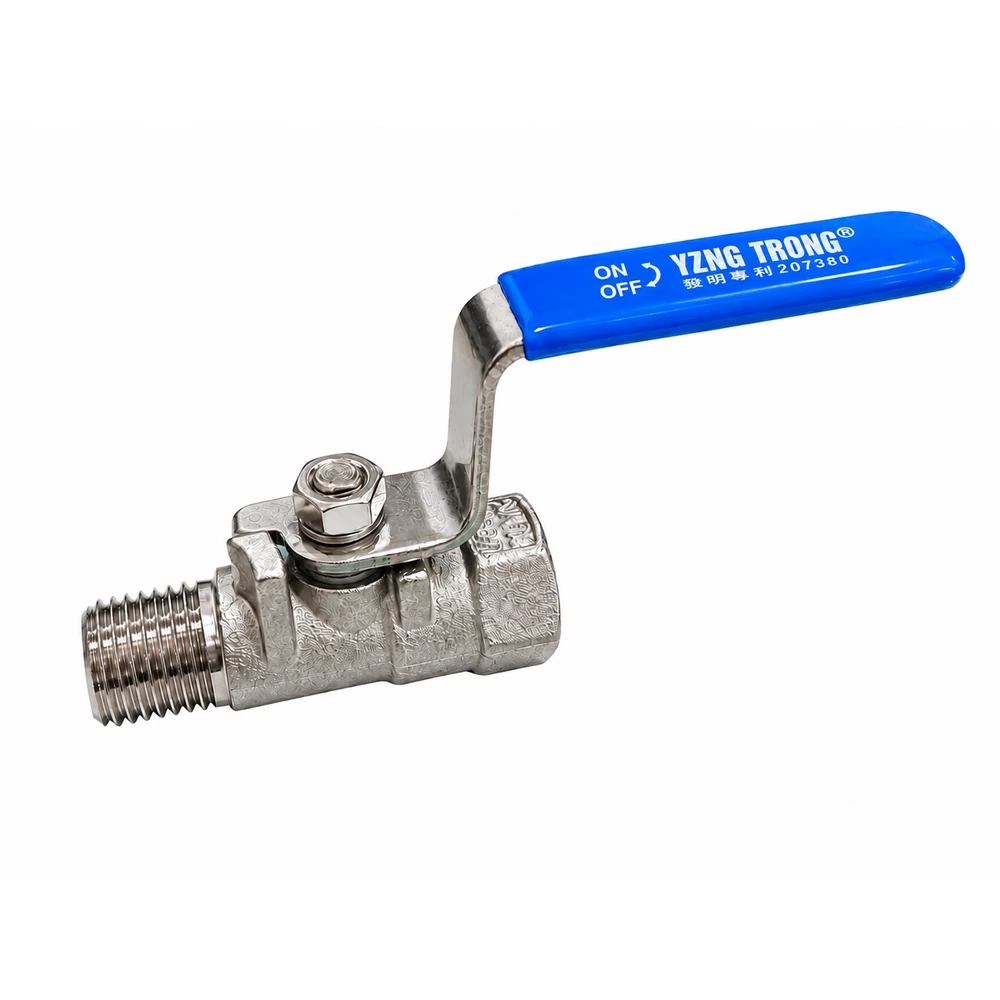
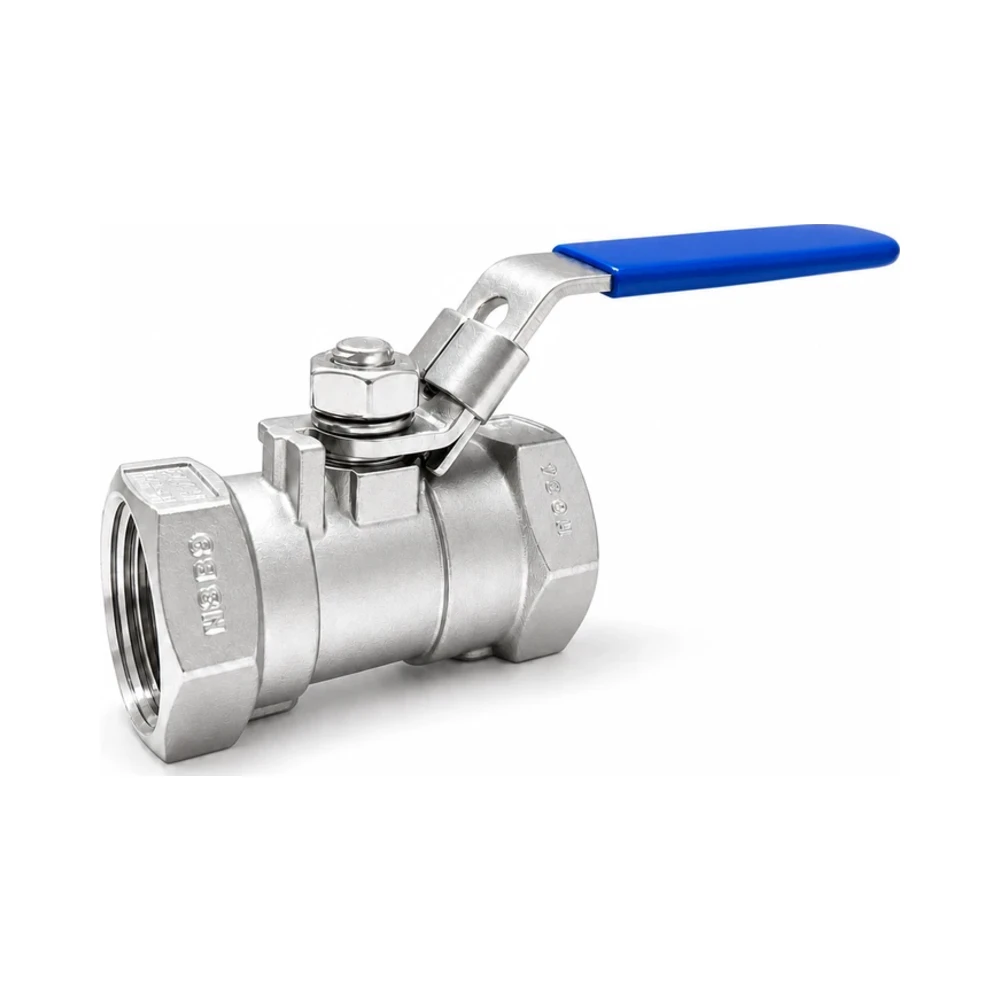
Product Name
One Piece Stainless Steel Ball Valve – Reduced Port, 316, 1000 WOG, PT/NPT/PF, 1/4″–3″ (R-1B)
Product Summary
One piece stainless steel ball valve, 1000 WOG. The body is cast as a single piece and welded closed — no threaded body joint, so one fewer place to leak. Reduced port, PTFE seats, manual lever. F×F 1/4″ to 3″, M×F 1/4″, 3/8″ and 1/2″. For water, oil and compressed air lines.
316 stainless in stock, 304 made to order · PTFE seat · 1000 WOG · −20 °C to +180 °C · PT threads standard, NPT and PF in stock
ISO 9001 · CE · Manufacturer since 1999 · Made in Taiwan
Product Description
A one piece stainless steel ball valve rated 1000 WOG, with the body cast as a single piece and welded closed. 316 (CF8M) is the stock material; 304 (CF8) is made to order. PTFE seats, manual quarter-turn lever, reduced port, −20 °C to +180 °C. Two end builds: female × female (F×F) from 1/4″ to 3″, and male × female (M×F) in 1/4″, 3/8″ and 1/2″.
Because the body is one piece instead of two or three bolted or screwed sections, there is no body joint — one fewer place for the valve to leak. The trade-off is honest: it cannot be opened for service, and the bore is one pipe size smaller than the line. We say so plainly further down, and we point you at the valve you should buy instead.
What 1000 WOG Actually Means
WOG stands for Water, Oil, Gas. A 1000 WOG rating means the valve is rated for 1000 psi of cold, non-shock working pressure on those media.
Three things buyers get wrong about it:
- WOG is a cold rating. It is not a steam rating. This valve runs from −20 °C to +180 °C, set by the PTFE seats — tell us your line temperature and we will confirm it suits.
- “Non-shock” is part of the rating. A line with water hammer or rapid pump starts sees pressure spikes well above its normal working pressure. Size for the spike, not the gauge reading.
- On this valve, “gas” means compressed air. Fuel gas lines (natural gas, propane) call for a gas-listed valve, and this is not one.
If your line runs above 1000 psi cold, this is not the valve — tell us the pressure and we will quote the right one.
F×F or M×F — Which One Do You Need?
- Female × Female (F×F) — both ends take a male pipe or fitting. The general-purpose choice, and the only one available above 1/2″ (up to 3″).
- Male × Female (M×F) — one male end screws straight into a female port, so you save a fitting and shorten the assembly. Available in 1/4″, 3/8″ and 1/2″ only. If you need M×F above 1/2″, see the two-piece MxF ball valve (1/2″–2″, full port).
Dimensions for both builds are on the PDF dimension sheets at the top of this page.
Specifications
| Item | Specification |
|---|---|
| Valve type | One piece (1-pc) stainless steel ball valve, welded body |
| Pressure rating | 1000 WOG (1000 psi cold, non-shock) |
| Working temperature | −20 °C to +180 °C |
| Body and ball | 316 (CF8M) in stock; 304 (CF8) made to order |
| Stem | 316 stainless steel |
| Seat and seals | PTFE |
| Service media | Water, oil, compressed air |
| End connections | Female × Female (F×F) or Male × Female (M×F), threaded |
| Thread | PT (taper) is the standard thread; NPT and PF are also in stock |
| Size range | F×F: 1/4″ – 3″ (2-1/2″ and 3″ on request) | M×F: 1/4″, 3/8″, 1/2″ |
| Port | Reduced (standard) port |
| Operation | Manual quarter-turn lever, stainless handle with vinyl sleeve |
| Actuator mounting | None — no ISO 5211 pad on this body |
| Country of origin | Made in Taiwan |
When Not to Choose This Valve
| If you need… | Buy this instead |
|---|---|
| Full bore flow — this valve is reduced port | Seal-welded two-piece ball valve (full port) |
| To open the valve for service — a welded body cannot be taken apart | Three-piece ball valve |
| Automation — this body has no actuator mounting pad | One-piece pneumatic ball valve (ISO 5211 pad cast in) |
| Fuel gas, steam, potable water or oxygen service — this valve carries no listing for those services | Tell us the service and we will say plainly whether we have a valve for it |
Applications
A reduced-port, non-serviceable body is a deliberate trade: the smallest envelope and the fewest joints of the three ball valve body types, at the lowest cost of the three. It belongs where those three things matter more than full flow or in-line repair.
- Instrument and gauge line isolation — the shut-off ahead of a pressure gauge or transmitter, so the instrument can be changed without draining the line. Open it slowly; this is an isolation valve, not a throttling one.
- OEM machinery and skid-mounted systems — small-bore utility shut-offs built into a machine frame or a packaged skid, where the valve is replaced as a unit rather than rebuilt in place.
- Tight installations — panels, cabinets and pipe runs where a two-piece or three-piece body will not fit. With no mid-body joint there is nothing to add length to the body.
- Compressed air branch isolation — take-offs from a plant air header to a machine, a filter-regulator or a blow-down point.
- Water and oil utility lines — general shut-off on cooling water, wash-down, lubrication and fuel-oil transfer lines up to 1000 psi cold.
Not for pump suction lines (use a full-port valve), fuel gas, steam, potable water or oxygen service — see the table above.
Buying From Us
- Manufacturer, not a trading company. Our own factory in Taiwan, stainless valves since 1999.
- Mill certificate on request.
- One supplier for the whole line — valves, fittings and strainers, one shipment, one set of documents.
Tell us the size, F×F or M×F, 316 or 304, and the line pressure. That is enough for us to quote.
FAQ
What is a one piece stainless steel ball valve?
A ball valve whose body is cast as a single piece and welded closed, instead of being bolted or screwed together from two or three sections. There is no body joint, so there is one fewer place for a line to weep. The trade-off is that the valve cannot be opened for service and the port is reduced — the bore is one pipe size smaller than the line. If you want the same no-body-joint construction with a full-port bore, see the seal-welded two-piece ball valve (V-2B / V-2C).
What does 1000 WOG mean?
WOG stands for Water, Oil, Gas. A 1000 WOG rating means the valve is rated for 1000 psi of cold, non-shock working pressure on those media. It is not a steam rating. On this valve “gas” means compressed air — it is not listed for fuel gas.
What is the working temperature range?
−20 °C to +180 °C, set by the PTFE seats. Tell us your line temperature and we will confirm the valve suits it.
What sizes are available?
Female × female (F×F) from 1/4″ to 3″ — 1/4″ to 2″ as standard, 2-1/2″ and 3″ on request. Male × female (M×F) in 1/4″, 3/8″ and 1/2″. Dimensions are on the two PDF dimension sheets at the top of this page.
Which thread standards do you supply?
PT (taper) is the standard thread; NPT and PF are also in stock.
316 or 304 — which should I order?
316 (CF8M) is the stock material and the one to choose wherever chlorides are present: brine, seawater, coastal air, most chemical service. The molybdenum in 316 is what resists chloride pitting. 304 (CF8) is made to order for general water, air and oil duty.
Can this valve be opened for cleaning or repair?
No. The body is welded, so it cannot be taken apart. That is the trade-off for having no threaded body joint to leak. If you need to service the valve in line, buy the three-piece ball valve instead. If you only need full-port flow and still want no threaded body joint, the seal-welded two-piece ball valve (V-2B / V-2C) is the one to look at.
Is this a full port valve?
No. It is a reduced (standard) port valve — the bore is smaller than the pipe. If you need full bore flow, buy the seal-welded two-piece ball valve.
Can I mount an actuator on it?
No. This body has no actuator mounting pad. If you need automation, buy the one-piece pneumatic ball valve, which has the ISO 5211 pad cast into the body.
Can you supply a material certificate?
Yes. A mill certificate is available on request.
Do you have a minimum order quantity?
No. Tell us what you need and we will quote it.
Sample Policy
We are happy to provide product samples for customers to evaluate quality or conduct testing. The process typically begins with a quotation based on the customer’s specifications.
If the pricing is acceptable, we can offer samples either free of charge or at a cost depending on the product type and availability.
Shipping fees are borne by the customer.
Order Process
After confirming the product requirements and other details with the customer, we will issue a Sales Confirmation for approval. Once confirmed, the customer is required to pay a 30% deposit to proceed with production.
When mass production is completed and the goods pass inspection, the customer must pay the remaining 70% balance before shipment is arranged.
Related Products
FAQ
A. How can I request a quote?
Please provide a detailed inquiry sheet including product specifications, materials, quantities, and any special requirements. We will offer a quotation based on your request.
B. What are your quotation terms?
Our quotations are typically based on FOB terms. However, we can also offer CFR, CIF, or other Incoterms upon request.
C. What is your Minimum Order Quantity (MOQ)?
MOQ depends on the product. We operate on a made-to-order basis, and trial orders are welcome. For smaller orders, freight is arranged and borne by the buyer.
D. What are your payment terms?
By T/T – 30% down payment upon order confirmation, and 70% balance before shipment.
E. What is your lead time?
Lead time depends on order quantity and specifications. We will confirm the exact schedule when you request a quote.
Want to know more?
If you’re interested in any of our products or services, simply fill out the form below. Our team will get in touch with you as soon as possible to provide the information you need.