
A hygienic ball valve RFQ (request for quotation) needs nine things: the product and cleaning media, the cleaning method, pressure and temperature, any hygienic requirement in your specification, the documents your QA will ask for, the size and ferrule or tube standard, the valve function, the cycle frequency, and the actuation with its fail position.
Key takeaways
- The cleaning cycle sets the seat. A fully encapsulated PTFE seat is rated −20 to +80 °C; a semi-encapsulated seat is rated −20 to +180 °C, and only the semi-encapsulated seat can take steam or SIP steps.
- Size by tube OD and name the ferrule standard. Two-way valves cover 1/2″ to 4″ and three-way valves 1/2″ to 2″. Our Tri-Clamp ferrules are the inch series (the sizes ASME BPE tables use), and the ferrule flange OD for every size is on the dimension sheets.
- Pressure is 1000 WOG on the ball valves. On a pneumatic valve the actuator adds its own −20 to +80 °C limit, so the assembly is governed by whichever part reaches its limit first.
- DA or SR, and the fail position, are decided at the factory. Neither the actuator type nor the position on air loss can be changed after delivery, so both belong in the RFQ.
- Name the documents. A material certificate (MTR) for the valve body and a copy of our ISO 9001 certificate are supplied on request, and dimension sheets are on each product page as PDF. Anything else, list it so we can say yes or no before you order.
We are YZNGTRONG, a hygienic ball valve manufacturer in Taichung, Taiwan, and these are the nine points we ask every buyer to fill in before we quote. Below is why each one matters and what to write.
This checklist is written for the person who has to buy the valve: a plant or project engineer, a purchasing officer working from a line list, or a distributor replacing a valve that is already installed. It covers 1/2″ to 4″ two-way valves with Tri-Clamp or OD-tube butt weld ends and 1/2″ to 2″ three-way valves with Tri-Clamp ends, manual or pneumatic, for food and beverage process lines.
What a hygienic ball valve is, and what the RFQ has to settle
A hygienic ball valve, also called a sanitary ball valve, is a stainless steel ball valve built for product-contact lines that are cleaned regularly. It has a polished 316 body, PTFE (fluoropolymer) seats that can be fully encapsulated so there is no cavity behind the ball, and Tri-Clamp or OD-tube weld ends so the valve can come out of the line or be welded into it. The RFQ has to settle which of those options fits your line, because the same model is built several ways.
The two words mean the same thing. North American specifications tend to say sanitary; European ones tend to say hygienic. On a Tri-Clamp end, the ferrule is the flanged tube end that the clamp pulls together against a gasket.
Our two-way hygienic ball valves, the V-3N and V-3NM, use a three-piece body. The center section and ball come out of the line without cutting the tube, so seats can be inspected or replaced in place. That matters for clean-out-of-place (COP) duty, where the valve is removed or opened for cleaning, and it is one reason the checklist asks how the line is cleaned before it asks anything about price.
Three more terms recur below. CIP is clean-in-place: cleaning solution circulates through the assembled line. SIP is sterilize-in-place: the assembled line is sterilized without being taken apart. WOG is a cold working pressure rating for water, oil and gas; 1000 WOG means 1000 psi at ambient temperature, non-shock.
The 9-point RFQ checklist
Use the nine rows below as the skeleton of your inquiry and fill in what you know. An RFQ with all nine points answered, plus quantities, can usually be quoted in one pass. One with three or four missing goes back and forth, and every round trip costs time.
| # | Point | What to write | Why the manufacturer needs it |
|---|---|---|---|
| 1 | Product and cleaning media | Product name, concentration, plus every cleaning chemical with its concentration | Checks the 316 body and PTFE seats against what actually touches them |
| 2 | Cleaning method | COP, CIP or SIP, with cycle temperatures | Decides seat type and whether the valve must come out of the line |
| 3 | Pressure and temperature | Normal and maximum, process and cleaning | Confirms the 1000 WOG rating and the seat and actuator limits |
| 4 | Hygienic requirements from your spec | The requirement as written in your specification | Lets us answer it point by point before you order |
| 5 | Documents required | Material certificate, dimension sheet, other QA documents by name | Lets us confirm before you order which documents travel with the shipment |
| 6 | Size and ferrule or tube standard | Tube OD, ferrule standard, or OD and wall thickness for weld ends | Ferrule standards are not always interchangeable |
| 7 | Valve function | Isolation, diverting or mixing | Two-way, L-port or T-port are different valves |
| 8 | Operating frequency | Cycles per day or per week | Manual versus pneumatic, and double-acting versus spring-return |
| 9 | Actuation and fail position | Manual, or pneumatic with DA (double-acting) or SR (spring-return) and the position on air loss | Actuator type and fail position are built in at the factory and cannot be changed afterwards |
Add the commercial basics too: quantity per size and end style, destination, and the date you need the valves. Our guide to writing a valve RFQ covers those.
1. Product and cleaning media, including concentration
Cleaning chemicals are process media. Caustic, acid and chlorinated sanitizers often do more to a valve than the product does, especially hot, so list them with concentration and temperature. Our hygienic ball valves are built in 316 stainless steel with PTFE seats; on the two-way V-3N and V-3NM the body is cast as CF8M, the cast form of 316. The usual reason 316 is specified over 304 in a food plant is chloride exposure, from the product or from chlorinated sanitizers, because chlorides drive pitting and the molybdenum in 316 resists it better; the Atlas Steels grade datasheets hosted by worldstainless say the same in the 316 entry. If your line is chloride-free and your specification allows 304, say so; 304 (CF8) bodies are made on request. Our CF8M material guide explains how to write the grade on a drawing.
2. Cleaning method: COP, CIP or SIP, with temperatures
Write down how the line is cleaned, because it changes the valve. Clean-out-of-place means the valve is removed or opened for cleaning, which favors Tri-Clamp ends and the three-piece body that opens in place. If the valve stays in the line for cleaning, the hottest step decides the seat: a fully encapsulated PTFE seat is rated −20 to +80 °C, a semi-encapsulated seat −20 to +180 °C. The semi-encapsulated seat can be used where the line sees steam or SIP steps within its +180 °C limit; the fully encapsulated seat cannot, so a line that is steamed takes the semi-encapsulated seat. Send the temperature and chemical of each step, and the steam pressure where there is one, and we confirm the seat limits against them. Whether an in-place cycle reaches every surface in your configuration is proven by your plant’s own cleaning validation.
3. Normal and maximum pressure and temperature
Give both the normal operating point and the peak, and separate process from cleaning. The ball valves are rated 1000 WOG. Temperature is set by the seat you choose, and on a pneumatic valve the actuator has its own working temperature limit of −20 to +80 °C, so the assembly is governed by whichever part reaches its limit first. A short hot step still counts as the maximum.
4. Hygienic requirements from your specification
If your specification sets hygienic or surface-finish requirements, quote the clause as written in the RFQ and we answer it point by point before you order. Our standard finish is a polished sanitary finish. The factory operates under ISO 9001 and our ball valves carry CE marking. A requirement that is written down gets a written answer; one that is only implied by the word sanitary cannot be answered until someone asks.
5. Documents required
List every document your quality assurance (QA) team will ask for when the valves arrive. On request we supply a material certificate (MTR) for the valve body, sent with the shipment, and a copy of our ISO 9001 certificate. Dimension sheets for each model are published as PDF on the product pages, for example the V-3N tri clamp ball valve. Anything beyond that, name it in the RFQ so we can tell you yes or no before the order is placed.
6. Size, and the ferrule or tube standard
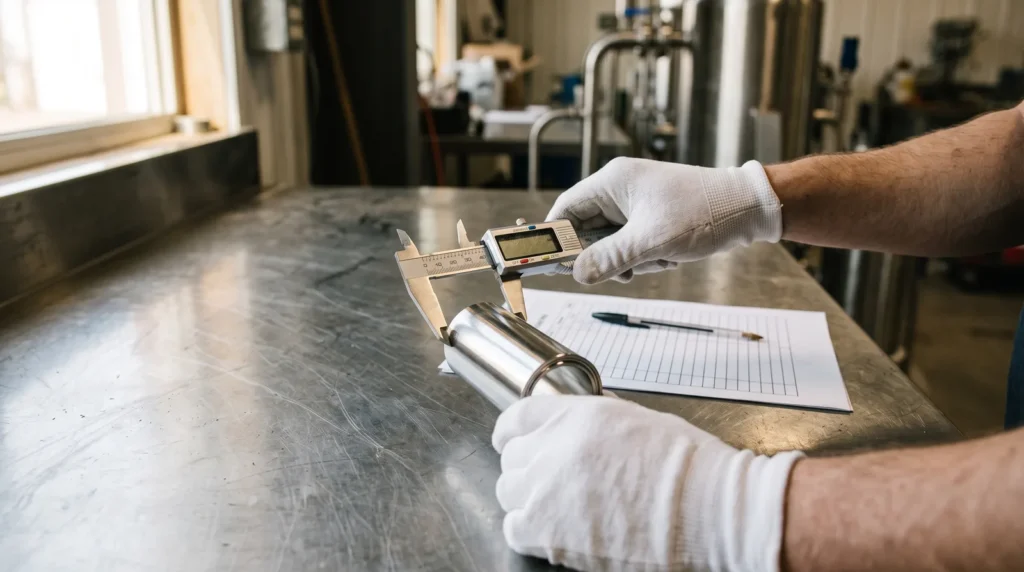
Hygienic valve sizes follow tube outside diameter, not pipe size, so write the tube OD. For Tri-Clamp ends also write the ferrule standard your line uses: metric DIN 32676 ferrules and inch-size ASME BPE ferrules of the same nominal size can differ in bore and flange diameter, older lines may still carry ferrules to ISO 2852, withdrawn in 2018, and a clamp that closes does not prove the bore and gasket match. Our Tri-Clamp ferrules are the inch series that ASME BPE standardizes, and the ferrule flange OD for every size is listed on the V-3N, V-3NM and MV-3N dimension sheets. For butt weld ends give the tube OD and wall thickness. Our two-way valves cover 1/2″ to 4″; three-way valves cover 1/2″ to 2″. The extended weld ends on the V-3N-L3 and V-3NM-L3 keep welding heat away from the PTFE seats, which is the detail to ask about if the valve will be welded into a permanent run. For the other end styles we make, see our guide to valve end connections.
7. Valve function: isolation, diverting or mixing
A two-way valve isolates. A three-way valve with an L-port ball diverts one inlet to one of two outlets. A T-port ball mixes or distributes and can feed two ports at once; on our T-port valves, in every position at least two ports are connected, so a T-port cannot be used as a shut-off. Port type is decided when you order, so draw the flow paths first. Our L-port versus T-port guide walks through them; the sanitary 3 way ball valve is stocked in both.
8. Operating frequency
Cycles per day decide how the valve is operated. A valve that an operator visits a few times a shift, a tank outlet or a hose station, is a manual valve. A valve that cycles every batch, sits out of reach or has to be sequenced by a control system is a pneumatic valve. Frequency also steers the actuator type: double-acting actuators have no springs to fatigue and suit high-cycle duty, spring-return actuators suit lines that must land in a defined position when air drops. Give us the number and we recommend manual or pneumatic, DA or SR, instead of guessing from the application name.
9. Actuation and fail position
State manual or pneumatic. For pneumatic, state double-acting (DA) or spring-return (SR), and for spring-return the position the valve must take when air is lost, open or closed. The actuator type and the fail position are built in at the factory and neither can be changed after delivery, so this belongs in the RFQ, not in a change order. Our sanitary pneumatic ball valve mounts the actuator on an ISO 5211 high-platform pad (ISO 5211 is the standard actuator mounting interface), runs on 4 to 8 bar air, and takes a solenoid valve, limit switch box or positioner as options. A quotation for a pneumatic valve includes the valve and the actuator by default; accessories are quoted as separate lines. For the full set of actuator questions, see our pneumatic actuator ball valve specification guide.
The choices the nine points lead to
Five choices come up in almost every hygienic valve RFQ. The last column is the question that decides each one.
| Choice | Option A | Option B | What decides it |
|---|---|---|---|
| Seat | Fully encapsulated PTFE: no cavity behind the ball; −20 to +80 °C; not for steam | Semi-encapsulated PTFE: −20 to +180 °C; usable for steam or SIP steps within that limit | The highest temperature the valve will see, usually the cleaning cycle |
| Ends | Tri-Clamp: the clamp comes off without tools; suits COP duty, take-off and sample points, frequent changeover | Extended OD-tube butt weld (V-3N-L3, V-3NM-L3): welded into a permanent run; the extended ends keep welding heat away from the seats | Whether the valve comes out of the line |
| Three-way port | L-port: diverts one inlet to one of two outlets | T-port: mixes or distributes; at least two ports are always connected, so it is not a shut-off | The flow paths, drawn before the port is named |
| Operation | Manual lever: a few cycles per shift, within reach of an operator | Pneumatic: cycles every batch, sits out of reach, or is sequenced by a control system | Cycles per day and who operates the valve |
| Actuator | Double-acting (DA): stays where it was on air loss; no springs to fatigue; suits high-cycle duty | Spring-return (SR): moves to open or to closed on air loss | What the line must do when air is lost |
Five RFQ mistakes that delay a quotation
The five that cost the most time: cleaning described by one word instead of by chemistry and temperature, the wrong three-way port, pipe size instead of tube OD, DA or SR left undecided, and no quantity per size. Each of these gaps adds at least one round of email before a quotation can go out.
Cleaning described by one word. The word sanitary tells us the line is cleaned. It does not tell us whether the cleaning agent is caustic, acid, peracetic or a chlorinated sanitizer, at what strength, or how hot. The chemistry often decides material suitability more than the product does, and the temperature decides the seat. The fully encapsulated seat removes the cavity behind the ball, which is why food lines ask for it, but it is rated to +80 °C; a hot caustic cycle or a steam step above that needs the semi-encapsulated seat. The RFQ has to say which cleaning temperature the valve will see so the seat can be chosen with the trade-off in view.
The wrong three-way port. L when you needed to feed both outlets together; T when you needed a clean either-or. Draw the flow paths you need before you name the port.
Pipe size instead of tube OD, or no ferrule standard. A 2″ hygienic valve is sized to 2″ tube OD. If the ferrule standard is missing we have to ask, and if it is wrong the valve will not match the gaskets and ferrules already on your line.
DA or SR decided after ordering. A spring-return actuator fails open or fails closed; a double-acting actuator stays where it was. Choose from process risk at RFQ stage, because neither the actuator type nor the fail position can be changed after delivery.
No quantity per size. A quotation needs the number of valves for each size and end style, together with the destination and the date you need them. Without quantities we can indicate a price, not quote one.
How YZNGTRONG builds and quotes against the nine points
Every model below is made in our own factory in Taiwan. 316 is the stocked body material on the ball valves; 304 is made on request. The butterfly valve is the other way round, with 304 stocked and 316 to order.
Four of the five mistakes above are settled by a column in this table: the seat column for the cleaning temperature, the type column for L-port or T-port, the ends column for tube OD and ferrule standard, and the operation column for DA or SR. The fifth, quantity per size, is yours to fill in.
Our hygienic valve range at a glance
| Model | Type | Sizes | Ends | Seat and temperature | Operation |
|---|---|---|---|---|---|
| V-3N / V-3N-L3 | Two-way, three-piece, full port, 1000 WOG | 1/2″–4″ | Tri-Clamp (V-3N) or extended OD-tube butt weld (V-3N-L3) | PTFE, fully encapsulated −20 to +80 °C or semi-encapsulated −20 to +180 °C | Manual lever with locking plate |
| V-3NM / V-3NM-L3 | Two-way, three-piece, full port, 1000 WOG | 1/2″–4″ | Tri-Clamp or extended OD-tube butt weld | PTFE, fully or semi-encapsulated, same limits as V-3N | Pneumatic, ISO 5211 high-platform F03–F10, DA or SR |
| MV-3N | Three-way, L-port or T-port, 1000 WOG | 1/2″–2″ | Tri-Clamp | PTFE, fully encapsulated −20 to +80 °C or semi-encapsulated −20 to +180 °C | Manual lever |
| MV-3M-TC | Three-way diverter, L-port or T-port, 1000 WOG | 1/2″–2″ | Tri-Clamp | PTFE, semi-encapsulated (called partial on the product page) −20 to +180 °C or fully encapsulated −20 to +80 °C | Pneumatic, ISO 5211, DA or SR |
| BFV-W | Sanitary butterfly, wafer body, 304 (316 to order) | 1/2″–4″ tube OD | Tri-Clamp | PTFE seat | Pneumatic only, DA or SR |
The full list is on the sanitary ball valve category page; each product page carries its dimension sheet as PDF. For the plant-level picture of where these valves sit, see our page on stainless steel valves for food and beverage plants.
How ordering from us works
We quote from the checklist, not from a model number alone, because the same model is built several ways. Samples are available and are charged, with freight paid by the buyer. Minimum order quantity depends on the product and trial orders are welcome.
Stocked items ship from stock; other configurations are made to order, and production starts after a deposit. Private labeling by laser marking, stamping, labels or printed boxes is available, and we build to customer drawings.
Every valve is leak tested and checked dimensionally before it leaves the factory. Pneumatic assemblies are assembled, stroke tested and torque tested before shipment. Export orders travel by sea freight. We will not be the cheapest quotation you receive; what we offer instead is that each valve is inspected before it ships.
Send us the nine points
Nine points, one table: media and chemistry, cleaning method, pressure and temperature, written hygienic requirements, documents, size and ferrule standard, function, frequency, and actuation. Answer them and the quotation that comes back is for the valve you actually need, not the one we had to guess at.
Paste the checklist into your inquiry with what you know, attach a drawing or line list if you have one, and send it through our contact page. With the duty defined, our engineering team can confirm which models fit, which seat and ends to use, and which documents will travel with the order. Request a Quote — reply within 24 hours →
Frequently asked questions
What should a hygienic ball valve RFQ include?
Nine points: product and cleaning media with concentrations; cleaning method (COP, CIP or SIP) with temperatures; normal and maximum pressure and temperature; any hygienic requirement in your specification, quoted as written; the documents your QA will ask for; tube OD and ferrule or tube standard; valve function; cycles per day; and actuation with the fail position on air loss. Add quantity per size, destination and the date needed.
Fully encapsulated or semi-encapsulated seat: which should I specify?
It depends on the highest temperature the valve will see, which is usually the cleaning cycle. Specify the fully encapsulated PTFE seat when product must not sit in a crevice and the line, including cleaning, stays at or below +80 °C. Specify the semi-encapsulated seat when the line runs hotter, up to +180 °C, including steam or SIP steps; the fully encapsulated seat is not for steam.
Tri-Clamp or butt weld ends: how do I decide?
It depends on whether the valve comes out of the line. Choose Tri-Clamp ends where the valve is opened or removed for cleaning, at take-off and sample points, or on lines that change over often. Choose extended OD-tube butt weld ends, the V-3N-L3 and V-3NM-L3, where the valve is welded into a permanent run; the extended ends keep welding heat away from the PTFE seats. Either way, state the tube OD.
Which model can start with a hand lever and take an actuator later?
The V-3NM. It can ship with a hand lever, and its ISO 5211 high-platform pad takes a pneumatic actuator later, so say at order stage that automation is planned. The V-3N is the manual-only model. For three-way service the automated model is the MV-3M-TC. State double-acting or spring-return and the fail position, because neither can be changed after delivery.
What documents, samples and order terms can I expect?
A material certificate (MTR) for the valve body is sent with the shipment on request, and dimension sheets are published as PDF on each product page. Samples are available and are charged, with freight paid by the buyer. Minimum order quantity depends on the product and trial orders are welcome. Production starts after a deposit, every valve is leak tested and checked dimensionally before it ships, and export shipments go by sea freight.
If one of the nine points is still open, send the other eight through our contact page; the gap tells us what to ask.