Ball Valve Types Explained: Manual vs. Pneumatic vs. Electric

Why the Right Choice of Ball Valve Types Matters More Than You Think

I’ll be honest with you: over the course of more than 35 years in the valve manufacturing industry, I’ve watched engineers agonize more over the brand of coffee machine for the break room than over which valve actuation type to specify for a critical production line. And then the valve fails mid-shift — and suddenly, everyone has a very strong opinion about what should have been specified in the first place.

The decision between manual, pneumatic, and electric ball valve actuation is one of those choices that looks deceptively simple on the surface but carries real downstream consequences in terms of safety compliance, system reliability, operating costs, and long-term maintenance burden. Get it right, and the valve quietly does its job for a decade without a second thought. Get it wrong, and it becomes the thing your facility manager mentions every time someone talks about specifying equipment.

At Yzng Trong International, we’ve been manufacturing and supplying valve solutions across a wide range of industries and markets since 1999 — working with clients in food processing, chemical manufacturing, building infrastructure, marine systems, agriculture, and industrial automation across North America, Europe, the Middle East, and Southeast Asia. The single most consistent source of specification errors we encounter? Valve selection driven by habit, initial unit price, or insufficient understanding of what the application actually demands.

This guide is designed to change that dynamic. According to the Valve Manufacturers Association of America (VMA), industrial valves represent one of the most critical — and consistently misspecified — categories of process equipment in modern industrial facilities. The stakes are real, and the selection framework matters.

What follows is a thorough, honest, and practical comparison of the three main ball valve types — manual, pneumatic, and electric — built not on marketing copy but on field experience. We’ll cover how each type operates, where it excels, where it falls short, how to evaluate total cost of ownership, the most common selection mistakes (and how to avoid them), and a set of practical recommendations by application sector. Let’s get into it.

Ball Valve Types Explained: Manual vs. Pneumatic vs. Electric

Breaking Down the Three Ball Valve Types

Before we can make a meaningful comparison, we need a solid working understanding of each option — not just what they are, but how they actually behave under real operating conditions. All three valve types share the same fundamental mechanism: a spherical ball with a bore through its center, rotated 90 degrees to open or close flow. The differences lie entirely in how that rotation is initiated and controlled. And as it turns out, that difference cascades into nearly every other performance characteristic that matters to engineers and procurement teams alike.

Manual Ball Valves — Dependable, Straightforward, and Unapologetically Classic

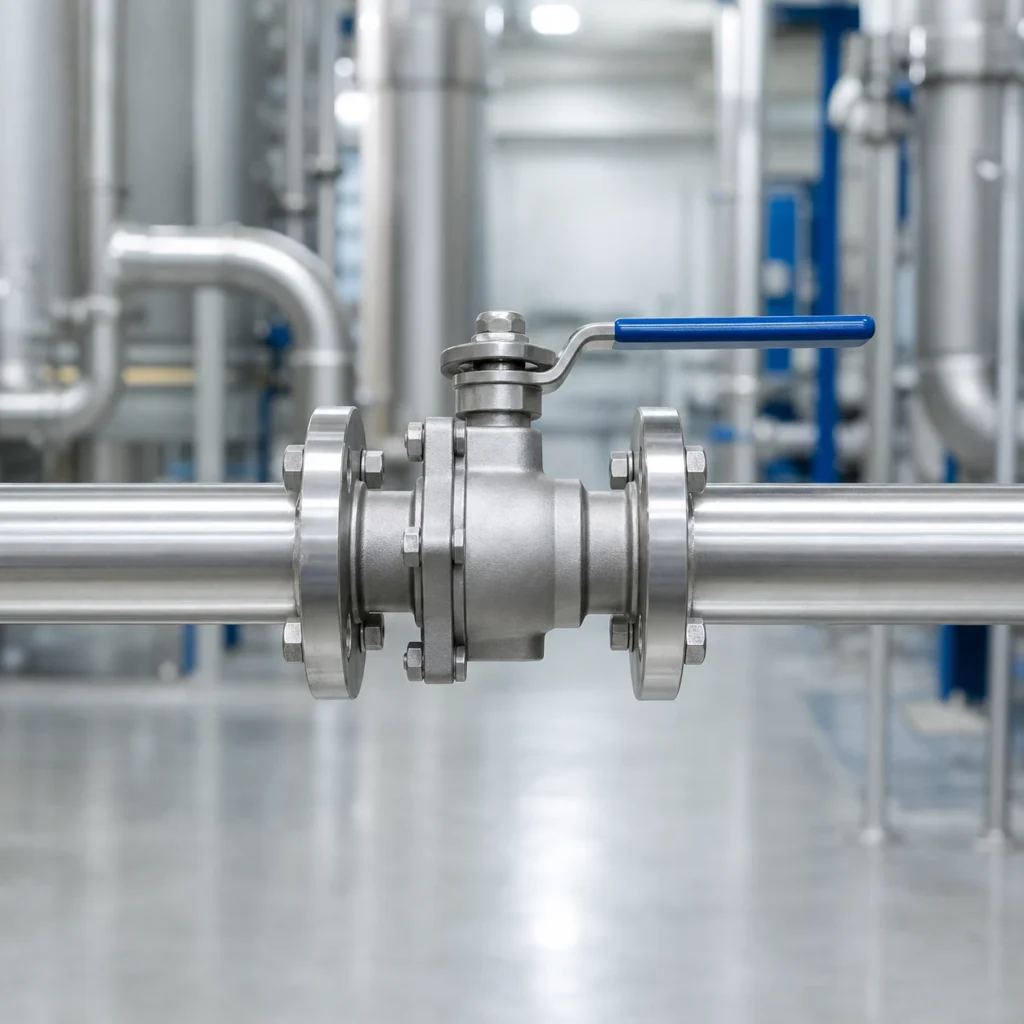
The manual ball valve is the original, and in many applications it remains the optimal choice. Operated by a human hand turning a lever handle or handwheel, the valve rotates its internal ball 90 degrees between fully open and fully closed positions. No power supply. No compressed air. No control signal. Just a person, a handle, and a reliable quarter-turn to isolate or restore flow.

This simplicity is the manual valve’s greatest strength. In environments where power is unavailable or unreliable, where remote or automated operation is unnecessary, and where valves are operated infrequently — for maintenance isolation, system bypass, or low-frequency process adjustments — the manual ball valve is consistently the most sensible and cost-effective solution available. There’s a reason manual ball valves are the global default for utility shutoffs, maintenance isolation points, sampling connections, and bypass lines in facilities of every type and scale.

Manual ball valves are available in a wide range of configurations: one-piece, two-piece, and three-piece body designs; threaded (NPT/BSP), flanged, socket weld, or butt weld end connections; and a broad spectrum of materials including 304 stainless steel, 316 stainless steel, brass, carbon steel, and engineering polymers. The ISO 17292 standard governs the design, materials, testing, and marking requirements for metal ball valves for use in industrial applications — a benchmark that quality manufacturers design to as a matter of course.

The limitations of manual operation are equally straightforward: an operator must be physically present to actuate the valve, they cannot be integrated into automated control sequences without the addition of an actuator, and for high-cycle applications — where a valve must open and close dozens or hundreds of times per shift — manual operation is inefficient and introduces human variability into what is supposed to be a consistent process. They are also fundamentally unsuitable for emergency shutdown applications where remote or automatic activation is required.

That said, for applications that genuinely fit the manual profile, these valves offer a level of reliability that borders on the monotonous — and in industrial valve applications, monotonous is exactly what you want. You can browse our complete range of manual ball valves to explore the full scope of configurations, pressure ratings, and material options available for your system requirements.

Pneumatic Ball Valves — Speed, Power, and Compressed Air as the Energy Medium

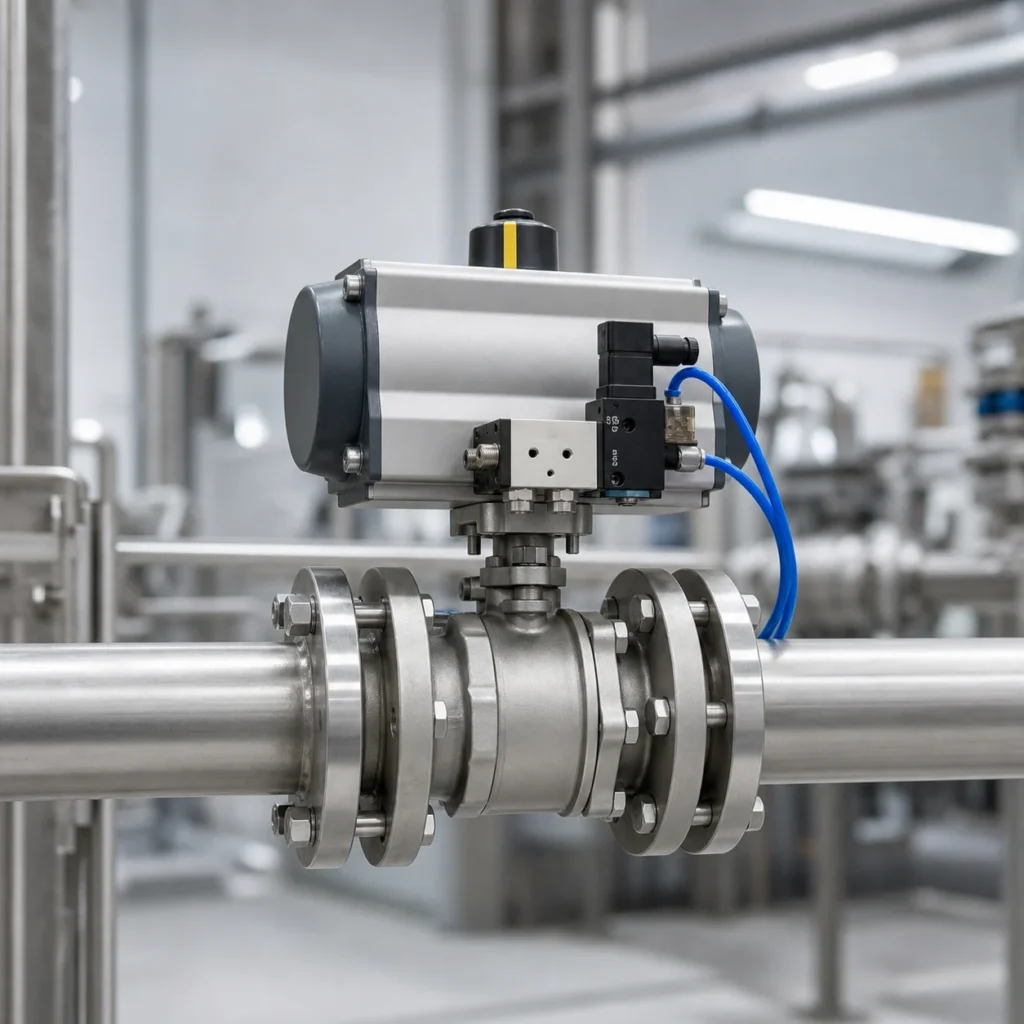
A pneumatic ball valve combines a standard ball valve body with a pneumatic actuator — a device that converts compressed air pressure (typically between 4 and 8 bar) into rotational mechanical force to turn the ball. The result is a valve that can open or close in a matter of seconds, respond to control signals from a PLC or distributed control system (DCS), and do so reliably thousands of times per day without an operator anywhere near it.

Pneumatic ball valves are the workhorses of automated process industries. They dominate in food and beverage processing, pharmaceutical manufacturing, chemical plants, water treatment facilities, semiconductor fabrication, and any process application where valves need to operate frequently, rapidly, or as part of an automated control sequence. Actuation speed — typically one to five seconds for a full stroke, depending on valve size and actuator sizing — is the fastest available among the three actuation types, which makes pneumatic actuators particularly suited to applications involving frequent cycling or emergency isolation requirements.

One of the most important features of pneumatic actuators is the spring-return fail-safe mechanism. Pneumatic actuators can be engineered to fail open (spring drives the valve to fully open on loss of air supply) or fail closed (spring drives the valve to fully closed on loss of air supply), providing a defined, predictable valve state in the event of instrument air failure or loss of control signal. This characteristic makes pneumatic ball valves the standard choice for safety-critical applications. The International Society of Automation (ISA), through standards including ISA-75.01.01 and the broader ISA-84 functional safety framework, provides the regulatory backbone for specifying and validating actuated valve behavior in safety-critical process environments.

The practical trade-offs of pneumatic actuation are well understood: a reliable compressed air supply is required, meaning investment in compressor infrastructure, air treatment equipment (filtration, drying, pressure regulation, and in some cases lubrication), and distribution piping. In remote locations or facilities without an existing compressed air network, this infrastructure requirement represents a meaningful cost adder. Additionally, while pneumatic actuators excel at rapid on/off operation, achieving precise proportional flow control requires the addition of a positioner and a modulating control signal — possible, but more complex than a standard on/off installation.

Despite these considerations, the combination of speed, fail-safe capability, environmental robustness, and proven reliability in demanding industrial environments has made the pneumatic ball valve the dominant choice in process industry automation globally. When the application calls for automated actuation in a safety-critical or high-cycle process environment, pneumatic is usually the starting point.

Electric Ball Valves — Precision Control for the Digital Industrial World

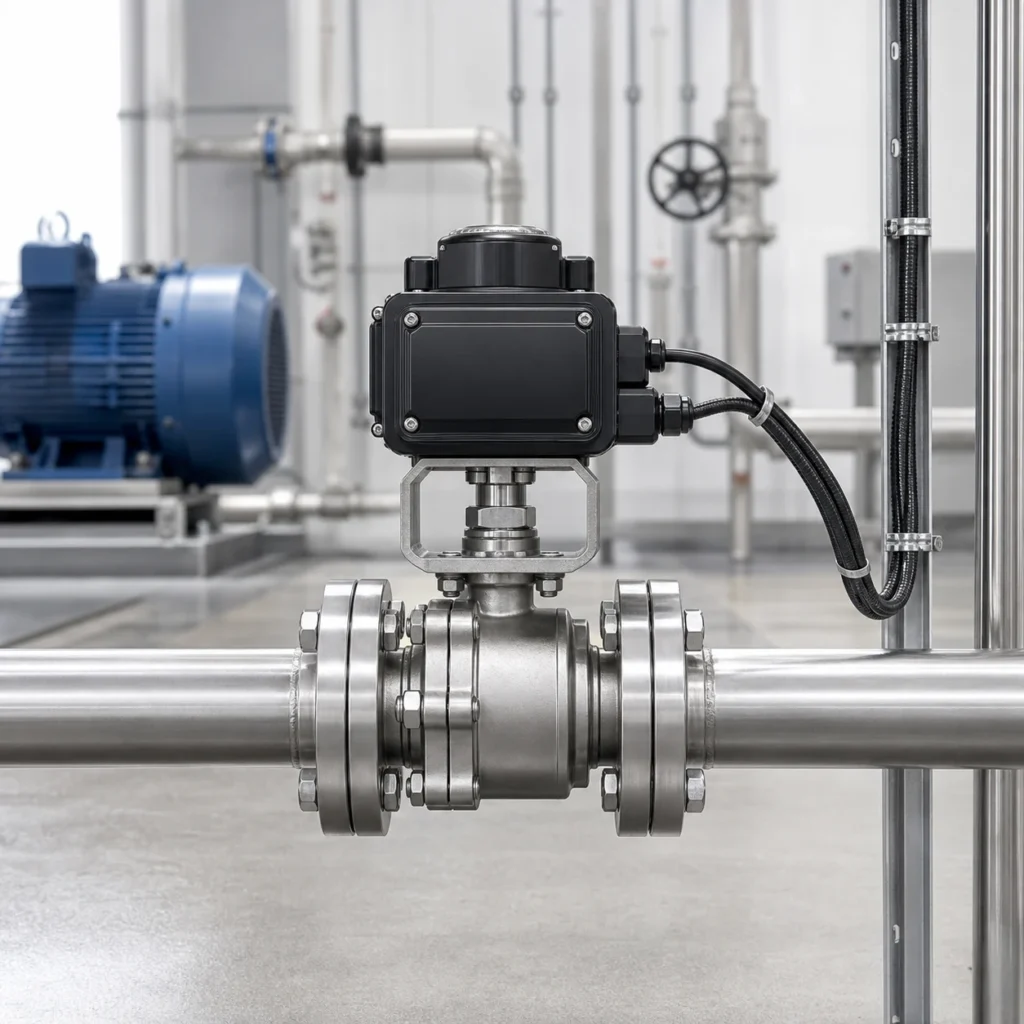
Electric ball valves replace the pneumatic actuator with an electric motor actuator — also called an electromechanical actuator. The motor drives a reduction gearbox that rotates the valve ball, powered by a standard electrical supply (typically 24V DC, 110V AC, or 220V AC depending on the application and actuator model). No compressed air infrastructure is required: just a power connection and a control signal.

The defining advantage of electric actuation is positional precision. Unlike pneumatic actuators — which in standard configuration are binary (fully open or fully closed) — electric actuators can position the valve at any intermediate position and hold it there with high repeatability. Combined with a 4–20 mA, 0–10V, or digital fieldbus control signal, an electric ball valve can be programmed to maintain a 30%, 55%, or 78% open position with accuracy that purely on/off pneumatic actuation cannot match. This makes electric actuators genuinely superior for applications requiring proportional flow modulation rather than simple isolation control.

Electric ball valves also integrate cleanly with Building Management Systems (BMS) and Industrial Internet of Things (IIoT) platforms — an increasingly important consideration as facilities modernize their process control and energy management infrastructure. The absence of a compressed air requirement simplifies installation in locations where pneumatic supply is impractical, including remote outdoor installations, building systems, and mobile or modular process units.

The limitations are equally real. Electric actuators are slower than pneumatic equivalents — typically 15 to 60 seconds for a full stroke, depending on valve size, actuator torque rating, and motor speed. They are sensitive to harsh environments involving extreme temperatures, persistent moisture, aggressive chemical vapor, or high mechanical vibration. Standard configurations lack a natural spring-return fail-safe mechanism (the valve stays in its last position on loss of power unless a battery backup module or spring-return mechanism is explicitly added). And the initial purchase cost tends to be higher than comparable pneumatic configurations.

For applications in building automation, HVAC systems, precision batch process control, and facilities without compressed air infrastructure, electric ball valves often represent the most practical and capable solution available. The Engineering Toolbox’s technical valve reference provides useful supplementary background on valve actuation physics and selection principles for engineers who want to go deeper on the mechanics.

Side-by-Side Comparison: Key Performance Factors

With all three types clearly in view, let’s put them head-to-head across the factors that drive real specification decisions. The comparison table below is designed to be useful, not just comprehensive — each row represents a factor that has been the deciding variable in real procurement conversations I’ve had with clients across multiple industries.

Factor Manual Ball Valve Pneumatic Ball Valve Electric Ball Valve
Actuation Method Hand-operated lever or handwheel Compressed air (4–8 bar) via pneumatic actuator Electric motor and reduction gearbox
Actuation Speed (Full Stroke) Operator-dependent (5–30+ sec) Fast (1–5 seconds typical) Slow to moderate (15–60 seconds)
Control Type On/Off only On/Off; modulating possible with positioner On/Off or full proportional modulation
Required Infrastructure None Compressed air supply and distribution network Electrical power connection and wiring
Fail-Safe Capability Stays in last position Spring-return FO or FC — standard and reliable Stays in last position unless battery or spring-return module added
PLC / Automation Integration Not natively supported Yes — via solenoid valve on/off or modulating signal Yes — direct 4–20 mA, 0–10V, or digital fieldbus
Cycle Frequency Suitability Low frequency only High frequency (thousands of cycles per day) Moderate frequency
Environmental Robustness Excellent (no electronics, no air dependency) Very good (rated actuators available for harsh environments) Good (moisture and vibration sensitivity to be managed)
Initial Purchase Cost Lowest Moderate Moderate to High
Positional Accuracy Binary (open/closed) via operator judgment Binary in standard config; proportional with positioner Proportional — any intermediate position
Long-Term Maintenance Complexity Very low Low to moderate (seals, air treatment) Moderate (electronics, motor, gearbox)

A few important observations about interpreting this table in practice. First, actuation speed is highly application-dependent in its importance. For an emergency shutdown valve (ESV) in a chemical plant, a two-second closure time can be the difference between containment and a process safety incident. For a modulating flow control valve in a building HVAC system, slow and precise is genuinely preferable to fast and binary. Speed matters — but how much it matters is entirely determined by the process requirements.

Second, the fail-safe column deserves more attention than it typically receives during early-stage specification work. In any regulated application — which encompasses the majority of process industry, food and pharma, offshore, and building system installations — the defined valve state upon loss of power or signal is a compliance requirement, not an engineering preference. Pneumatic spring-return actuators provide this by design. Electric actuators require it to be explicitly specified and added. Missing this distinction at the design stage creates problems at the commissioning stage or, in the worst case, during an incident.

Third, “environmental robustness” in this context refers primarily to the actuator, not the valve body. Both pneumatic and electric actuators are available in IP65, IP67, and even IP68-rated enclosures for demanding environments — but pneumatic actuators tend to be inherently more forgiving in wet, vibration-intensive, and thermally challenging conditions. For detailed reference on piping and valve specifications applicable to North American markets, ASME’s standards library — including ASME B16.34 for valve design — is the authoritative starting point.

Matching Ball Valve Types to Real-World Applications

Comparative tables are useful. What’s more useful is understanding how these characteristics actually play out in the specific industries and operating environments you’re most likely to be specifying for. Let me walk through the major application categories we work with most frequently and give you an honest picture of what the right selection looks like in each context — and why.

Industrial, Chemical, and Oil and Gas Environments

In heavy industrial and chemical processing environments, the primary selection drivers are safety compliance, operational reliability, and the ability to integrate with automated control architectures. These environments almost universally operate with existing compressed air infrastructure, frequently require high-cycle valve operation, and are subject to regulatory frameworks that explicitly address valve fail-safe behavior in hazardous service.

For these reasons, pneumatic ball valves are the dominant specification in industrial automation and chemical process applications. The combination of fast actuation, reliable spring-return fail-safe behavior, robustness in chemically aggressive and thermally demanding environments, and long-established integration with PLC and DCS control systems makes pneumatic actuation the rational default choice for mainline process control, remote isolation, and emergency shutdown service in these sectors.

Manual ball valves remain entirely appropriate — and often specifically required — for maintenance isolation points, instrument root valves, manual bypass lines, and any valve position that needs to be physically locked out for safe maintenance access. Their simplicity in these roles is a genuine advantage: no actuator to fail, no air supply to lose, and full visibility of valve position through a lever handle indicator.

Material specification is equally critical in this sector. For aggressive chemical service, 316 stainless steel with PTFE seats is typically the minimum appropriate specification. For cryogenic service, sulfide stress cracking resistant materials, or specific API ratings, specialist configurations are required. Our industrial application resources provide detailed guidance on the valve configurations we recommend for common chemical and industrial process scenarios, including pressure ratings, material compatibility guidance, and actuator options.

Food, Beverage, and Pharmaceutical Processing Lines

The food, beverage, and pharmaceutical industries impose a set of requirements that fundamentally shape valve selection: hygienic design, cleanability, regulatory material compliance, and process control precision. These requirements apply across all three actuation types — but they interact with actuation type selection in ways that produce a fairly consistent pattern in practice.

In food and beverage production — breweries, dairy facilities, juice processing, bottling plants, and similar environments — the most commonly specified configuration is the sanitary clamp-type valve in pneumatically actuated format. The reasons align well with pneumatic strengths: high cycle frequency (these valves may open and close hundreds of times per shift in automated filling or CIP/SIP cleaning sequences), rapid actuation speed for tight process timing, clean integration with PLC-driven automation, and proven reliability in the wet, washdown-intensive environments typical of food production facilities.

Hygienic design requirements — full-bore flow paths, smooth internal surfaces without dead legs or crevices that could harbor contamination, FDA-compliant elastomers (typically EPDM or silicone), and compatibility with CIP cleaning chemicals — apply equally regardless of actuation type. The actuation selection depends on the control logic: frequent automated on/off cycling points to pneumatic; proportional flow control or precise batch metering points toward electric. For facilities exploring our food and beverage application solutions, both pneumatic and electric configurations are available in sanitary clamp and weld-end designs.

In pharmaceutical manufacturing, requirements escalate further: USP Class VI-compliant elastomers, electropolished internal surfaces, full material traceability documentation, and validation support packages. Here, the actuation type decision often comes down to the facility’s existing automation architecture (pneumatic-based DCS or electric-based BMS), the specific process control precision requirements, and the clean room or containment zone classifications that govern infrastructure design.

Agricultural Irrigation, Building Systems, and Marine Installations

These three sectors are grouped not because they are operationally similar, but because they share a common characteristic in how valve actuation decisions are made: simplicity, durability, and lifecycle cost tend to be weighted more heavily than maximum automation sophistication, and the operating environments vary widely in ways that create genuinely interesting selection considerations.

In agricultural irrigation — from drip systems in orchards and vineyards to large-scale center-pivot irrigation and aquaculture recirculation systems — manual ball valves remain the default for infrequently operated zone isolation. However, the development of precision agriculture and smart irrigation has driven meaningful demand for automated valve control, and electric ball valves have gained significant ground here due to their clean integration with timer-based and sensor-driven irrigation controllers, combined with the absence of compressed air infrastructure requirements in remote field installations. UPVC union ball valves, available in both manual and pneumatic configurations, are also widely used in agricultural water systems for their corrosion resistance and cost-effectiveness in non-hazardous fluid service.

In building systems — commercial HVAC, chilled water distribution, heating systems, and fire protection — the mix of valve types reflects the diverse control requirements within a single facility. Manual isolation is standard for zone shutoffs and maintenance access; electric modulating valves are common in AHU and fan coil unit control for BMS integration; fire suppression systems have highly specific actuation and material requirements governed by NFPA and FM approval frameworks that must be followed regardless of other selection preferences.

In marine installations, pneumatic ball valves have a long and well-established history in ballast systems, bilge management, firefighting supply, and engine room automation due to their robustness in wet, vibration-intensive, and potentially explosive-atmosphere environments. Material selection is non-negotiable: 316 stainless steel is the minimum specification for any valve in contact with seawater or seawater-saturated air, and actuator enclosure ratings must address continuous salt spray exposure. For a detailed review of valve requirements in marine contexts, visit our marine industry application page.

The True Cost of Ownership — Looking Beyond the Purchase Price

Here is the part of the conversation where I am going to ask you to resist a very human impulse: the impulse to look at unit price, find the lowest number, and stop there. I have watched this instinct drive specification decisions at every level of industrial procurement — from site engineers to category managers — and it almost always costs more over the system lifecycle than the savings it was supposed to generate.

Total cost of ownership for a ball valve encompasses the initial purchase price, installation costs, required infrastructure investment, energy consumption, maintenance labor and parts, and the downtime costs associated with failures or premature replacement. When you account for all of these over a realistic operational horizon, the relative cost rankings across actuation types can shift dramatically from what a purchase-price comparison alone would suggest.

The table below provides a structured TCO comparison across the three actuation types for a representative high-cycle automated industrial application evaluated over a five-year operating horizon. Figures are indicative and will vary significantly with application-specific variables including cycle frequency, valve size, operating pressure, and ambient conditions.

Cost Category Manual Ball Valve Pneumatic Ball Valve Electric Ball Valve
Typical Unit Purchase Cost Low ($30–$250) Moderate ($150–$900) Moderate to High ($200–$1,400+)
Installation Cost Very Low (pipe fitter only) Moderate (air supply connection, solenoid wiring) Low to Moderate (electrical wiring, signal cable)
Infrastructure Investment None Significant if no existing air supply Low if existing power available
Recurring Energy Cost None Low (air consumption per cycle) Very Low (energized only during operation)
5-Year Maintenance Cost Very Low (visual inspection, occasional seat replacement) Low to Moderate (actuator seals, air treatment maintenance) Moderate (electronics checks, gearbox, motor service)
Failure Risk and Downtime Exposure Low Low with proper air treatment Moderate (electronics failure potential)
Labor Automation Saving None High (replaces operator presence for every cycle) High (same as pneumatic for automated applications)
5-Year TCO Summary Lowest — ideal where automation is not needed Medium — strong ROI in high-cycle automated service Medium to High — best justified where proportional control or lack of air supply drives selection

The TCO calculation changes fundamentally when operator labor is included in the analysis. In a facility where manual valve operation requires an operator to physically walk to a valve location every 30 to 60 minutes — a scenario that is more common than many system designers appreciate — the annual labor cost of that operation can exceed the cost differential between a manual and pneumatic valve within the first operating year alone. The return on investment for automated actuation in high-cycle applications is typically realized in months, not years.

Conversely, for a valve that is operated twice a year for a planned maintenance isolation task, the TCO of a pneumatic or electric configuration — with all the associated infrastructure, wiring, and maintenance overhead — is genuinely disproportionate to the operating value delivered. A quality manual ball valve with the appropriate material specification will serve that function for the life of the installation with nothing more than an annual visual inspection.

The Engineering Toolbox’s valve selection reference provides a useful supplementary framework for building your own TCO models for specific application scenarios. And if you’d like a more direct conversation about the right configuration for your system, our team is ready to help — contact us directly to discuss your project requirements.

Three Costly Selection Mistakes — and How to Avoid Them

In my experience, the vast majority of valve specification errors fall into a small number of recurring patterns. Understanding these patterns is not a theoretical exercise — each one represents a type of failure I have personally seen cause system downtime, safety incidents, budget overruns, and uncomfortable conversations between procurement teams and operations managers. Let me walk through the three I encounter most frequently.

Mistake 1 — Defaulting to the Lowest Unit Price Without a TCO Analysis

This is the most common specification error in industrial procurement generally, and it is certainly not unique to valve selection. The logic appears sound on the surface: you’re purchasing a large number of valves, the price difference between actuation types adds up quickly at scale, and the budget is already under pressure. So the specification gravitates toward the lowest unit cost option that technically satisfies the nominal service conditions.

The fundamental problem is that “technically satisfies the nominal service conditions on paper” and “right for the application in practice” are not the same thing — and they diverge particularly sharply in the context of actuation type selection. A manual valve specified for a high-cycle automated production line delivers cost savings at the procurement stage and pays them back many times over in operator labor, process variability, cycle time extension, and the eventual reliability issues that come from repeated human interaction with a process that was never designed for it.

Similarly, an undersized pneumatic actuator selected to save cost against the correctly sized alternative will deliver marginal savings at purchase and fail to fully seat the valve under differential pressure at the top of the operating range — causing internal leakage that gradually becomes a process quality issue, then a maintenance issue, then an unplanned shutdown. At that point, the cost of the “savings” has been paid several times over in lost production.

The discipline of total cost of ownership analysis exists precisely to prevent this pattern. For any valve specification involving automated actuation, high-cycle operation, or a safety function, build a TCO model before finalizing the specification. You may still choose the lower-cost option when all the numbers are in — but you’ll do so with complete information rather than with a spreadsheet that only shows half the picture.

Mistake 2 — Missing Fail-Safe Requirements in Safety-Critical Applications

This mistake is less about cost and considerably more about safety — which makes it potentially the most serious on this list. In any application involving hazardous fluids, high operating pressures, explosive atmospheres, or regulated process safety requirements, the behavior of every valve on loss of power, loss of instrument air, or loss of control signal must be deliberately engineered, explicitly documented, and rigorously validated.

Pneumatic ball valves with spring-return actuators provide a clear, reliable, and well-understood fail-safe mechanism by design: the spring drives the valve to a defined position — open or closed, depending on the spring orientation — regardless of what happens to the compressed air supply or control signal. This is precisely why pneumatic actuation remains the near-universal specification for safety-critical isolation valves in chemical processing, oil and gas, pharmaceutical, and offshore applications, despite the commercial availability of mature electric actuator alternatives.

Electric ball valves, in their standard configuration, remain in their last position when power is lost. This may be the safe state — or it may not be. For an electric valve serving a safety function, a battery backup module, spring-return mechanism, or dedicated uninterruptible power supply must be explicitly included in the specification and verified as part of the safety case. Missing this requirement at the design stage and discovering it during commissioning — or worse, during an actual process upset — is entirely avoidable with proper specification discipline.

The ISA’s functional safety standards framework (ISA-84, aligned with IEC 61511) governs the design, validation, and documentation requirements for safety instrumented systems in process industries, and the specification of fail-safe valve behavior is a central element of compliant SIS design. If your application has any process safety dimension, these standards are not optional reading.

Mistake 3 — Underestimating the Impact of Operating Environment Conditions

The third recurring mistake is specifying a valve actuation type without fully accounting for the actual operating environment in which it will spend its service life — and then being genuinely surprised when performance degrades faster than anticipated or failures occur outside the expected pattern.

Electric actuators are capable, well-engineered devices, but they are also electromechanical assemblies with motor windings, circuit boards, sensor elements, and gearbox lubrication that are sensitive to moisture ingress, aggressive chemical vapor, sustained vibration, and operating temperature extremes. An IP65-rated electric actuator is entirely adequate for a dry indoor installation in a controlled environment. It is not adequate for an outdoor coastal installation with daily salt spray, condensation cycling, and ambient temperatures ranging from -10°C to +50°C. Making that specification without checking the actuator’s rated operating range and ingress protection level against the actual site conditions is a common path to premature actuator failure.

Pneumatic actuators require clean, dry, oil-free (or appropriately lubricated, depending on the actuator design), and consistently pressurized compressed air to deliver their rated service life. Compressed air that carries moisture, particulate contamination, or insufficient lubrication accelerates seal and O-ring wear in the actuator cylinder, shortens service intervals, and in severe cases causes actuator seizure. This is not an argument against pneumatic actuation — it’s an argument for investing properly in compressed air treatment equipment and maintenance procedures rather than treating the air supply system as an afterthought in the facility design.

Manual valves, to their credit, are almost entirely immune to the environmental concerns that affect actuated options. No power supply to lose, no electronics to corrode, no seals to degrade from contaminated air. But they are not immune to fluid compatibility and corrosion issues in the valve body itself: a brass manual valve in seawater service is a material specification error that will express itself as a corrosion failure in a timeline that depends on temperature and chloride concentration, not on whether the specification looked fine on paper.

Frequently Asked Questions About Ball Valve Types

These are the questions that come up most consistently when engineers, procurement teams, and system designers are working through a valve selection decision. I’ve tried to give direct, practical answers — the kind that help you move forward rather than send you searching for more information.

Can I convert a manual ball valve to pneumatic or electric actuation at a later stage?

In most cases, yes — and this flexibility is one of the practical advantages of the ball valve design worth planning for explicitly. Most quality industrial ball valves are manufactured with an ISO 5211 actuator mounting flange: a standardized bolt pattern that allows a pneumatic or electric actuator to be mounted directly onto the valve body without replacing the valve or modifying the pipeline.

This means you can start a project with manual operation — for example, during initial commissioning, in phases where automation funding hasn’t been approved, or on valve positions where the cycle frequency doesn’t yet justify automation — and upgrade to automated actuation later without buying a new valve assembly. The only cost is the actuator and associated solenoid valve or control wiring.

The important caveat is “most quality ball valves.” Not all manufacturers maintain ISO 5211 compliance across their product range, particularly at lower price points. If future actuator compatibility is a possibility, verify ISO 5211 compliance before procurement. At Yzng Trong, this compatibility is a design standard across our manual ball valve range — because we know how often projects evolve after initial installation.

Which ball valve type is best suited for high-pressure service?

The pressure rating of a ball valve is determined by the valve body design, material specification, and seat/seal configuration — not by the actuation method. A well-designed 316 stainless steel ball valve can be rated to 1000 WOG (Working, Oil, Gas), 2000 WOG, or higher regardless of whether it is operated manually, pneumatically, or electrically. The fundamental valve performance under pressure is independent of the actuator sitting on top of it.

What changes with high-pressure applications is the actuator torque requirement. Higher pipeline pressure creates a larger pressure differential across the ball during opening and closing, which requires greater actuator torque to operate the valve reliably. A standard-sized pneumatic or electric actuator that would be adequate for a valve at 10 bar may be completely undersized for the same valve at 100 bar — a specification error that manifests as the actuator failing to fully open or close the valve at operating pressure.

For very high-pressure applications, pneumatic actuators with appropriately sized air cylinders generally offer the highest torque output per unit cost and are the preferred choice for high-pressure isolation duties. Manual valves at high pressure typically require handwheel operators or gearboxes to reduce the required operating force to a manageable level for the operator. Always size actuators from the calculated operating torque, not from the valve body size alone.

How do I determine whether a pneumatic actuator should be fail-open or fail-closed?

The fail-safe position — the valve state on loss of compressed air or control signal — must be determined by the process safety analysis for each specific valve location in your system. This is not a preference, a convention, or a default; it is a safety engineering decision that must be made deliberately and documented as part of the process safety documentation.

Fail-closed (spring drives the valve to closed on air failure) is the correct specification when closing the valve represents the safe state on loss of control — for example, fuel supply lines, chemical injection systems, toxic or flammable fluid supply valves, or any line where continued flow on loss of control represents a hazard to process integrity or personnel safety.

Fail-open (spring drives the valve to open on air failure) is correct when stopping flow is the dangerous condition — cooling water supply to a reactor or heat exchanger is the classic example, where closing the valve on loss of control would cause dangerous temperature excursion or equipment damage.

For applications where neither fail-open nor fail-closed is appropriate — where the valve must hold its last position on instrument air failure — a double-acting actuator with a lock-in-last-position solenoid valve arrangement is required. Work with your process safety engineer to determine and document the required fail-safe position for every actuated valve in a safety-critical system before specifying the actuator spring configuration.

Are electric ball valves suitable for outdoor and washdown environments?

Yes, but actuator selection for harsh environments requires careful attention to specification details that are easy to overlook. Modern electric actuators are available in a wide range of ingress protection ratings. IP67 (dust-tight and immersion-resistant to 1 meter depth for 30 minutes) and IP68 (higher immersion resistance at greater depth and duration) rated electric actuators are available from reputable manufacturers for demanding outdoor, washdown, and near-immersion environments.

Operating temperature range is equally important and frequently under-specified. Standard commercial electric actuators may carry operating temperature ratings of -10°C to +60°C — adequate for many temperate climate outdoor installations, but insufficient for arctic environments, high-altitude installations, or valves located close to heat sources. Extended-range temperature models exist but must be explicitly selected based on the site temperature profile, including both ambient air temperature and process fluid temperature effects on actuator body temperature.

For coastal and marine environments with salt spray exposure, the actuator housing material matters as much as the IP rating. Aluminum alloy housings with high-quality epoxy or polyester powder coating are standard; 316 stainless steel housings are available for premium specifications where coating degradation is a concern over extended service periods. For the most demanding outdoor environments in terms of corrosive atmosphere, vibration, and temperature range, pneumatic actuators typically offer more inherent robustness — but well-specified electric actuators are entirely capable of long service lives in these environments when correctly selected.

What is the expected service life of each valve type and its actuator, and when should replacement be planned?

Service life projections for ball valves and their actuators are highly application-dependent — the type of fluid, operating temperature, pressure, cycle frequency, and maintenance practices all play significant roles. That said, some realistic general expectations apply.

A quality stainless steel manual ball valve in a low-to-moderate cycle, non-abrasive, non-contaminated fluid application can reasonably be expected to provide 15 to 25 years of service with minimal maintenance. In higher-cycle applications or with fluids that cause progressive seat wear, the PTFE seat is the primary wear component. Three-piece body valves offer the advantage of seat replacement without removing the valve from the line; one-piece and two-piece body designs typically require full valve replacement when seat integrity is compromised.

Pneumatic actuators from reputable manufacturers are typically rated for one million or more full-stroke operating cycles. In practical terms, this translates to 10 to 20+ years of service in most industrial applications, with periodic seal and O-ring replacement every 3 to 5 years depending on cycle frequency and air quality. The valve body in a properly maintained pneumatic assembly typically outlasts multiple actuator service lives — which further reinforces the value of ISO 5211 compatibility that allows actuator replacement without valve replacement.

Electric actuator service life is more variable, depending heavily on motor quality, gearbox design, cycle frequency, and operating environment conditions. Premium electric actuators from established manufacturers may be rated for 10,000 to 50,000 full-stroke cycles with appropriate maintenance. The electronics and motor windings are the components most likely to define the practical service life ceiling. Establishing a preventive maintenance schedule — including actuator diagnostics, position feedback verification, and enclosure seal integrity checks — is worthwhile for electric actuators in critical service positions.

Final Verdict — Choosing the Right Ball Valve Types for Your System

Let me bring this back to the practical framework you actually need when you’re standing in front of a specification sheet trying to make a call under time pressure.

If your valve is operated infrequently — for maintenance isolation, occasional bypass, or low-frequency process adjustments — and integration with automated control systems is not required, specify a manual ball valve. It is the most reliable, lowest-maintenance, and most cost-effective solution for applications that genuinely fit this profile, and there is no engineering merit in adding actuation complexity where it does not add operational value.

If your valve needs to operate frequently, must respond to automated control signals, and your facility has or can reasonably install compressed air infrastructure — and particularly if the valve serves any process safety or emergency shutdown function — specify a pneumatic ball valve with the appropriate actuator type, sizing, and spring-return fail-safe configuration. This has been the dominant choice in process industry automation for decades, and it has earned that position through performance rather than inertia.

If your application requires precise proportional flow control, your facility lacks compressed air infrastructure, and integration with a digital building management or process control system is a priority — specify an electric ball valve, with deliberate attention to actuator IP rating, operating temperature range, and fail-safe behavior for any position that carries a safety function.

In real-world systems, you will almost certainly end up using all three actuation types across different valve positions within the same facility. That is the right outcome: each valve position matched to the actuation method that best serves its specific function, rather than a facility-wide standardization that prioritizes procurement convenience over engineering appropriateness.

If you’re working through a valve specification for a new project, a capacity expansion, or a system modernization and would like to talk through the specifics, our engineering team at Yzng Trong International has helped clients across industries — from large-scale chemical plants to precision food processing facilities — select and specify the right valve configurations for their exact operating requirements. Our complete product catalog covers manual, pneumatic, and electric valve configurations across a wide range of sizes, pressure ratings, material specifications, and actuation options.

The right valve choice is not the most expensive, the most technologically sophisticated, or the one that was used on the last project. It’s the one that most accurately matches the operational demands of your specific application while providing confidence in safety compliance, long-term reliability, and total lifecycle value. Get that right, and the valve becomes the least of your system’s concerns. Get it wrong, and you will hear about it at every engineering review for years to come.

To discuss your specific requirements or request a quotation, contact our team directly — we’re ready to help you make the right call.

Leave a Comment

Your email address will not be published. Required fields are marked *

Scroll to Top