
Every liquid-cooled data center is, underneath the servers, a piping project. Coolant has to be distributed, isolated, balanced, drained, and serviced, and the components that make that possible are valves. This guide explains where ball valves sit in a data center liquid cooling loop, why stainless steel is the default body material for coolant service, and how to match valve type, seat, and end connection to each part of the system, from the facility water side down to the coolant distribution unit (CDU).
We write this from the supplier’s side of the fence: we are a Taiwan-based manufacturer that has been producing stainless steel ball valves since 1999, including valves for semiconductor facility lines where water purity and corrosion control follow rules very similar to coolant loops.
Why AI Servers Are Forcing the Move to Liquid Cooling
Air cooling stops being practical once rack power climbs past what fans and room-level air handling can remove, and AI training racks have pushed well past that point. Liquid carries heat far more efficiently than air, so operators are adopting direct-to-chip cold plates and, in some designs, full immersion cooling. Industry guidance for these systems is published by ASHRAE’s datacom committee and the Open Compute Project, and both treat the coolant loop as permanent infrastructure rather than an add-on. Lawrence Berkeley National Laboratory’s data center efficiency program tracks the same shift from the energy side.
For anyone specifying components, the practical consequence is this: a liquid-cooled data hall now contains hundreds of valve positions that did not exist in an air-cooled building, spread across three zones.
Where Valves Sit in a Liquid Cooling System
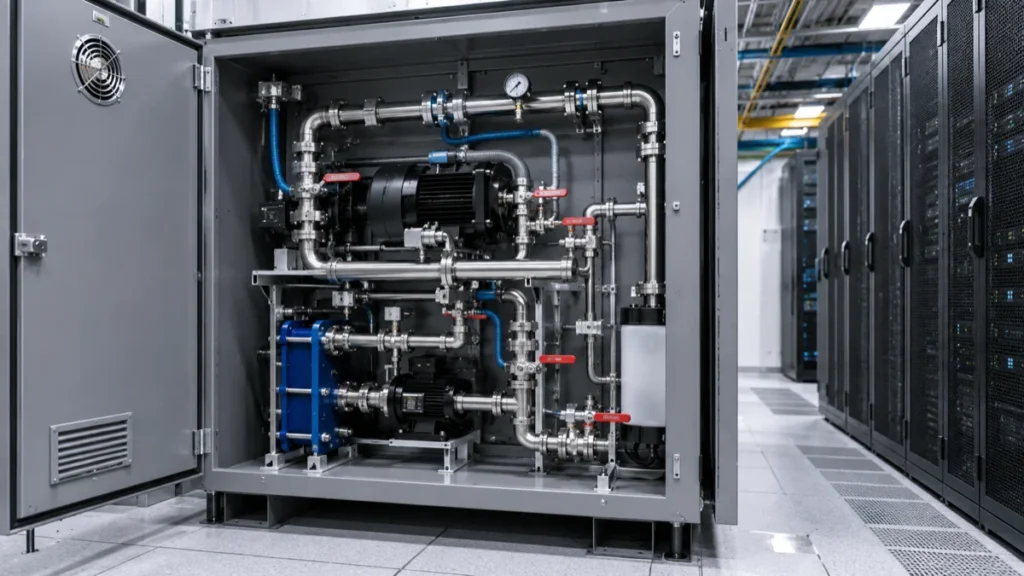
Ball valves appear at every boundary where a section of the loop must be isolated, filled, drained, or balanced. In ASHRAE’s terminology the system splits into a facility water system (FWS), the building-side chilled or condenser water, and a technology cooling system (TCS), the treated coolant that actually reaches the IT equipment. The CDU is the bridge between the two: a cabinet containing a heat exchanger, pumps, and controls that keeps the server-side coolant isolated from facility water.
| Location in the loop | What the valve does | Typical valve type |
|---|---|---|
| Facility water supply and return to each CDU | Isolates a CDU for service without shutting down the plant loop | Flanged ball valve, JIS 10K/20K or ANSI Class 150/300 |
| Inside the CDU (fill, drain, bypass, sensor taps) | Commissioning, flushing, maintenance drain-down | Compact threaded ball valve, 1/2″ to 2″ |
| Secondary loop headers and row manifolds | Isolates one row or rack group; balancing | Two-piece or three-piece ball valve, threaded or welded |
| Automated isolation and leak response | Closes a segment on a leak signal or under remote control | Pneumatic actuated ball valve (double acting or spring return) |
The last connection from manifold to server is usually a quick disconnect, which is a different product family. Everything upstream of it, however, is conventional valve territory, and that is where material choice starts to matter.
Why Stainless Steel Is the Default for Coolant Loops
Coolant chemistry is the reason. Direct-to-chip loops typically run treated water or a propylene glycol and water mix, dosed with corrosion inhibitors, and the wetted-materials guidance in Open Compute Project cooling documentation is strict about what may touch that fluid: metals that shed ions or rust particles poison the coolant, clog cold-plate microchannels, and shorten fluid life. Austenitic stainless steel is on the safe list; plain carbon steel and uncoated iron are not. Brass appears in some loops, but mixing too many metals raises galvanic corrosion risk, so many operators simplify by standardizing on stainless wetted parts.
Our valve bodies are investment-cast CF8 (cast 304 stainless) or CF8M (cast 316 stainless). The choice between them follows one variable more than any other: chlorides. 316 adds molybdenum, which resists the pitting corrosion that chloride ions cause in 304. If the loop uses well-treated deionized or inhibited water and sits in a normal indoor environment, 304 is generally sufficient. Specify 316 when the coolant or the site introduces chloride exposure, for example coastal plants where outdoor-side piping sees salt-laden air. This is the same 304-versus-316 logic we apply in semiconductor facility water and gas lines, where particle and ion cleanliness rules are even tighter than in data centers.
Matching Valve Construction to Each Zone
Short answer: use flanged valves where the pipe is flanged and serviceability drives the design, threaded or welded compact valves inside skids and manifolds, and pneumatic actuation where isolation must respond automatically. The details below are the specifications of our own product lines, so you can treat them as one concrete reference point rather than abstract advice.
Facility water side: flanged ball valves
Building-side loops are usually flanged for maintainability. Our manual flanged ball valves are available in JIS 10K and ANSI Class 150 from 1/2″ to 8″, and JIS 20K and Class 300 from 1/2″ to 4″, with PTFE seats and a working temperature range of -20°C to +180°C. Pressure capability follows the flange rating, for example 1.0 MPa nominal for JIS 10K and 275 psi at ambient for Class 150 per the flange standards, which is far above what a typical facility cooling loop runs. In other words, the flange class you need for bolting compatibility will normally settle the pressure question by itself.
Inside CDUs and manifolds: compact two-piece and three-piece valves

Skid builders care about envelope size, wetted materials, and how the valve comes apart. Compact two-piece threaded ball valves rated 1000 WOG handle fill, drain, and instrument isolation duties; if the rating jargon is unfamiliar, our guide to WOG pressure ratings explains what 1000 WOG means in practice. For header and manifold positions that will be serviced in place, a three-piece ball valve, also rated 1000 WOG, is the usual pick: the center section swings out for seat replacement without cutting pipe, and it is offered with threaded (PT taper), butt-weld, or socket-weld ends. Welded ends eliminate a potential leak path entirely, which some CDU designers prefer for joints that will never be opened; our overview of valve end connections compares the trade-offs.
One caution on threads: taper thread systems differ. Our threaded valves use PT taper threads (the JIS/BSPT system common in Asian-built equipment). PT and NPT are not interchangeable, and a mixed connection can seal in testing yet weep under thermal cycling. Confirm which system your skid drawings call for before ordering anything.
Automated isolation: pneumatic actuated ball valves
Leak containment schemes and remote segment control need valves that close without a human present. Our pneumatic flanged ball valves pair the flanged body sizes above with aluminum rack-and-pinion actuators, in double acting (DA) and spring return (SR) versions, mounted on the ISO 5211 standard pad and driven by 4 to 7 bar instrument air. Spring return is the natural choice for leak response because it drives the valve to a defined safe position on air failure. Solenoid valves, limit switch boxes, and positioners are available as options. Note that the actuator, not the stainless body, sets the temperature limit of the assembly, so check actuator ratings against the installed environment rather than assuming the body’s range applies.
Specification Mistakes We See Most Often
These are the recurring problems in coolant-loop valve specifications, and each one is avoidable at the drawing stage.
| Mistake | Why it hurts | What to do instead |
|---|---|---|
| Carbon steel or iron valves on treated coolant | Rust particles and ions degrade coolant and clog cold plates | Stainless wetted parts (CF8/CF8M body, stainless ball and stem) |
| Mixing PT and NPT threads | Seals initially, leaks under thermal cycling | Standardize one thread system per skid and state it on the drawing |
| Specifying 316 everywhere “to be safe” | Pays the molybdenum premium with no benefit in chloride-free indoor loops | Reserve 316 for chloride exposure; document the reason |
| Rating the whole actuated assembly by the valve body | Actuator seals and springs have lower temperature limits | Check actuator specifications separately for hot-aisle installations |
Frequently Asked Questions
What valves are used in data center liquid cooling systems?
Ball valves do most of the isolation work: flanged ball valves on facility water connections to each CDU, compact threaded or welded ball valves inside CDUs and on row manifolds, and pneumatically actuated ball valves where segments must close automatically. Balancing valves and check valves appear at specific points, and quick disconnects handle the final rack-to-server connection. Stainless steel is the usual body material because coolant chemistry punishes corroding metals.
Are stainless steel ball valves compatible with water-glycol coolant?
Yes. Austenitic stainless steels such as 304 and 316 are broadly compatible with treated water and propylene glycol mixtures used in direct-to-chip cooling, and stainless appears on wetted-materials lists in industry cooling guidance. The seat material matters too: PTFE seats, standard on our valves, are chemically inert to glycol coolants across the temperature range these loops operate in. Always confirm compatibility with your specific coolant vendor’s inhibitor package.
Should I choose 304 or 316 stainless steel for a cooling loop?
Decide based on chloride exposure. 316 contains molybdenum, which resists chloride-induced pitting; 304 does not. Indoor loops running deionized or inhibited coolant with no chloride source are normally fine with 304 (cast grade CF8). Choose 316 (CF8M) when chlorides are present, for example coastal sites where outdoor piping and cooling towers see salt air, or where the water treatment program allows chloride excursions. Acidity alone is not the trigger; chloride is.
What pressure rating do CDU and coolant loop valves need?
Coolant loops run at modest pressures compared with general industrial service, so standard valve ratings carry comfortable margin. Compact threaded ball valves rated 1000 WOG (water, oil, gas at ambient temperature) exceed typical loop requirements many times over, and flanged valves carry the rating of their flange class, such as JIS 10K or ANSI Class 150. In practice you select the flange class to match the mating piping, and the pressure requirement follows automatically.
Can ball valves in a cooling loop be automated?
Yes. Any quarter-turn ball valve with an ISO 5211 mounting pad accepts a standard actuator. Pneumatic rack-and-pinion actuators are the common choice: double acting (DA) where air drives both strokes, or spring return (SR) where a spring closes the valve on air or signal failure, which suits leak-response isolation. Options such as solenoid valves, limit switch boxes for position feedback, and positioners integrate the valve into the building management system.
Summary: Specify the Loop, Then the Valves Follow
Valve selection for liquid cooling is not exotic. Map the three zones (facility water, CDU, secondary loop), put flanged stainless valves where the piping is flanged, compact two-piece or three-piece valves inside skids and manifolds, and spring return actuated valves where isolation must happen without a person. Choose 304 or 316 by chloride exposure, keep thread systems consistent, and read actuator temperature limits separately from body ratings.
We manufacture these valves in our own factory in Taichung, Taiwan, with ISO 9001 quality management and CE marking, and we have supplied stainless ball valves to facility piping applications for 27 years. If you are building or retrofitting a CDU, a manifold skid, or facility-side cooling piping and want a manufacturer directly involved in specification, contact us at sales@ballvalves.tw or on WhatsApp at +886-928-629-980 with your line sizes, end connections, and coolant details, and we will confirm material and seat compatibility item by item.