
Agriculture is by far the largest consumer of the world’s freshwater, so the pressure to water crops precisely — not generously — has never been higher. That is the job of smart irrigation valves: instead of a worker walking the field to open and close taps, the system opens the right zone, for the right time, automatically. The most robust way to do this at scale is not a single clever device but a proven pairing — a pneumatic ball valve doing the heavy lifting and a small solenoid valve giving the command. This article explains how that pairing works, why it is so reliable, and how to specify it for your own system.
Why Manual Valves Don’t Scale for Irrigation
A small plot can be watered by hand. A modern farm, orchard or greenhouse with dozens of zones cannot. Manual valves mean labour, inconsistency and waste: a zone left open too long floods the soil and leaches fertiliser, while a missed cycle stresses the crop. According to the Food and Agriculture Organization (FAO), irrigated agriculture accounts for the overwhelming majority of global freshwater withdrawals, so even small efficiency gains matter at scale. Automating the valves is the single biggest step toward applying water by schedule and sensor rather than by guesswork — and that is where smart irrigation valves earn their keep.
The Two Devices Behind Smart Irrigation Valves
The confusion many buyers have is thinking they must choose between a pneumatic ball valve and a solenoid valve. In a well-designed system they are not alternatives — they are partners. The solenoid is the brain’s messenger; the pneumatic ball valve is the muscle.
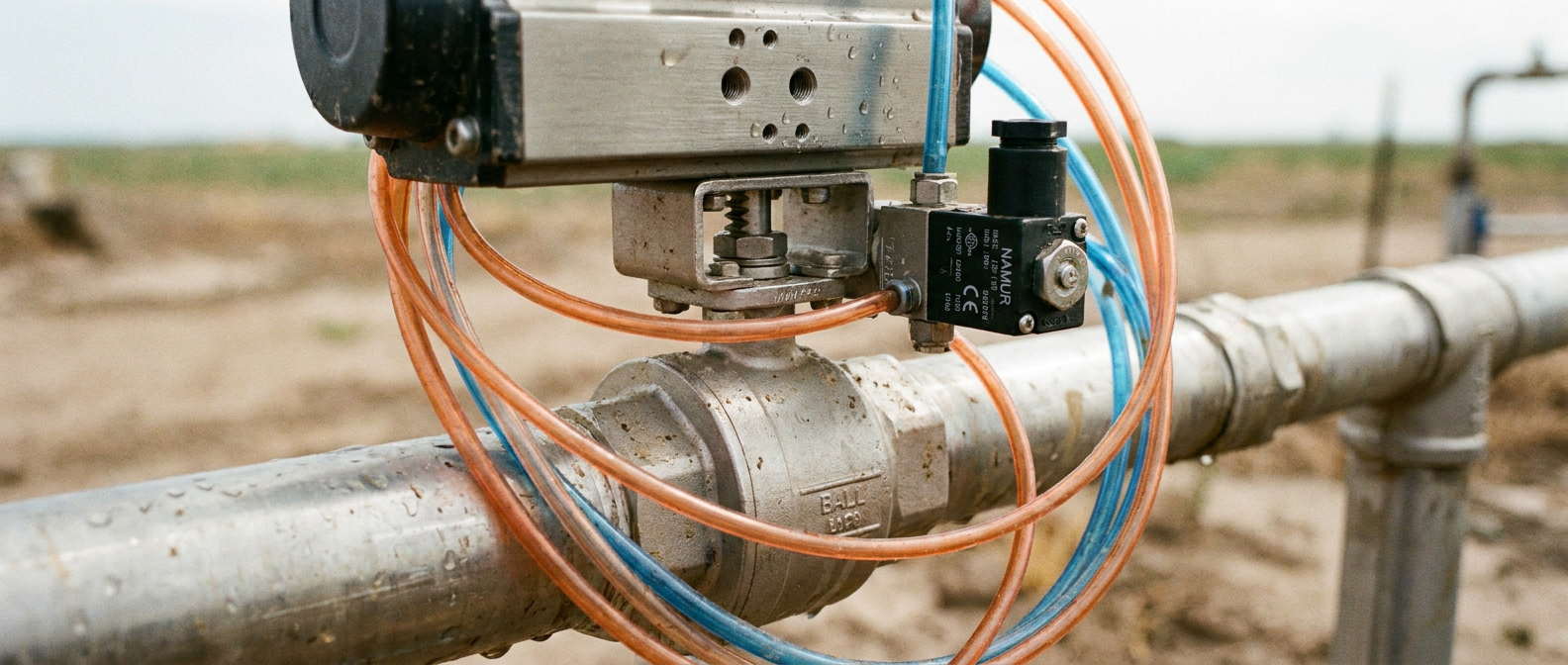
The pneumatic ball valve: the muscle
A pneumatic ball valve is a standard quarter-turn ball valve fitted with an air-driven rack-and-pinion actuator. Compressed air rotates the ball 90° to open or close the line. Because the actuator delivers strong, repeatable torque, this arrangement handles full-bore flow, larger pipe sizes and higher pressures without strain — exactly what a main irrigation header needs. A pneumatic ball valve with a rack-and-pinion actuator is the workhorse here.
The solenoid valve: the pilot signal
The actuator needs air directed to the right port at the right moment, and that is the solenoid’s job. A small electrically operated NAMUR solenoid valve mounts on (or near) the actuator and switches the compressed-air supply when it receives a low-power electrical signal from the controller. In other words, a tiny electrical pulse commands a large mechanical movement — letting a low-voltage controller operate a big valve safely and efficiently.
How the Pairing Works in a Smart Irrigation System
Put together, the control chain is elegantly simple. The irrigation controller (timer, soil-moisture sensor or cloud schedule) sends an electrical signal to the solenoid; the solenoid routes compressed air to the actuator; the actuator turns the ball valve; flow starts or stops. Reverse the signal and the cycle closes. This is the backbone of nearly all industrial-grade smart irrigation valves.

The table below clarifies which device does what, so you can size and specify each part correctly.
| Component | Role | Driven by | Acts on |
|---|---|---|---|
| Controller / sensor | Decides when to water | Schedule / soil data | Sends electrical signal |
| Solenoid valve | Switches the air supply | Electrical signal | Routes compressed air |
| Pneumatic actuator | Generates turning torque | Compressed air | Rotates the ball |
| Ball valve | Starts / stops flow | Actuator | The water line |
Single-Acting vs Double-Acting: Choosing Fail-Safe Behaviour
Actuators come in two flavours, and the choice affects what happens during a power or air failure. A double-acting actuator uses air to both open and close, giving strong two-way control. A single-acting (spring-return) actuator uses air one way and a spring the other, so it fails to a known safe position when air is lost — typically closed, which stops irrigation and prevents flooding if the system trips. For unattended field stations, spring-return fail-closed behaviour is often the safer default, while double-acting suits zones that must hold position. Pairing the right actuator type with a reliable solenoid is central to dependable smart irrigation valves.
Design Tips and the Payoff
Beyond the basic pair, a few design choices multiply the benefit. Group the field into zones, each with its own valve, so water goes only where it is needed. Use a three-way valve where you need to divert flow between lines rather than simply stop it — a 3-way pneumatic ball valve is ideal for switching between fields or between irrigation and fertigation. Keep one compressed-air supply feeding many actuators to keep per-zone cost low.
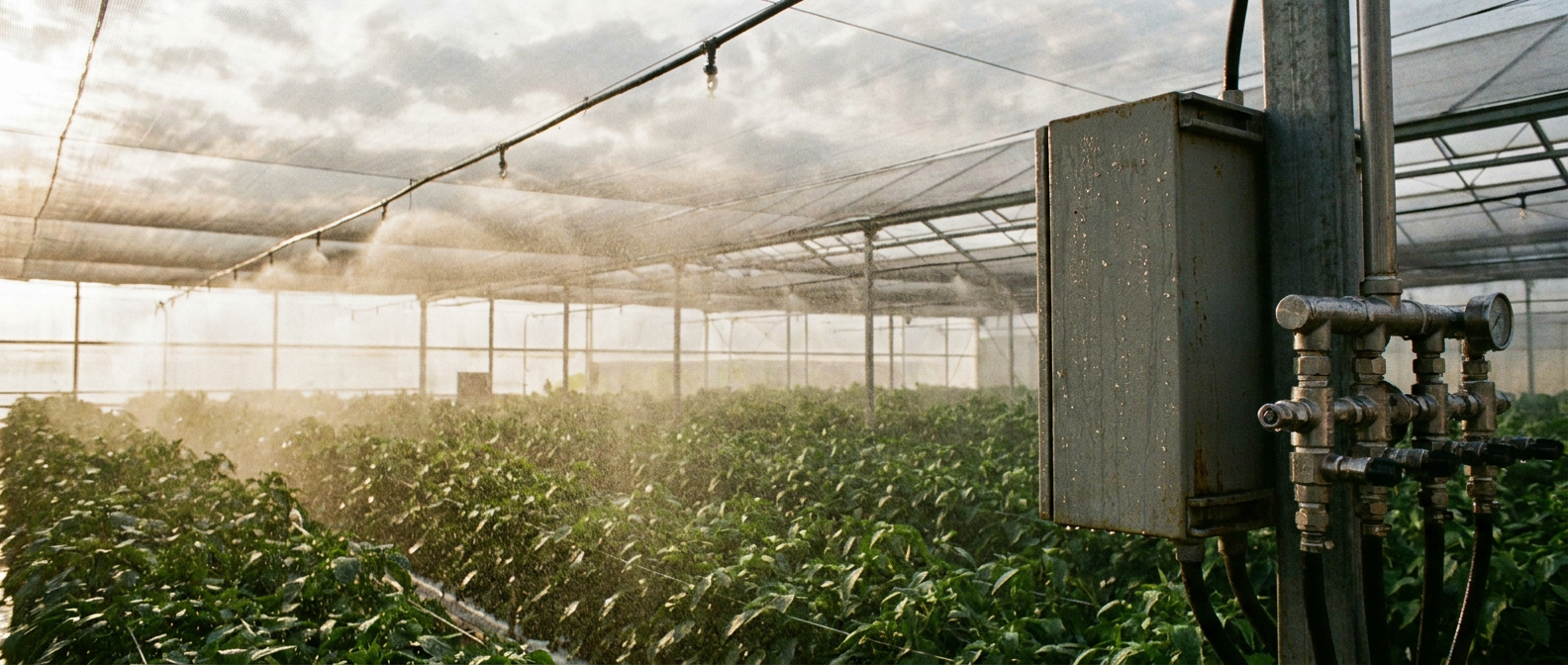
The payoff is real. Peer-reviewed reviews of automated and sensor-driven irrigation report meaningful water savings versus manual watering, alongside lower labour and more consistent yields, as summarised in this open-access review of smart irrigation technologies. The comparison below shows why the pneumatic-plus-solenoid approach is preferred for larger systems.
| Approach | Pipe size / pressure | Reliability | Best for |
|---|---|---|---|
| Manual valves | Any | Depends on labour | Tiny plots |
| Solenoid valve alone | Small bore, low pressure | Good | Small drip zones |
| Pneumatic ball valve + solenoid | Large bore, higher pressure | High, full-bore | Farm headers, greenhouses, orchards |
Choosing the Right Valves for Your System
Match the valve body and actuator to the line: full-bore stainless ball valves resist the grit and minerals in irrigation water, rack-and-pinion actuators give the torque for larger headers, and a NAMUR-mounted solenoid keeps wiring simple. For multi-zone builds, standardising on one platform makes spares and maintenance far easier — our full pneumatic ball valve range covers two-piece, three-piece and three-way bodies with compatible actuators, and you can see field uses on our agricultural applications page.
Keeping a Smart Irrigation System Reliable
Automation only saves water if it keeps working, and most field failures trace back to two things: dirty water and dirty air. On the water side, fit a strainer upstream of the valves so grit and organic matter do not score the ball or jam the seat — irrigation water is rarely clean. On the air side, the compressed-air supply driving the actuators must be clean and dry; moisture and oil carried into a solenoid or actuator are a leading cause of sticking and slow response. A simple air filter-regulator and periodic draining of the receiver go a long way.
Beyond that, the maintenance routine for smart irrigation valves is light: cycle each valve periodically so seats do not take a set, check solenoid coils and wiring for corrosion at outdoor stations, and in cold climates protect actuators and arrestors from freezing. Because the pneumatic ball valve and solenoid are separate parts, a faulty solenoid can be swapped without disturbing the valve in the line — a practical reliability advantage of the paired design over an all-in-one unit.
Frequently Asked Questions
Do I need both a pneumatic ball valve and a solenoid valve?
For larger or higher-pressure irrigation lines, yes. The solenoid switches the air, and the pneumatic actuator provides the torque to turn a full-bore ball valve. A solenoid valve alone can handle small, low-pressure drip zones, but it cannot drive a large main-line ball valve directly.
What happens to the valve if power or air fails?
It depends on the actuator. A single-acting (spring-return) actuator fails to a preset safe position — usually closed — when air or power is lost, stopping irrigation. A double-acting actuator holds or requires air to move both ways. Choose spring-return fail-closed for unattended stations where flooding must be avoided.
Why use a pneumatic actuator instead of an electric one?
Pneumatic actuators are simple, fast, robust and inexpensive per zone when one air supply feeds many valves, and they have no motor to burn out. Electric actuators suit sites without compressed air; both can form part of smart irrigation valves, but pneumatics dominate multi-zone field systems.
What size and material should irrigation valves be?
Size the valve to the pipe for full-bore flow, and choose stainless steel to resist the minerals, grit and fertiliser chemicals common in irrigation water. Reduced-port valves can cause excess pressure drop on long runs, so full port is usually preferred for headers.
Can the same setup handle fertigation?
Yes. A three-way pneumatic ball valve can switch a zone between plain water and a fertiliser-dosed line, and the same controller logic applies. Use chemically compatible seals and stainless bodies to handle fertiliser solutions safely.
Conclusion
The most dependable smart irrigation valves are not a single gadget but a partnership: a solenoid valve to carry the controller’s command and a pneumatic ball valve to do the work. Get that pairing right — with the correct actuator fail-safe, full-bore stainless valves and sensible zoning — and you convert irrigation from a labour-heavy chore into a precise, water-saving, automated process. If you would like help specifying pneumatic ball valves, actuators and solenoids for your fields or greenhouse, contact our team for a tailored quote.