
When you automate a valve, the first real decision is not the brand of actuator — it is the choice of spring return vs double acting. Both turn a quarter-turn ball valve open and closed with compressed air, but they behave completely differently in the one moment that matters most: when the air supply or power fails. Get this choice right and your process fails to a safe state; get it wrong and a “stuck” valve can flood, over-pressurise or shut down a line at the worst possible time. This guide explains how each type works and how to choose between them with confidence.
How a Pneumatic Actuator Works
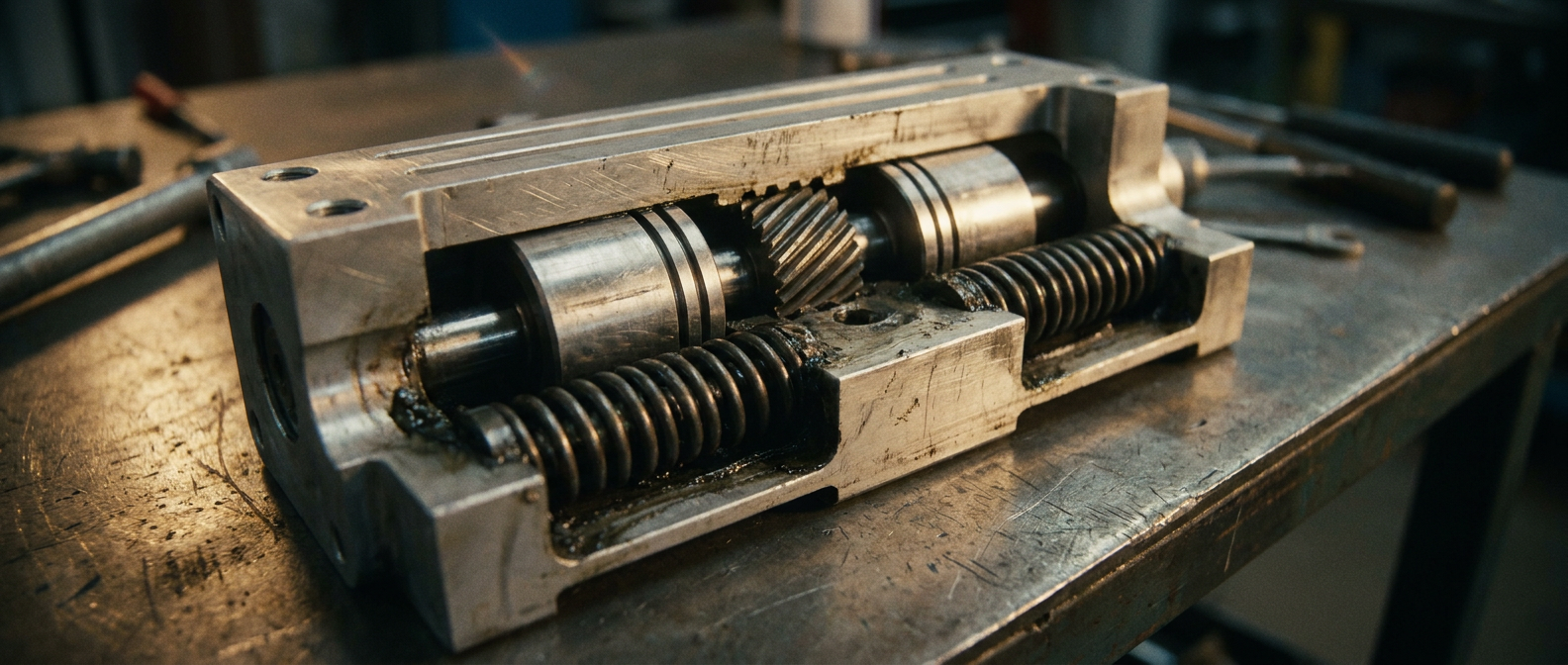
Most automated ball valves use a rack-and-pinion pneumatic actuator. Compressed air pushes two opposed pistons; their racks mesh with a central pinion gear, converting that linear push into the 90° rotation the ball needs. The actuator bolts to the valve through a standardised ISO 5211 mounting flange, which is what lets one actuator fit many valve brands and sizes. Everything in the spring return vs double acting debate comes down to one design change inside this housing: whether the return stroke is powered by air or by a spring.
Double-Acting Actuators: Air Both Ways
A double-acting (DA) actuator uses compressed air for both the opening and closing strokes, through two air ports. Because no spring is fighting the air, all of the air pressure goes into useful torque — so for a given physical size, a DA actuator delivers higher, more consistent torque and has a more compact footprint. The catch is its failure mode: if air is lost, a DA actuator simply stays where it was. It has no built-in “safe” position. That makes DA the economical, high-torque choice for valves where a stuck-in-place valve is not a hazard and where the air supply is stable.
Spring-Return (Single-Acting) Actuators: Built-In Fail-Safe
A spring-return (SR), or single-acting, actuator uses air for one stroke and a bank of powerful internal springs for the other. The defining benefit is mechanical fail-safe: if the air or the electrical signal is lost, the springs automatically drive the valve to a pre-set safe position — either fail-closed (normally closed) to stop flow, or fail-open (normally open) to relieve pressure. This passive, no-electronics safety is exactly why SR actuators dominate emergency shut-off duty in chemical, oil-and-gas, food and other hazard-sensitive processes. The trade-offs: the spring consumes part of the available torque, so an SR actuator is larger and heavier than a DA unit of equal output, and the springs are a wear item over very high cycle counts.
Spring Return vs Double Acting at a Glance
The table below summarises the core differences so you can shortlist quickly.
| Factor | Double Acting (DA) | Spring Return (SR) |
|---|---|---|
| Return stroke powered by | Compressed air | Internal springs |
| On air/power loss | Stays in last position | Moves to safe position (FC or FO) |
| Torque for a given size | Higher | Lower (spring takes a share) |
| Size & weight | More compact | Larger for same torque |
| Air consumption | Air on both strokes | Air on one stroke only |
| Relative cost | Lower | Higher |
| Best for | Stable-air, non-hazard duty | Fail-safe / emergency shut-off |
How to Choose: Spring Return vs Double Acting
The decision almost always starts with one question, then refines from there.
1. What must happen on failure?
If a loss of air or power must drive the valve to a known safe state, choose spring return and define fail-closed or fail-open accordingly. If the valve can safely stay put, double acting is fine — and cheaper. This single safety question overrides the others.
2. Torque, size and budget
For the same torque, DA is smaller and less expensive, which matters when you are automating many valves. If space and budget are tight and there is no safety requirement, DA wins. If you need fail-safe but also high torque, expect a physically larger SR unit — size it accordingly.
3. Air supply and cycling
DA consumes air on both strokes, while SR only consumes air on the powered stroke, which can lower air use on slow-cycling valves. On the other hand, very high cycle counts favour DA because there is no spring to fatigue. For unattended remote stations, the passive safety of SR is usually worth the premium. Where there is no compressed air at all, an electric actuator with fail-safe battery backup can provide a similar safe-position function electrically.
Getting the Specification Right
Whichever type you choose, a few practical details make or break reliability.
Size the actuator torque above the valve’s breakaway torque with a safety margin (commonly 25–50%) so it operates reliably as seats age. Calculate torque at your actual supply pressure — industrial systems typically run 0.2–0.8 MPa, with around 0.55 MPa (≈80 psi) used as the standard sizing point. Feed the actuator clean, dry air to a recognised quality class such as ISO 8573-1, because moisture and oil are leading causes of sticking solenoids and actuators. Finally, standardise on ISO 5211 mounting and a NAMUR-mounted solenoid valve so accessories bolt straight on. The table below maps common scenarios to a starting choice.
| Scenario | Recommended | Reason |
|---|---|---|
| Emergency shut-off / hazardous media | Spring return (fail-close) | Passive safe state on failure |
| General process, stable air | Double acting | Higher torque, lower cost, compact |
| Remote / unattended station | Spring return | Fails safe without operator |
| Very high-cycle automation | Double acting | No spring to fatigue |
| No compressed air available | Electric (battery fail-safe) | Electric safe-position return |
For a complete automated assembly, our pneumatic ball valve range pairs rack-and-pinion actuators with matched valves, solenoids and mounting brackets in both DA and SR configurations.
Common Mistakes When Specifying Actuators
Most actuator problems in the field are not failures of the actuator itself but of the original specification. A few recurring mistakes are worth avoiding in the spring return vs double acting decision.
The first is sizing on the catalogue torque without a margin: as seats bed in and age, breakaway torque rises, and an actuator chosen with no headroom will eventually stall. The second is assuming a double-acting valve will “fail closed” — it will not; without a spring it simply holds position, so any line that needs a safe state on failure must be spring return from the start. A third is mixing up fail-closed and fail-open: the spring drives the valve to whichever position you specify, and getting it backwards can be as dangerous as having no fail-safe at all. Finally, neglecting air quality quietly undermines both types — wet, oily air gums up the solenoid and actuator regardless of how well the unit was sized. Confirm the fail-safe logic, the torque margin and the air quality at the specification stage and the installation will run for years.
Frequently Asked Questions
What is the main difference between spring return and double acting?
A double-acting actuator uses air to move the valve both ways and stays put if air is lost. A spring-return actuator uses air one way and a spring the other, so it automatically returns the valve to a safe position (fail-closed or fail-open) when air or power is lost. The spring return vs double acting choice is fundamentally a fail-safe decision.
Does a spring-return actuator use less air than double acting?
Per cycle it can, because it only needs air for one stroke while the spring handles the return; a double-acting unit uses air on both strokes. However, the spring takes a share of the torque, so a spring-return actuator must be larger to match a double-acting unit’s output.
Can I make a double-acting valve fail-safe?
Not mechanically — a double-acting actuator has no spring, so it stays in its last position on failure. To get a true fail-safe position you need a spring-return actuator, or an electric actuator with a battery or capacitor backup that drives the valve to a safe position.
How much torque margin should I allow?
Size the actuator above the valve’s breakaway torque with a safety margin, commonly 25–50%, and calculate at your real supply pressure (around 0.55 MPa is the usual reference). This keeps the valve operating reliably as seats wear and torque rises over time.
Why does air quality matter for actuators?
Moisture and oil carried in the compressed air are a leading cause of sticking and slow response in solenoids and actuators. Supplying clean, dry air to a recognised quality class such as ISO 8573-1, with a filter-regulator, greatly improves reliability for both spring return and double acting units.
Conclusion
The spring return vs double acting decision is, at its core, about what your process must do when the lights go out. Choose spring return when failure must drive the valve to a safe position; choose double acting for compact, high-torque, lower-cost automation where a stuck valve is harmless. Then size for torque with margin, feed it clean dry air, and standardise the mounting. If you would like help selecting and sizing actuators — DA or SR — for your valves, contact our team for a tailored quote.