
In a food or beverage plant, the most dangerous contamination rarely comes from the obvious places. It hides in the wetted corners of the process line — and very often, at the valves. Food processing cross-contamination happens when residue from one batch, an allergen, or a colony of bacteria survives cleaning and carries over into the next product. A poorly chosen or badly installed valve can become exactly the kind of trap that allows this, while the right valve configuration removes the hiding places entirely. This article explains how contamination starts at the valve and how correct hygienic design and layout prevent it.
How Cross-Contamination Starts at the Valve
Most food processing cross-contamination at the valve traces back to one root cause: somewhere in the flow path, product can collect and cleaning fluid cannot reliably reach it. Three mechanisms dominate.
- Dead legs. A dead leg is a length of pipe or a tee branch where flow stagnates. Hygienic design guidance treats a branch as a dead leg once it exceeds roughly half a pipe diameter in the non-flow direction; beyond that, clean-in-place fluid loses the mechanical scrubbing action needed to clear it, and product sits and spoils.
- Crevices and gaps. Threaded joints, socket-weld gaps, unsealed body joints and worn seats all create micro-spaces that trap product and shelter bacteria from cleaning chemicals.
- Biofilm. Where residue lingers, bacteria attach to the surface and build a protective biofilm that ordinary cleaning struggles to remove, seeding every subsequent batch.
A standard industrial ball valve — with its body cavity around the ball, threaded ends and non-cleanable internals — is full of exactly these traps, which is why it has no place in direct product contact on a hygienic line.
The Hygienic Design Principles That Prevent It
Preventing food processing cross-contamination is a design problem before it is a cleaning problem. The recognised hygienic-design principles all aim at the same goal: leave the product nowhere to hide and let cleaning fluid reach every wetted surface.
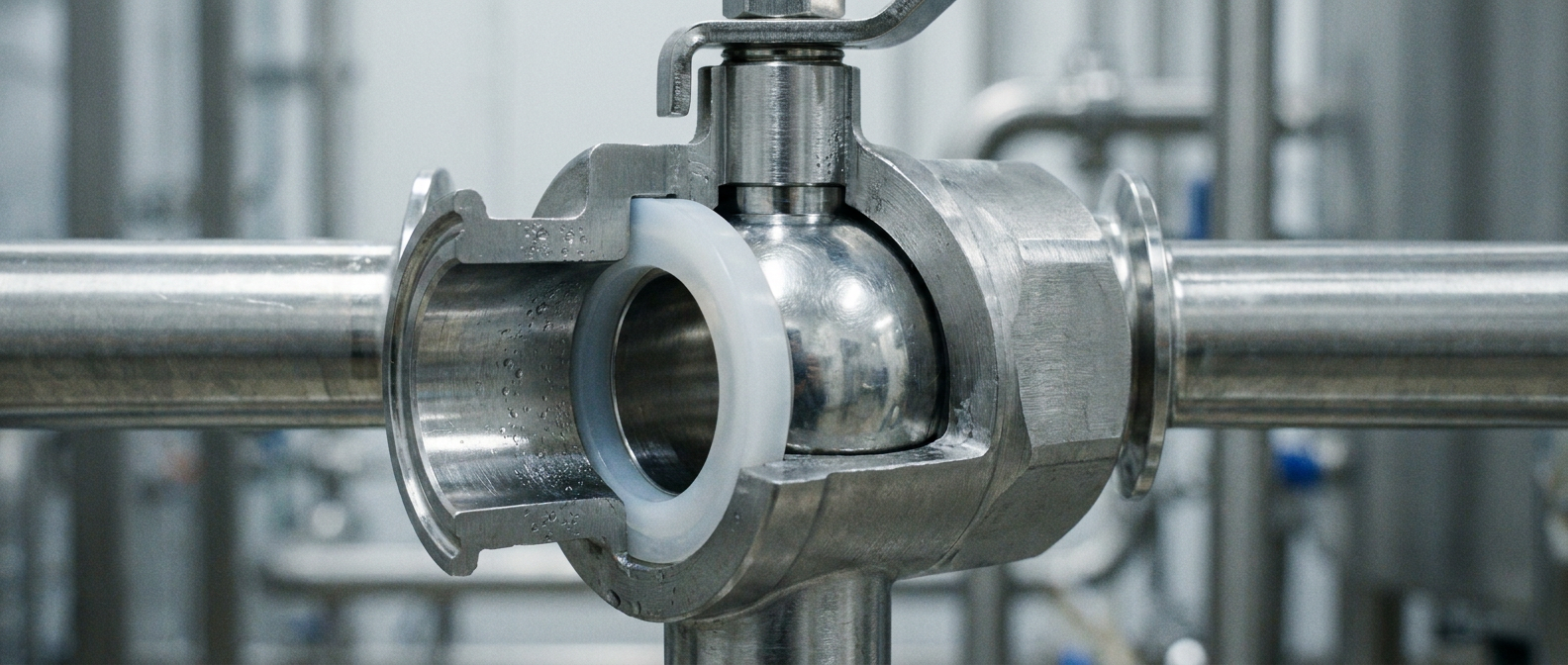
In practice, hygienic valves and fittings are built around a handful of rules: product-contact surfaces are smooth and polished (commonly to a roughness of Ra ≤ 0.8 µm) so soil cannot key into them; there are no crevices, sharp internal corners or unsealed threads; the assembly is self-draining so liquid cannot pool; and the whole flow path is either cleanable in place or quickly dismantled for cleaning. Continuous welds are preferred over fasteners, and any joint is sealed so bacteria cannot enter. A sanitary three-piece tri-clamp ball valve with an encapsulated seat is engineered to meet these criteria, unlike a standard industrial valve.
Choosing the Right Valve Configuration
Correct configuration is about both the valve you choose and how you arrange it. The following moves do the most to eliminate food processing cross-contamination.
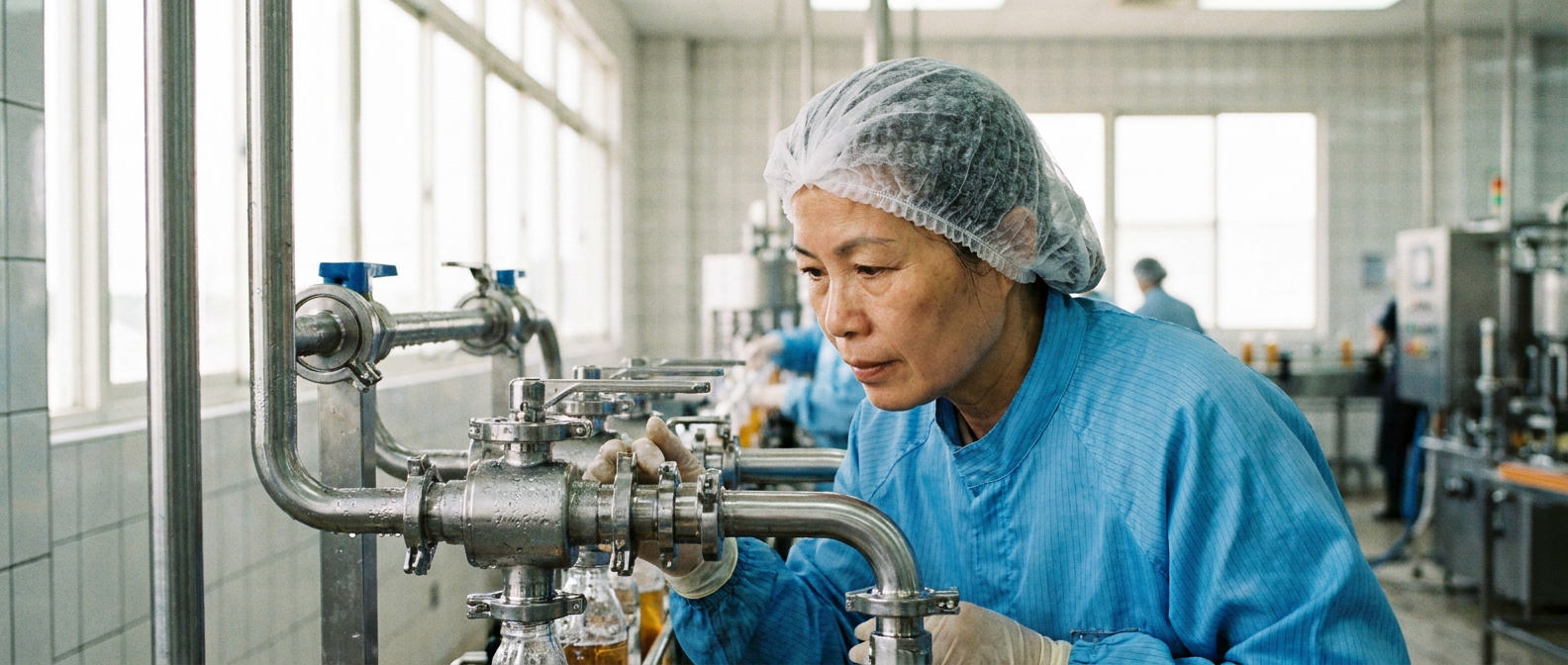
Use sanitary tri-clamp valves in direct product contact, because the clamp connection is quick to open for inspection and the valve is built crevice-free. Replace tee dead legs with swept-elbow routing or a diverting valve so no branch stagnates — a sanitary three-way ball valve lets you switch flow paths cleanly instead of leaving an idle branch full of product. Specify three-piece bodies so the valve can be opened for clean-out-of-place where needed, and automate critical isolation with a sanitary pneumatic ball valve to keep operators (and their gloves) out of the product zone. The table below maps the common risk to its configuration fix.
| Contamination risk | Configuration fix |
|---|---|
| Dead leg / stagnant branch | Swept routing or 3-way diverter valve |
| Threaded / socket-weld crevices | Tri-clamp or sanitary butt-weld ends |
| Trapped product in valve cavity | Crevice-free encapsulated-seat sanitary valve |
| Cannot clean internals in place | 3-piece body for clean-out-of-place |
| Operator contact during isolation | Pneumatic/automated sanitary valve |
CIP, COP and Why the Difference Matters
Cleaning strategy must match the valve, or the hygiene benefit is lost. Clean-in-place (CIP) circulates cleaning solution through the assembled line; clean-out-of-place (COP) requires the valve to be dismantled and cleaned manually. The trap many plants fall into is treating a COP-rated valve as if it were CIP-capable: if a valve that needs disassembly is only flushed in place, residue stays inside and cross-contamination is guaranteed.
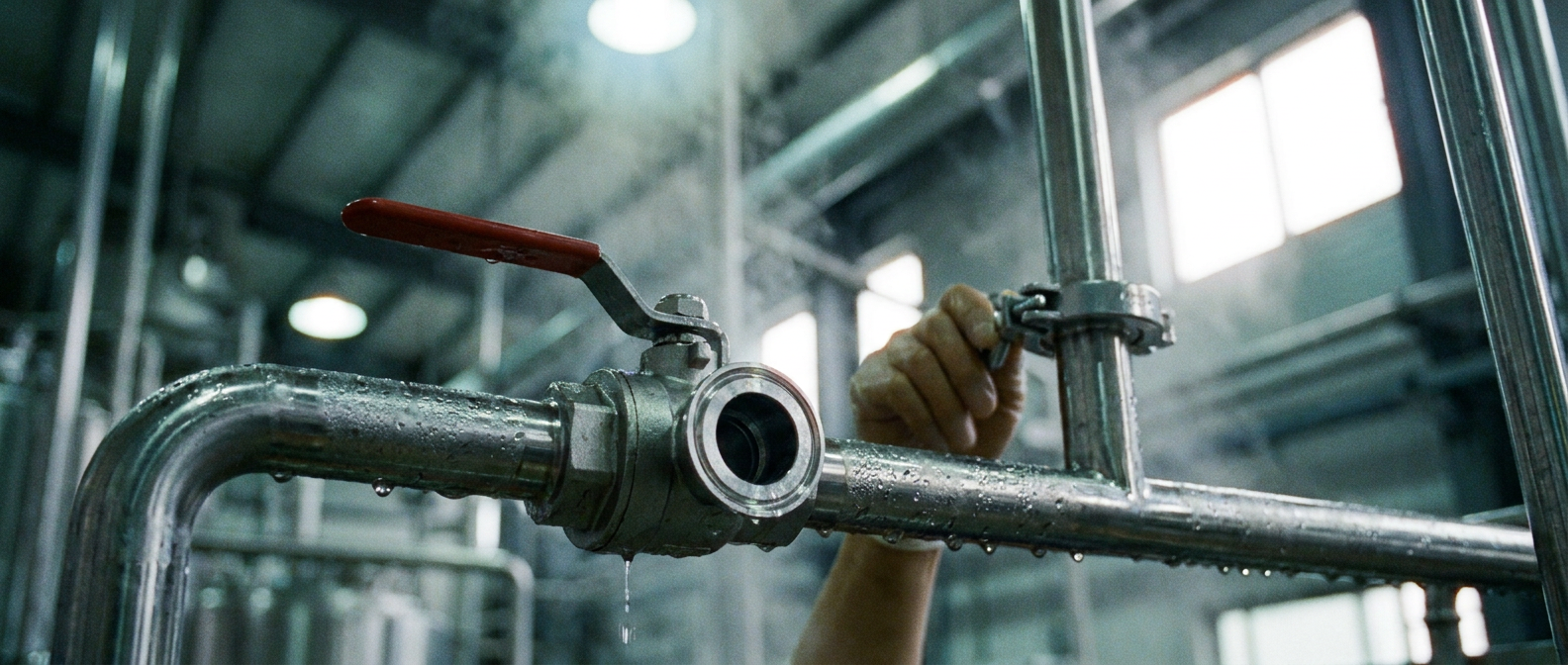
The practical rules: confirm whether each valve is certified for CIP or only COP; for CIP lines, ensure the valve has no shadow zones the flow cannot reach; and for any valve that must be opened to clean, build that disassembly into the sanitation schedule rather than assuming a rinse will do. Matching the cleaning regime to the valve design is one of the most cost-effective controls against food processing cross-contamination.
Material, Surface Finish and Seals
The last layer of defence is material specification. Hygienic valves are typically made from 316/316L stainless steel for corrosion resistance against acidic foods and aggressive cleaning chemicals, with food-grade elastomer or PTFE seals that carry the appropriate compliance. The checklist below summarises what to confirm before a sanitary valve enters a product line.
| Specification | What to confirm |
|---|---|
| Body material | 316/316L stainless for product contact |
| Surface finish | Smooth, polished (commonly Ra ≤ 0.8 µm) |
| Seats & seals | Food-grade PTFE / elastomer, crevice-free |
| Connection | Tri-clamp or sanitary weld — no threads in product zone |
| Cleanability | CIP-capable or scheduled COP, self-draining |
| Documentation | Material certificate; hygienic-design conformity |
Our full food-grade sanitary clamp valve range is built to these criteria, and you can see the broader picture on our food & beverage applications page.
The Standards and Bodies That Define Hygienic Design
Hygienic valve design is not a matter of opinion; it is codified by recognised bodies. The European Hygienic Engineering & Design Group (EHEDG) publishes guidelines and test methods for cleanability, dead-leg limits and hygienic welding, and certifies compliant equipment. In North America, 3-A Sanitary Standards, Inc. sets sanitary design criteria for food equipment, including the important distinction between CIP- and COP-cleanable certifications. Specifying valves that conform to these standards turns “we think it’s clean” into demonstrable food safety.
Allergen Changeover: The Hardest Test for Your Valves
Nowhere is valve configuration tested harder than during an allergen changeover — switching a line from, say, a milk-based product to a nut-free one. Here, even a trace carry-over is a recall-level event, because allergen residue that survives cleaning can trigger a severe reaction in a sensitive consumer. This is the scenario where every weakness in the flow path shows up at once.
A valve that hides a few millilitres of product in a dead leg or an uncleanable cavity is exactly what causes a failed allergen swab after cleaning. Controlling this means combining the measures above with verification: route out dead legs, use crevice-free sanitary valves that the CIP cycle can fully reach, and then prove the result with allergen swab testing or rinse-water analysis after changeover rather than trusting the schedule. When a line repeatedly fails post-clean verification at the same point, the valve configuration at that point is usually the culprit. Designing food processing cross-contamination out of the line at the valve level is far cheaper than discovering it in a finished-product test — or a recall.
Frequently Asked Questions
What is a dead leg and why does it cause cross-contamination?
A dead leg is a section of pipe or a tee branch where flow stagnates. Once it exceeds roughly half a pipe diameter, cleaning fluid can no longer scrub it effectively, so product sits, spoils and seeds the next batch. Eliminating dead legs with swept routing or diverter valves is a primary defence against food processing cross-contamination.
Can I use a standard industrial ball valve in a food line?
Not in direct product contact. Standard ball valves have body cavities, threaded ends and non-cleanable internals that trap product and harbour bacteria. Use sanitary tri-clamp valves with crevice-free, encapsulated seats designed for hygienic service instead.
What is the difference between CIP and COP valves?
CIP (clean-in-place) valves can be cleaned by circulating solution through the assembled line, while COP (clean-out-of-place) valves must be dismantled and cleaned by hand. Treating a COP valve as if it were CIP-capable leaves residue inside and causes cross-contamination, so the cleaning method must match the valve.
Which stainless steel is best for hygienic valves?
316/316L stainless steel is the usual choice for product-contact parts because it resists corrosion from acidic foods and aggressive cleaning chemicals better than 304. Pair it with food-grade PTFE or elastomer seals and a smooth, polished surface finish.
How do three-way valves help prevent cross-contamination?
A three-way (diverting) valve switches flow cleanly between paths instead of leaving an idle branch full of stagnant product. This removes a common dead-leg source and keeps the whole flow path active and cleanable, reducing the risk of food processing cross-contamination.
Conclusion
Food processing cross-contamination is, at heart, a design issue: give product and bacteria nowhere to hide and cleaning does the rest. That means crevice-free sanitary valves in product contact, layouts without dead legs, a cleaning regime matched to each valve, the right 316/316L materials, and conformity to recognised hygienic standards. Get the valve configuration right and you convert a hidden liability into a controlled, auditable part of your food-safety system. If you would like help specifying sanitary valves and configurations for your line, contact our team for a tailored quote.