
Specify the wrong valve and you pay for it twice: once at purchase, and again every time a maintenance crew has to cut it out of the line. One of the most consequential — and most overlooked — choices in that decision is the valve’s construction. The three common ball valve body types (one-piece, two-piece and three-piece) all do the same basic job of starting and stopping flow, yet they differ sharply in how they seal, how easily they are serviced, and what they cost over a 10- or 20-year service life. This guide breaks down each design so engineers, distributors and OEM buyers can match the right body style to the right application instead of defaulting to whatever is cheapest on the shelf.
What “Ball Valve Body Types” Actually Refers To
Every quarter-turn ball valve shares the same core anatomy: a body (or “shell”), a bored ball that rotates 90°, two seats that the ball presses against to seal, a stem that transmits handle or actuator torque, and the end connections that join the valve to the pipe. What distinguishes the main ball valve body types is simply how many separate pieces the pressure-containing shell is split into — and therefore how the internals are accessed.
That single design decision cascades into everything that matters in the field: the number of potential leak paths, whether the valve can be rebuilt in place, how much it weighs, and how it is welded or threaded into a system. Most of these valves use a floating ball design, where line pressure pushes the ball against the downstream seat to create the seal — a configuration that the relevant standards treat as the baseline for general industrial service.
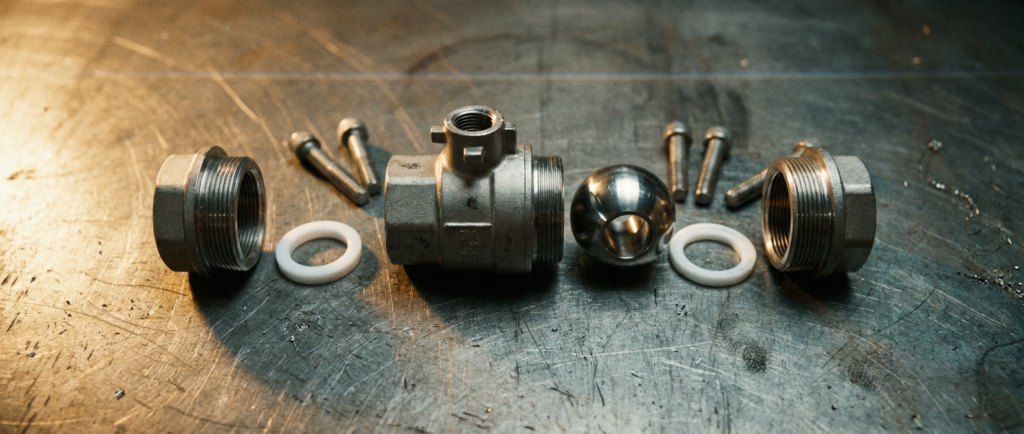
One-Piece Ball Valves: Simple, Sealed and Economical
A one-piece (or “unibody”) valve has its entire shell formed from a single casting or forging, with the ball and seats captured inside through one machined opening. Because there is no body joint, there is no body gasket to fail and no bolting to loosen — the design has the fewest potential external leak paths of any ball valve.
The trade-offs are equally clear. To fit the ball through that single opening, one-piece valves almost always run a reduced (standard) port, which restricts flow and raises pressure drop. More importantly, they cannot be disassembled: when the seats eventually wear, the valve is replaced, not rebuilt. That makes one-piece valves ideal where low cost, compact size and a tight seal matter more than serviceability — utility water lines, instrument isolation, OEM equipment and high-volume applications where valves are treated as consumable components. Our one-piece stainless steel ball valve rated 1000 WOG is a typical example of this economical, leak-resistant class.
Two-Piece Ball Valves: The Industrial Workhorse
The two-piece design splits the shell into a main body and a single screwed-on end cap. This is the most widely used of the ball valve body types for general industrial duty, and for good reason: it offers a strong balance of full-bore flow, reasonable cost and solid pressure ratings. Because the end cap can be separated from the body, a two-piece valve can be inspected — and in many cases the seats and ball can be accessed — although it usually must be removed from the line to do so.
Two-piece valves are the natural fit for water treatment, compressed air, general process lines and HVAC, and they are commonly available in higher-pressure variants. Where pressure demands climb, a dedicated two-piece high-pressure ball valve rated 2000 WOG handles the load, while a standard full-port two-piece valve at 1000 WOG covers the majority of everyday installations. The main limitation is that the body joint is captive: you cannot easily replace the seats without unscrewing the assembly, and once welded into a line, a threaded two-piece valve is awkward to service.
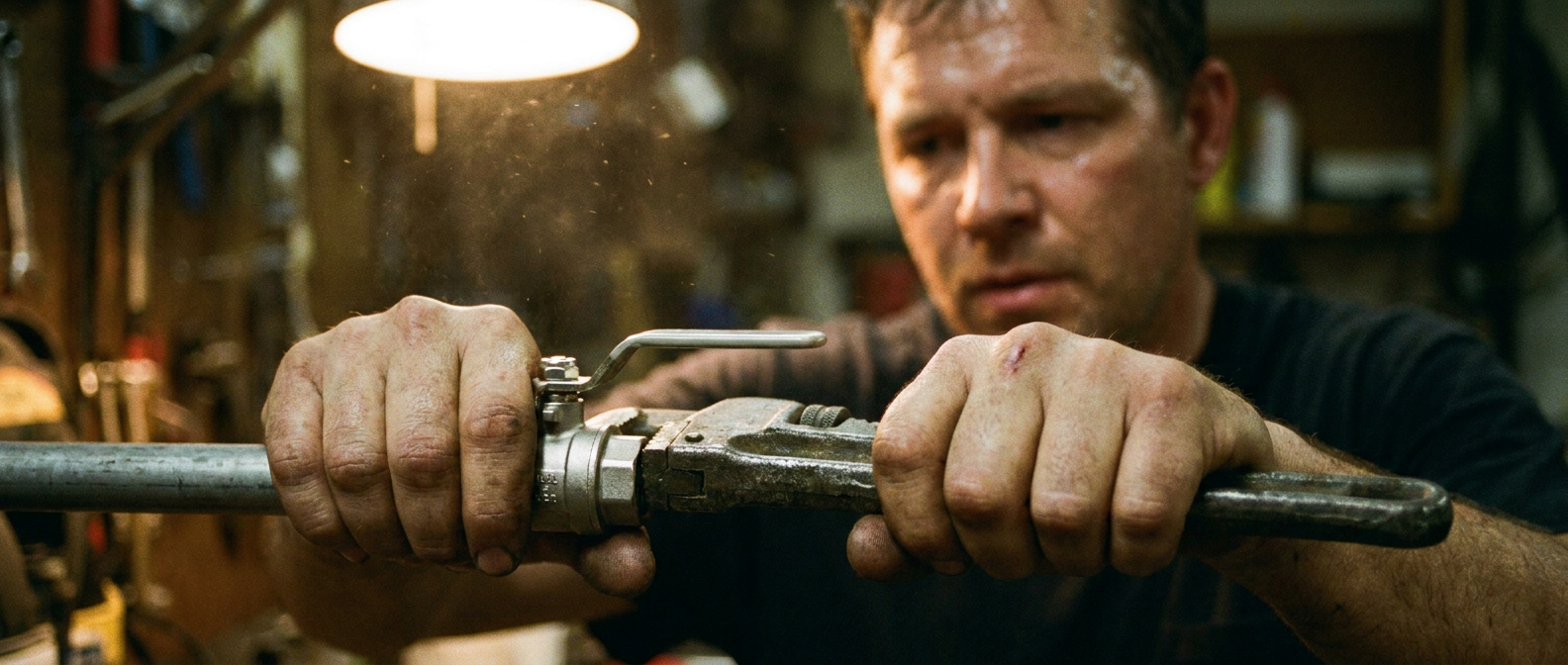
Three-Piece Ball Valves: Built to Be Rebuilt
The three-piece design separates the shell into a central body and two end caps, all held together by a ring of body bolts. Of the three ball valve body types, this is the premium construction, and its defining advantage is in-line maintainability: undo the bolts, swing the centre section out, and you can replace the ball, seats and seals without disturbing the end caps — which stay welded or threaded into the pipe. For a continuously running plant, that means a seat change measured in minutes rather than a pipe-cutting shutdown.
Three-piece valves also accept a wide mix of end connections on the same body platform — threaded, socket weld (SW) or butt weld (BW) — which is why they dominate steam, high-purity and demanding process service. They cost more and add a few external leak paths at the bolted joints (managed with quality body seals and correct bolt torque), but over the life of a critical line that premium is usually repaid many times over. See our three-piece ball valve with threaded, socket-weld and butt-weld options for a representative unit, and the sanitary three-piece ball valve for food and pharmaceutical lines that demand a cleanable, encapsulated-seat build.
Ball Valve Body Types Compared Side by Side
The table below summarises how the three constructions stack up across the factors buyers weigh most often. Treat it as a starting filter rather than an absolute rule — port size, pressure class and seat material can shift the picture.
| Factor | One-Piece | Two-Piece | Three-Piece |
|---|---|---|---|
| Shell construction | Single unibody | Body + 1 end cap | Body + 2 bolted end caps |
| Typical port | Reduced / standard | Full or standard | Full port |
| External leak paths | Fewest | Few | More (bolted joints) |
| In-line serviceability | None — replace whole valve | Limited (remove to service) | Excellent — rebuild in place |
| End connections | Mostly threaded | Threaded, weld | Threaded, SW, BW, tri-clamp |
| Relative cost | Lowest | Moderate | Highest |
| Best for | OEM, utility, isolation | General process, air, water | Steam, food, critical/continuous lines |
How to Choose the Right Ball Valve Body Type
Selecting among the ball valve body types comes down to honestly ranking a handful of priorities for your specific line. The following criteria, in roughly the order they tend to matter, will steer most decisions.
Maintenance strategy and downtime cost
This is usually the deciding factor. If a valve failure means shutting a production line, the in-line rebuild capability of a three-piece valve pays for itself the first time you avoid cutting pipe. If the valve is buried in low-priority utility service and is cheap to swap, a one-piece valve is the rational choice.
Flow and pressure requirements
Where pressure drop matters — pump suction, long runs, viscous media — favour a full-port two-piece or three-piece valve. For high static pressure, confirm the WOG or pressure-class rating rather than the body style alone; a robust two-piece valve can out-rate a poorly specified three-piece one.
End connection and installation method
Threaded ends suit small-bore and serviceable lines; socket weld and butt weld suit permanent, high-integrity piping. Three-piece bodies give you the most freedom here because the same valve platform is offered across all of these end types, which simplifies standardisation across a plant.
Hygiene and process purity
Food, beverage, pharmaceutical and semiconductor lines need cleanable internals and crevice-free seats — territory where sanitary three-piece (tri-clamp) valves are the norm. A one-piece valve that cannot be opened is rarely acceptable in these settings.
The matrix below maps common applications to the body type most teams reach for first.
| Application | Recommended body type | Why |
|---|---|---|
| OEM machinery / built-in isolation | One-piece | Compact, low cost, leak-resistant, treated as a component |
| Building services, water, compressed air | Two-piece | Full-bore flow at moderate cost; easy to install |
| Continuous chemical / process lines | Three-piece | Rebuild in place; minimise unplanned downtime |
| Steam on/off service | Three-piece | Withstands cycling; seats replaceable without re-piping |
| Food, beverage & pharma | Sanitary three-piece | Cleanable, crevice-free, tri-clamp serviceability |
End Connections and the Standards That Govern Them
Body style and end connection are specified together, and both are anchored in recognised standards. According to the International Organization for Standardization (ISO 17292), metal ball valves are defined across flanged, butt-welding, socket-welding and threaded ends, with bores categorised as full, reduced and double-reduced — the same vocabulary used to describe the body types above. In the North American supply chain, the American Petroleum Institute’s API 608 standard layers additional design and testing requirements on top of ASME B16.34 for floating- and trunnion-ball valves in petroleum and process service.
For buyers, the practical takeaway is that a well-built valve should clearly state its body type, port size, pressure rating and the standard it conforms to. Understanding the ball valve body types alongside these ratings is what turns a parts list into a confident specification. If you are standardising across multiple lines, our full manual ball valve range spans one-, two- and three-piece constructions in matching materials and ratings, which keeps spare-part inventories simple.
Frequently Asked Questions
Which ball valve body type lasts the longest?
Service life depends more on seat material, media and cycling than on body style, but three-piece valves effectively last the longest in practice because their seats and balls can be replaced in place. A one-piece valve may seal reliably for years, but once its seats wear, the whole valve is scrapped.
Are three-piece ball valves more likely to leak than one-piece?
Externally, a one-piece valve has fewer potential leak paths because it has no body joints. A three-piece valve’s bolted joints are sealed with body gaskets and rely on correct bolt torque, but when assembled and maintained properly they are fully reliable — the serviceability benefit usually outweighs the extra joints on critical lines.
What does “full port” mean and which body types offer it?
Full port (full bore) means the ball’s opening matches the pipe’s inside diameter, minimising pressure drop. Two-piece and three-piece valves are commonly available in full port, while one-piece valves are typically reduced port due to their single-opening construction.
Can I weld a two-piece or three-piece ball valve directly into a pipe?
Yes. Both are offered with socket-weld and butt-weld ends. With a three-piece valve, however, you can remove the centre section for seat replacement after welding without disturbing the welded end caps — a key reason it is preferred for permanent, high-integrity piping.
How do I choose between the ball valve body types for a new project?
Rank your priorities: if downtime is expensive, choose three-piece; if flow and cost are balanced, choose two-piece; if the valve is a low-cost, set-and-forget component, choose one-piece. Then confirm port size, pressure rating and end connection against your line conditions before ordering.
Is a 2-piece ball valve better than a 3-piece ball valve?
Neither is better in every case. A two-piece valve gives you full-bore flow, solid pressure ratings and a lower price, and it is the default for general industrial duty. A three-piece valve costs more but can be rebuilt in line: undo the bolts, swing out the centre section and replace the ball and seats without disturbing the pipe ends. If your maintenance plan replaces worn valves rather than rebuilding them, a two-piece valve is the sensible choice. If downtime on that line is expensive, pay for the three-piece.
Which ball valve body type is least likely to leak from the body?
Count the body joints. A one-piece valve has none, so it has the fewest external leak paths, but it is usually reduced port. A threaded two-piece valve has one body joint; a three-piece valve has two bolted joints sealed by gaskets, which are reliable when torqued and maintained correctly. A seal-welded two-piece valve sits in between: the two halves are welded into one body at the factory, so there is no threaded body joint to weep, and the bore stays full port. Our V-2B / V-2C seal-welded ball valve is built this way. Keep in mind that the body joint is only one of four leak points; the stem seal, the pipe ends and the seats exist on every body type.
What is the difference between a welded-body and a threaded-body 2-piece ball valve?
Both are two-piece designs with a body and an end cap. In a threaded-body valve the cap is screwed into the body, so there is a body joint with a seal that has to hold for the life of the valve. In a welded-body valve the two halves are welded into one integrated body at the factory, so there is no body gasket to age and no threads to lose preload. The trade-off is that a welded body is not made to be opened; when the seats wear, you replace the valve. “Welded-body” refers only to the joint between the two halves. The pipe connections are ordinary female threads, and the valve is not welded to your pipe.
Can a 2-piece ball valve be repaired or rebuilt?
Sometimes, but usually not in line. Because the end cap can be separated from the body, a threaded two-piece valve can be inspected, and in many designs the seats and ball can be reached, but the valve normally has to come out of the pipe first. A welded-body two-piece valve cannot be opened at all; like a one-piece valve, it is replaced rather than rebuilt. If you want to change seats in place, that is the job a three-piece valve is built for.
Conclusion
There is no single “best” valve — only the right match between the ball valve body types and the job in front of you. One-piece valves win on cost and simplicity, two-piece valves are the dependable industrial default, and three-piece valves justify their premium wherever uptime and serviceability rule. Get that match right and the valve quietly does its job for years; get it wrong and you pay in downtime and replacement labour. If you would like help specifying the optimal construction, port and end connection for your application, contact our engineering team for a tailored quote and we will recommend the right valve for your line.