
Product Name
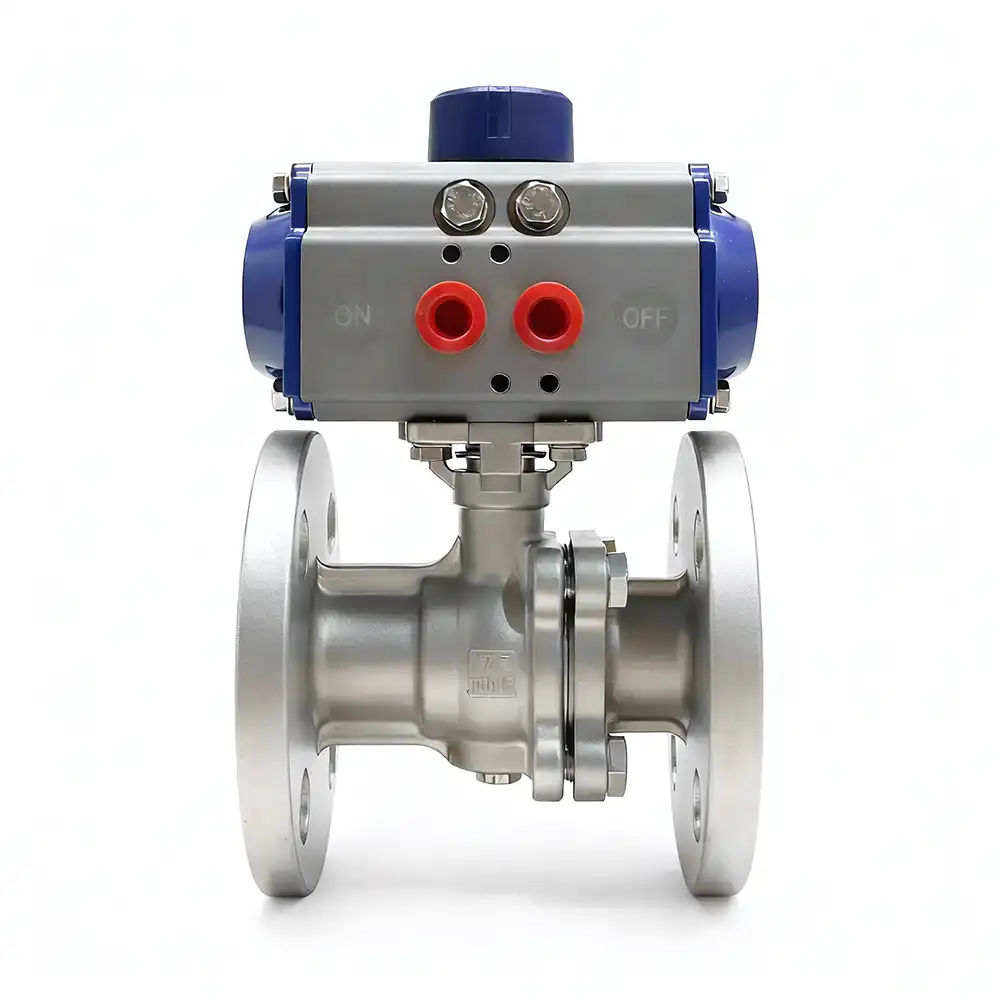
Pneumatic Flanged Ball Valve – 304/316 Stainless, Full Port, ASME Class 150/300 (JIS 10K/20K also available)
Product Summary
A pneumatically actuated flanged ball valve in 304/316 stainless steel, full port, 1/2″–4″. Two-piece (split body) — the body bolts apart, so seats and ball are replaceable without cutting the valve out of the line. PTFE seats, −20 °C to +180 °C. Rack-and-pinion actuator, double acting or spring return, direct-mounted on the ISO 5211 pad. Available in ASME Class 150/300 (B16.5) and JIS 10K/20K (B2220) — these flanges are not interchangeable, so tell us which standard your pipeline uses.
ISO 9001 · CE · Manufacturer since 1999
Product Description
A pneumatically actuated flanged ball valve in 316 or 304 stainless steel, full port, with a rack-and-pinion air actuator mounted directly on the ISO 5211 pad — no bracket, no coupling, nothing to align.
The body is two-piece (split body). That matters when a seat wears out: the body bolts apart and the ball and seats come out, so the valve is rebuilt in place instead of being cut out of the line and thrown away.
Flange Standard — Read This Before You Order
ASME (American) and JIS (Japanese) flanges are not interchangeable. They have different bolt-circle diameters and different bolt holes. A 4″ JIS 10K flange has a 175 mm bolt circle; a 4″ ASME Class 150 flange has a 190 mm bolt circle. They will not bolt together.
We build both. Tell us which standard your pipeline uses and we will supply the matching valve.
ASME / ANSI (North America, most export markets)
| Model | Pressure class | Flange standard | Face-to-face | Size range |
|---|---|---|---|---|
| F-2BM | ASME Class 150 | ASME B16.5 | ASME B16.10 | 1/2″ – 4″ |
| F-2DM | ASME Class 300 | ASME B16.5 | ASME B16.10 | 1/2″ – 4″ |
← Swipe the table to see all columns →
JIS (Japan, parts of Asia)
| Model | Pressure class | Flange standard | Face-to-face | Size range |
|---|---|---|---|---|
| F-2KM | JIS 10K | JIS B2220 | — | 1/2″ – 4″ |
| F-2EM | JIS 20K | JIS B2220 | — | 1/2″ – 4″ |
← Swipe the table to see all columns →
Valve Specifications
| Item | Specification |
|---|---|
| Body material | ASTM A351 CF8 (304) or CF8M (316) |
| Body construction | Two-piece (split body) — the body bolts apart, so seats and ball can be replaced without cutting the valve out of the line |
| Port | Full port |
| Seat material | PTFE + 15% glass fibre |
| Temperature range | −20 °C to +180 °C |
| Actuator mounting | ISO 5211 direct mount — the actuator bolts onto the valve, no bracket, no coupling |
Actuator Specifications
| Item | Specification |
|---|---|
| Type | Rack-and-pinion, aluminium alloy body |
| Action | Double Acting (DA) or Spring Return (SR) |
| Spring return position | Normally closed or normally open — specify when ordering |
| Rotation | 90° |
| Air supply | 4 – 7 bar (approx. 60 – 100 psi) |
| Control | On/Off (standard); modulating with positioner (optional) |
| Options | Solenoid valve, limit switch box, positioner |
Two-Piece Body — Why It Is Worth Knowing
Flanged ball valves come in two constructions, and the difference only shows up years later, in the maintenance budget:
- Unibody (one-piece): the body is a single casting. Cheaper to make. When the seat fails, the valve is scrap.
- Two-piece (split body) — this valve: the body bolts apart. When the seat wears, you undo the body bolts, replace the seats and the ball, and put it back. The flanges never leave the pipeline.
On a line that runs abrasive or high-cycle service, that difference is the difference between a seat kit and a new valve.
Applications
- Chemical processing — on/off control of acids, solvents and corrosive process fluids. CF8M (316) resists chloride pitting; PTFE seats handle aggressive media.
- Water treatment — raw-water intake, filtration and disinfection lines, opened and closed remotely.
- Wastewater — chemical dosing and sludge lines; when solids wear the seats, the split body lets you replace them in place.
- Petrochemical and refinery process lines — remote isolation with an air-operated valve, so no electrical actuator is needed at the valve.
- Low-pressure steam distribution — plant utility steam lines up to 180 °C.
- Process skids and automated dosing — batch dosing, reactor feed and tank-farm isolation; ISO 5211 direct mount, double acting or spring return, driven by a solenoid from the PLC.
- Flanged pipework in general — remote on/off where a threaded valve is not an option.
Related: the hand-operated version is our manual flanged ball valve. For a flanged non-return valve, see the flanged check valve. If you need position feedback, add a limit switch box.
FAQ
Can I use a JIS 10K valve on an ASME Class 150 pipeline?
No. The bolt circles are different — 175 mm versus 190 mm on a 4″ flange — and the bolt holes do not line up. Tell us which standard your pipeline uses and we will build the valve to match. We supply both.
Is this a unibody or a split-body valve?
Two-piece, split body. The body bolts apart, so the ball and seats can be replaced without cutting the valve out of the pipeline. A unibody valve is cheaper up front but has to be scrapped when the seat fails.
What sizes are available?
1/2″ to 4″ in all four models. The direct-mount (high-platform) body is built to 4″.
What is the temperature range?
−20 °C to +180 °C, set by the PTFE seats.
Double acting or spring return — which should I choose?
Double acting uses air to open and air to close, and holds its last position if the air supply is lost. Spring return uses air one way and a spring the other, so it moves to a preset position when air is lost. Tell us whether that position should be open or closed and we will build it that way.
Does the actuator need a mounting bracket?
No. The valve has an ISO 5211 pad on top and the actuator bolts straight onto it — nothing to machine, nothing to align.
Is there a minimum order quantity?
No. We have no MOQ. Tell us what you need and we will quote it.
Sample Policy
We are happy to provide product samples for customers to evaluate quality or conduct testing. The process typically begins with a quotation based on the customer’s specifications.
If the pricing is acceptable, we can offer samples either free of charge or at a cost depending on the product type and availability.
Shipping fees are borne by the customer.
Order Process
After confirming the product requirements and other details with the customer, we will issue a Sales Confirmation for approval. Once confirmed, the customer is required to pay a 30% deposit to proceed with production.
When mass production is completed and the goods pass inspection, the customer must pay the remaining 70% balance before shipment is arranged.
Related Products
FAQ
A. How can I request a quote?
Please provide a detailed inquiry sheet including product specifications, materials, quantities, and any special requirements. We will offer a quotation based on your request.
B. What are your quotation terms?
Our quotations are typically based on FOB terms. However, we can also offer CFR, CIF, or other Incoterms upon request.
C. What is your Minimum Order Quantity (MOQ)?
MOQ depends on the product. We operate on a made-to-order basis, and trial orders are welcome. For smaller orders, freight is arranged and borne by the buyer.
D. What are your payment terms?
By T/T – 30% down payment upon order confirmation, and 70% balance before shipment.
E. What is your lead time?
Lead time depends on order quantity and specifications. We will confirm the exact schedule when you request a quote.
Want to know more?
If you’re interested in any of our products or services, simply fill out the form below. Our team will get in touch with you as soon as possible to provide the information you need.