
Product Name
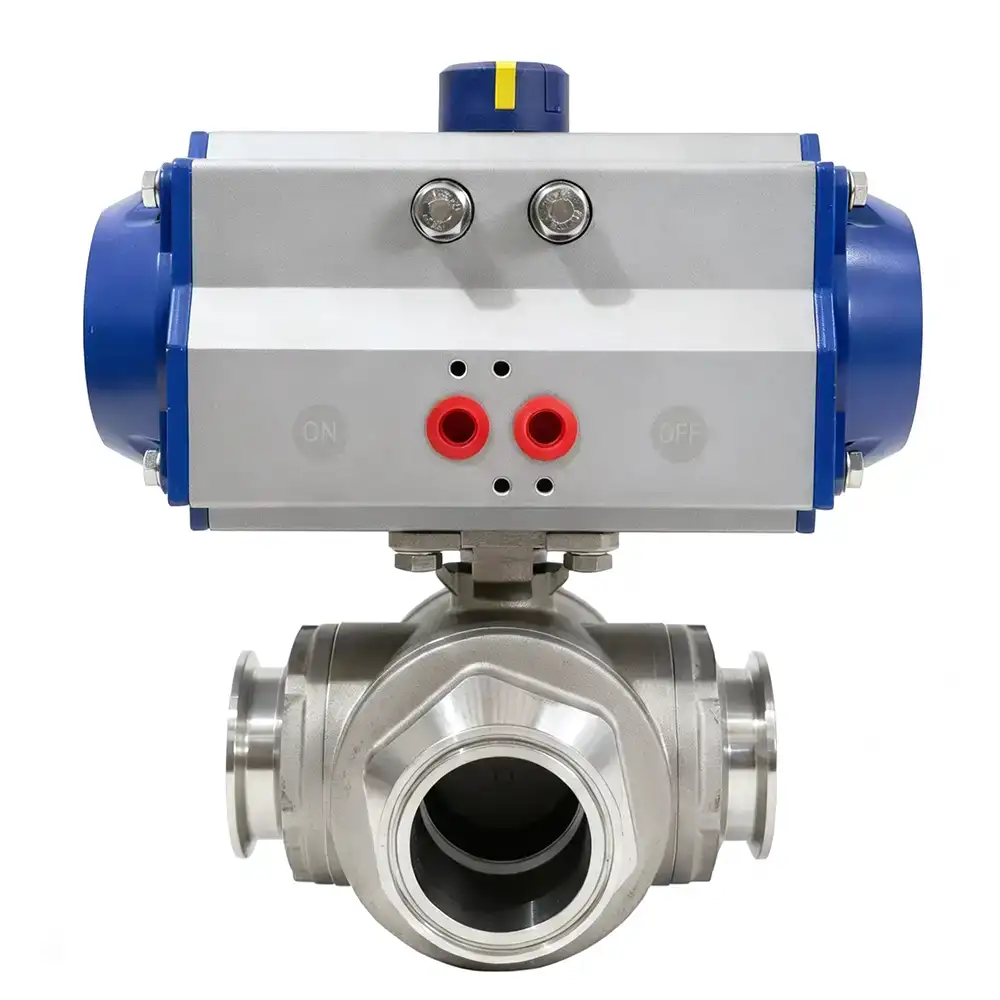
Sanitary Diverter Valve — Pneumatic 3-Way Ball Valve, Tri-Clamp, L-Port or T-Port, 316 (MV-3M-TC)
Product Summary
Sanitary diverter valve — a 3-way ball valve with a pneumatic actuator. 316 stainless, polished, Tri-Clamp ends, 1/2″ to 2″, 1000 WOG.
Two decisions you make when you order:
- L-port (diverts to one outlet or the other) vs T-port (can feed two at once)
- Fully encapsulated seat (−20 °C to +80 °C, no dead space for product) vs semi-encapsulated (−20 °C to +180 °C)
Double acting or spring return, ISO 5211 mount, 4–8 bar air. Tell us what the valve has to do and we will tell you which to order.
For the hand-lever version, see the sanitary manual 3-way ball valve.
ISO 9001 · CE · Manufacturer since 1999 · Made in Taiwan
Product Description
A sanitary diverter valve built as a 3-way ball valve in polished 316 stainless steel, driven by a rack-and-pinion pneumatic actuator (double acting or spring return). Tri-Clamp ends let you break the line without tools, and the ball is available with an L-port to divert flow between two destinations, or a T-port to mix two streams into one.
The part that matters in hygienic service is what happens behind the ball — see below.
The Cavity Problem — and What a Fully Encapsulated Seat Does About It
In a standard ball valve there is a small gap between the ball and the body. When the valve closes, product sits in that gap. On a water line nobody cares. On a line carrying food, beverage or process chemicals, that trapped product is where the last batch contaminates the next one, and where a sugar syrup crystallises solid.
A fully encapsulated seat fills that space with PTFE. The ball touches nothing but the seat — there is no cavity, so there is nothing to trap product. This is what the industry means by a non-retention ball valve.
It is not free, though: filling the cavity with PTFE lowers the temperature ceiling. Choose with your process temperature in front of you.
| Seat design | What happens behind the ball | Temperature range | Choose it for |
|---|---|---|---|
| Partial (standard) | A small cavity remains behind the ball. Media can sit in it when the valve is closed. | −20 °C to +180 °C | Water, air, and media where a trace of residue is not a problem. |
| Fully encapsulated | PTFE fills the space around the ball. No cavity, nothing to trap product. | −20 °C to +80 °C | Food, beverage, process chemicals, and viscous or crystallising media that must not stay behind in the valve. |
← Swipe the table to see all columns →
The judgement is not “food versus water” — it is whether your medium can be left sitting in a cavity, and how hot your line runs. A crystallising chemical needs a full seat as much as a sugar syrup does. A hot wash cycle above 80 °C rules a full seat out. Tell us the medium and the temperature when you request a quote and we will confirm which seat you need.
Valve Specifications
| Item | Specification |
|---|---|
| Body material | ASTM 316 stainless steel, polished sanitary finish (304 to order) |
| Port configuration | 3-way, L-port (diverting) or T-port (mixing / diverting) |
| End connection | Tri-Clamp (quick clamp) sanitary ends |
| Pressure rating | 1000 WOG |
| Size range | 1/2″ – 2″ |
| Seat material | PTFE — partial or fully encapsulated (see the seat table above) |
| Temperature range | −20 °C to +180 °C with a partial seat; −20 °C to +80 °C with a fully encapsulated seat |
| Cleaning | Clean-out-of-place (COP) — the body bolts open so the ball and seats can be removed and cleaned |
| Actuator mounting | ISO 5211 |
Actuator Specifications
| Item | Specification |
|---|---|
| Type | Rack-and-pinion, aluminium alloy body |
| Action | Double Acting (DA) or Spring Return (SR) |
| Spring return position | Returns to the port you nominate when the air supply is lost — specify when ordering |
| Working temperature | −20 °C to +80 °C |
| Rotation | 90° |
| Air supply | 4 – 8 bar (approx. 60 – 116 psi) |
| Control | On/Off (standard); modulating with positioner (optional) |
| Options | Solenoid valve, limit switch box, positioner |
Cleaning: This Valve Comes Apart
The body bolts open. Undo the clamps, take the ball and the seats out, clean them, put it back — clean-out-of-place (COP). You can see the parts you cleaned, which is more than can be said for a valve you can only flush from the outside.
Every product-contact surface — ball, seats, body bore — can be reached by hand, cleaned and inspected before the valve goes back on the line. Spare seats are stocked, so a seat that has done its hours gets replaced rather than nursed.
L-Port or T-Port: Two Ways to Build a Sanitary Diverter Valve
- L-Port (Diverter): the bore is bent 90°, connecting the inlet to one of two outlets at a time. Use it to switch a line between two tanks, two fillers or two filter banks.
- T-Port (Mixing / Diverting): the bore is T-shaped, so it can join two ports together or feed either outlet. Use it to blend two streams into one.
Related: the same 3-way body in a threaded (non-sanitary) version is our pneumatic 3-way ball valve; the hand-operated sanitary version is the sanitary manual 3-way ball valve. For a two-way sanitary valve, see the sanitary pneumatic ball valve.
Applications
- Batch changeover: switching a filler between two product tanks without cross-contaminating the next batch.
- Blending: combining two ingredient streams into one line with a T-port.
- Viscous and crystallising media: syrups, sauces and concentrates that would set solid in a standard valve cavity.
- Semiconductor chemical and slurry loops: holding a polishing slurry in a recirculation loop and switching it to the tool only when it is called for — solids drop out the moment a line stands still.
- Paint, ink and pigment colour change: keeping pigment moving in a ring main, then diverting to the dispense head; low dead space is what stops the last colour turning up in the next one.
- Remote switching on a PLC signal: the flow path changes from the panel, so nobody has to walk out to the line to turn a handle.
FAQ
What is a non-retention (fully encapsulated) ball valve?
It is a ball valve in which PTFE fills the space around the ball, so there is no cavity behind it for product to sit in. Nothing is trapped when the valve closes — no residue, no crystallised syrup, nothing left for the next batch to pick up. The trade-off is temperature: our fully encapsulated seat is rated −20 °C to +80 °C, against −20 °C to +180 °C for the standard partial seat.
Should I choose a partial seat or a fully encapsulated seat?
Ask two questions. First: can my medium be left sitting in a small cavity when the valve is closed? If it crystallises, sets solid, separates, or would contaminate the next batch, you need a fully encapsulated seat. Second: how hot does the line run? Above 80 °C the fully encapsulated seat is out, and you take the partial seat. Tell us the medium and the temperature and we will confirm.
How do I clean it?
You take it off the line and open it. Undo the clamps, lift the ball and the seats out, clean them, put it back — clean-out-of-place (COP). Every surface the product touched is in your hand while you do it, so you can see the result instead of assuming it.
What is the difference between an L-port and a T-port?
An L-port bore is bent 90° and connects the inlet to one of two outlets at a time — it diverts. A T-port bore is T-shaped and can join two ports together — it can mix as well as divert. Choose L-port for switching, T-port for blending.
What sizes and end connections are available?
1/2″ to 2″, with Tri-Clamp (quick clamp) sanitary ends. The body is polished 316 stainless steel.
What happens if the air supply fails?
It depends which actuator you order. A spring return (SR) unit drives the valve back to the port you nominated when you ordered it — tell us which flow path the line must fall back to and we build it that way. A double acting (DA) unit stays where it was when the air stopped.
What certifications do you hold?
ISO 9001 and CE, and we have been manufacturing stainless steel valves in Taiwan since 1999.
The valve itself: a polished 316 stainless body, PTFE seats (partial or fully encapsulated), no threads anywhere in the wetted path, and a body that bolts open so every product-contact surface can be reached, cleaned and inspected.
Sample Policy
We are happy to provide product samples for customers to evaluate quality or conduct testing. The process typically begins with a quotation based on the customer’s specifications.
If the pricing is acceptable, we can offer samples either free of charge or at a cost depending on the product type and availability.
Shipping fees are borne by the customer.
Order Process
After confirming the product requirements and other details with the customer, we will issue a Sales Confirmation for approval. Once confirmed, the customer is required to pay a 30% deposit to proceed with production.
When mass production is completed and the goods pass inspection, the customer must pay the remaining 70% balance before shipment is arranged.
Related Products
-
 Sanitary Ball Valves (Tri-Clamp)
Sanitary Butterfly Valve — Pneumatic Wafer Body, 304 Stainless, Tri-Clamp
-
 Sanitary Ball Valves (Tri-Clamp)
Sanitary 3 Way Ball Valve — Manual, L-Port or T-Port, Tri-Clamp, 316 (MV-3N)
-
 Sanitary Ball Valves (Tri-Clamp)
Sanitary Pneumatic Ball Valve – 3-Piece 316, Tri-Clamp or OD-Tube Butt Weld, ISO 5211 High-Mount, DA or SR (V-3NM / V-3NM-L3)
-
 Sanitary Ball Valves (Tri-Clamp)
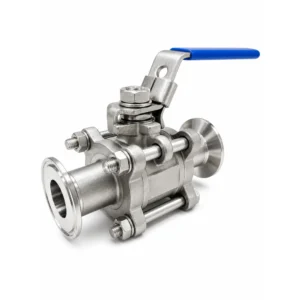
Tri Clamp Ball Valve – Manual 3-Piece Sanitary, 316, Full Port, Tri-Clamp or OD-Tube Butt Weld (V-3N / V-3N-L3)
FAQ
A. How can I request a quote?
Please provide a detailed inquiry sheet including product specifications, materials, quantities, and any special requirements. We will offer a quotation based on your request.
B. What are your quotation terms?
Our quotations are typically based on FOB terms. However, we can also offer CFR, CIF, or other Incoterms upon request.
C. What is your Minimum Order Quantity (MOQ)?
MOQ depends on the product. We operate on a made-to-order basis, and trial orders are welcome. For smaller orders, freight is arranged and borne by the buyer.
D. What are your payment terms?
By T/T – 30% down payment upon order confirmation, and 70% balance before shipment.
E. What is your lead time?
Lead time depends on order quantity and specifications. We will confirm the exact schedule when you request a quote.
Want to know more?
If you’re interested in any of our products or services, simply fill out the form below. Our team will get in touch with you as soon as possible to provide the information you need.