
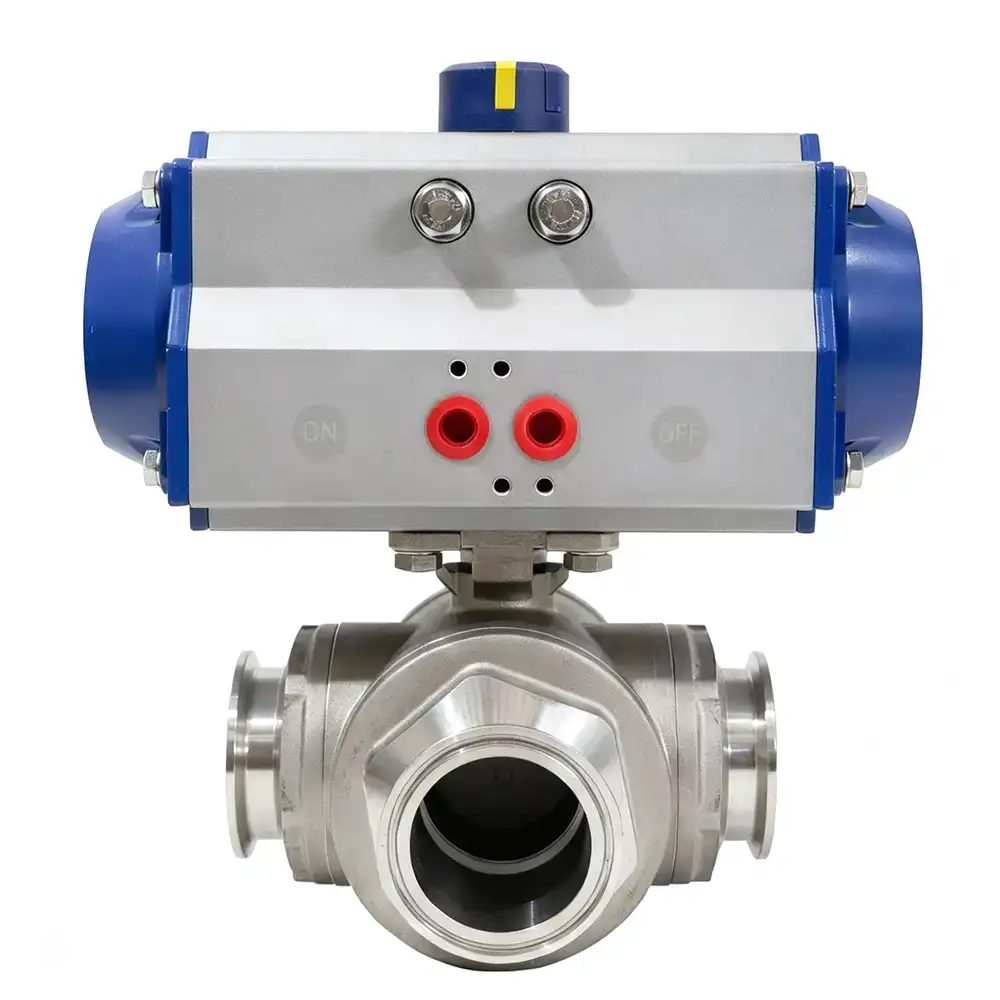
Produktname
Sanitary Diverter Valve — Pneumatic 3-Way Ball Valve, Tri-Clamp, L-Port or T-Port, 316 (MV-3M-TC)
Produktübersicht
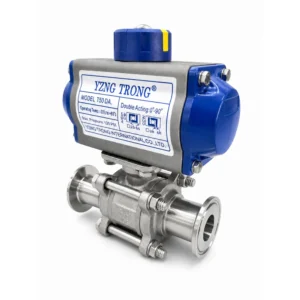
Sanitary diverter valve — a 3-way ball valve with a pneumatic actuator. 316 stainless, polished, Tri-Clamp ends, 1/2″ to 2″, 1000 WOG.
Two decisions you make when you order:
- L-Port (diverts to one outlet oder the other) vs T-Port (can feed two at once)
- Fully encapsulated seat (−20 °C to +80 °C, no dead space for product) vs semi-encapsulated (−20 °C to +180 °C)
Double acting or spring return, ISO 5211 mount, 4–8 bar air. Tell us what the valve has to do and we will tell you which to order.
For the hand-lever version, see the 3-Wege-Kugelhahn für Sanitäranlagen.
ISO 9001 · CE · Manufacturer since 1999 · Made in Taiwan
Produktbeschreibung
A sanitary diverter valve built as a 3-way ball valve in polished 316 stainless steel, driven by a rack-and-pinion pneumatic actuator (double acting or spring return). Tri-Clamp ends let you break the line without tools, and the ball is available with an L-Port to divert flow between two destinations, or a T-Port to mix two streams into one.
The part that matters in hygienic service is what happens behind the ball — see below.
The Cavity Problem — and What a Fully Encapsulated Seat Does About It
In a standard ball valve there is a small gap between the ball and the body. When the valve closes, product sits in that gap. On a water line nobody cares. On a line carrying food, beverage or process chemicals, that trapped product is where the last batch contaminates the next one, and where a sugar syrup crystallises solid.
A fully encapsulated seat fills that space with PTFE. The ball touches nothing but the seat — there is no cavity, so there is nothing to trap product. This is what the industry means by a non-retention ball valve.
It is not free, though: filling the cavity with PTFE lowers the temperature ceiling. Choose with your process temperature in front of you.
| Seat design | What happens behind the ball | Temperaturbereich | Choose it for |
|---|---|---|---|
| Partial (standard) | A small cavity remains behind the ball. Media can sit in it when the valve is closed. | −20 °C bis +180 °C | Water, air, and media where a trace of residue is not a problem. |
| Fully encapsulated | PTFE fills the space around the ball. No cavity, nothing to trap product. | −20 °C to +80 °C | Food, beverage, process chemicals, and viscous or crystallising media that must not stay behind in the valve. |
← Wischen Sie über die Tabelle, um alle Spalten anzuzeigen →
The judgement is not “food versus water” — it is whether your medium can be left sitting in a cavity, and how hot your line runs. A crystallising chemical needs a full seat as much as a sugar syrup does. A hot wash cycle above 80 °C rules a full seat out. Tell us the medium and the temperature when you request a quote and we will confirm which seat you need.
Ventilspezifikationen
| Artikel | Spezifikation |
|---|---|
| Material der Karosserie | ASTM 316 stainless steel, polished sanitary finish (304 to order) |
| Portkonfiguration | 3-Wege, L-Anschluss (Verzweigung) oder T-Anschluss (Mischung/Verzweigung) |
| Endanschluss | Tri-Clamp (quick clamp) sanitary ends |
| Druckstufe | 1000 WOG |
| Größenauswahl | 1/2″ – 2″ |
| Sitzmaterial | PTFE — partial or fully encapsulated (see the seat table above) |
| Temperaturbereich | −20 °C to +180 °C with a partial seat; −20 °C to +80 °C with a fully encapsulated seat |
| Cleaning | Clean-out-of-place (COP) — the body bolts open so the ball and seats can be removed and cleaned |
| Befestigung des Stellantriebs | ISO 5211 |
Technische Daten des Stellantriebs
| Artikel | Spezifikation |
|---|---|
| Typ | Zahnstangenlenkung, Gehäuse aus Aluminiumlegierung |
| Aktion | Doppeltwirkend (DA) oder mit Federrückstellung (SR) |
| Federrückstellposition | Returns to the port you nominate when the air supply is lost — specify when ordering |
| Betriebstemperatur | −20 °C to +80 °C |
| Rotation | 90° |
| Luftzufuhr | 4 – 8 bar (ca. 60 – 116 psi) |
| Steuerung | Ein/Aus (Standard); modulierend mit Stellungsregler (optional) |
| Optionen | Magnetventil, Endschalterkasten, Stellungsregler |
Cleaning: This Valve Comes Apart
The body bolts open. Undo the clamps, take the ball and the seats out, clean them, put it back — clean-out-of-place (COP). You can see the parts you cleaned, which is more than can be said for a valve you can only flush from the outside.
Every product-contact surface — ball, seats, body bore — can be reached by hand, cleaned and inspected before the valve goes back on the line. Spare seats are stocked, so a seat that has done its hours gets replaced rather than nursed.
L-Port or T-Port: Two Ways to Build a Sanitary Diverter Valve
- L-Anschluss (Umlenker): the bore is bent 90°, connecting the inlet to one of two outlets at a time. Use it to switch a line between two tanks, two fillers or two filter banks.
- T-Port (Mischen / Verteilen): the bore is T-shaped, so it can join two ports together or feed either outlet. Use it to blend two streams into one.
Related: the same 3-way body in a threaded (non-sanitary) version is our pneumatisches 3-Wege-Kugelventil; the hand-operated sanitary version is the 3-Wege-Kugelhahn für Sanitäranlagen. For a two-way sanitary valve, see the Hygienisches pneumatisches Kugelventil.
Anwendungen
- Batch changeover: switching a filler between two product tanks without cross-contaminating the next batch.
- Blending: combining two ingredient streams into one line with a T-port.
- Viscous and crystallising media: syrups, sauces and concentrates that would set solid in a standard valve cavity.
- Semiconductor chemical and slurry loops: holding a polishing slurry in a recirculation loop and switching it to the tool only when it is called for — solids drop out the moment a line stands still.
- Paint, ink and pigment colour change: keeping pigment moving in a ring main, then diverting to the dispense head; low dead space is what stops the last colour turning up in the next one.
- Remote switching on a PLC signal: the flow path changes from the panel, so nobody has to walk out to the line to turn a handle.
Häufig gestellte Fragen
What is a non-retention (fully encapsulated) ball valve?
It is a ball valve in which PTFE fills the space around the ball, so there is no cavity behind it for product to sit in. Nothing is trapped when the valve closes — no residue, no crystallised syrup, nothing left for the next batch to pick up. The trade-off is temperature: our fully encapsulated seat is rated −20 °C to +80 °C, against −20 °C to +180 °C for the standard partial seat.
Should I choose a partial seat or a fully encapsulated seat?
Ask two questions. First: can my medium be left sitting in a small cavity when the valve is closed? If it crystallises, sets solid, separates, or would contaminate the next batch, you need a fully encapsulated seat. Second: how hot does the line run? Above 80 °C the fully encapsulated seat is out, and you take the partial seat. Tell us the medium and the temperature and we will confirm.
How do I clean it?
You take it off the line and open it. Undo the clamps, lift the ball and the seats out, clean them, put it back — clean-out-of-place (COP). Every surface the product touched is in your hand while you do it, so you can see the result instead of assuming it.
What is the difference between an L-port and a T-port?
An L-port bore is bent 90° and connects the inlet to one of two outlets at a time — it diverts. A T-port bore is T-shaped and can join two ports together — it can mix as well as divert. Choose L-port for switching, T-port for blending.
What sizes and end connections are available?
1/2″ to 2″, with Tri-Clamp (quick clamp) sanitary ends. The body is polished 316 stainless steel.
What happens if the air supply fails?
It depends which actuator you order. A spring return (SR) unit drives the valve back to the port you nominated when you ordered it — tell us which flow path the line must fall back to and we build it that way. A double acting (DA) unit stays where it was when the air stopped.
What certifications do you hold?
ISO 9001 and CE, and we have been manufacturing stainless steel valves in Taiwan since 1999.
The valve itself: a polished 316 stainless body, PTFE seats (partial or fully encapsulated), no threads anywhere in the wetted path, and a body that bolts open so every product-contact surface can be reached, cleaned and inspected.
Musterpolitik
Wir stellen unseren Kunden gerne Produktmuster zur Verfügung, um die Qualität zu bewerten oder Tests durchzuführen. Der Prozess beginnt in der Regel mit einem Angebot auf der Grundlage der Spezifikationen des Kunden.
Wenn der Preis akzeptabel ist, können wir je nach Produkttyp und Verfügbarkeit kostenlose oder kostenpflichtige Muster anbieten.
Die Versandgebühren gehen zu Lasten des Kunden.
Bestellvorgang
Nachdem wir die Produktanforderungen und andere Details mit dem Kunden abgestimmt haben, stellen wir eine Verkaufsbestätigung zur Genehmigung aus. Nach der Bestätigung muss der Kunde eine 30%-Anzahlung leisten, um mit der Produktion fortzufahren.
Wenn die Massenproduktion abgeschlossen ist und die Waren die Inspektion bestehen, muss der Kunde den Restbetrag 70% bezahlen, bevor der Versand veranlasst wird.
Verwandte Produkte
-
 Hygienekugelhähne (Tri-Clamp)
Sanitary Butterfly Valve — Pneumatic Wafer Body, 304 Stainless, Tri-Clamp
-
 Hygienekugelhähne (Tri-Clamp)
Sanitary 3 Way Ball Valve — Manual, L-Port or T-Port, Tri-Clamp, 316 (MV-3N)
-
 Hygienekugelhähne (Tri-Clamp)
Tri Clamp Ball Valve – Manual 3-Piece Sanitary, 316, Full Port, Tri-Clamp or OD-Tube Butt Weld (V-3N / V-3N-L3)
Häufig gestellte Fragen
A. Wie kann ich ein Angebot anfordern?
Bitte fügen Sie ein detailliertes Anfrageformular mit Produktspezifikationen, Materialien, Mengen und besonderen Anforderungen bei. Wir werden Ihnen ein Angebot auf der Grundlage Ihrer Anfrage unterbreiten.
B. Wie lauten Ihre Angebotsbedingungen?
Unsere Kostenvoranschläge basieren in der Regel auf FOB-Bedingungen. Wir können aber auch anbieten CFR, CIFoder andere Incoterms auf Anfrage.
C. Wie hoch ist Ihre Mindestbestellmenge (MOQ)?
MOQ depends on the product. We operate on a made-to-order basis, and trial orders are welcome. For smaller orders, freight is arranged and borne by the buyer.
D. Wie lauten Ihre Zahlungsbedingungen?
per Überweisung - 30% Anzahlung bei Auftragsbestätigung, und 70% Restbetrag vor Versand.
E. Wie lange ist Ihre Vorlaufzeit?
Die Lieferzeit hängt von der Bestellmenge und den Spezifikationen ab. Wir werden Ihnen den genauen Zeitplan bestätigen, sobald Sie Ein Angebot anfordern.
Möchten Sie mehr erfahren?
Wenn Sie sich für eines unserer Produkte oder eine unserer Dienstleistungen interessieren, füllen Sie einfach das unten stehende Formular aus. Unser Team wird sich so schnell wie möglich mit Ihnen in Verbindung setzen und Ihnen die gewünschten Informationen zukommen lassen.