
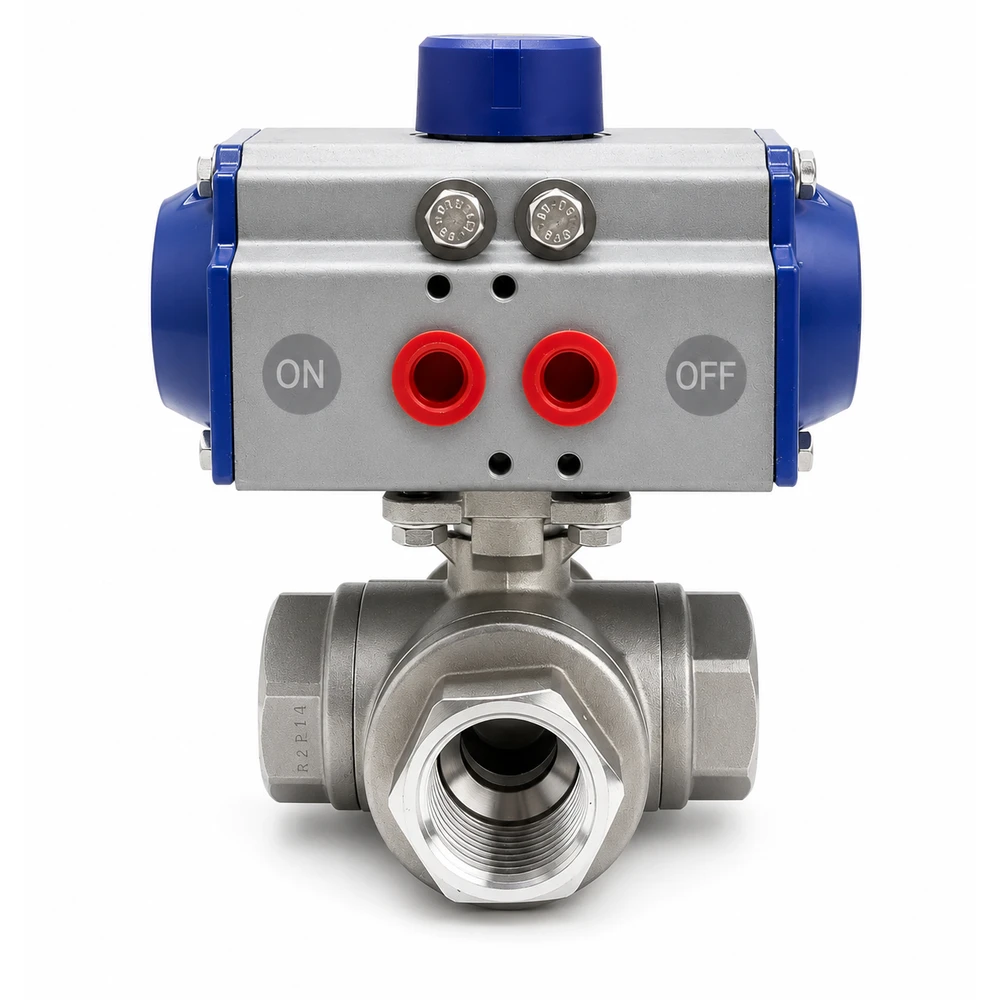
Produktname
3-Way Pneumatic Ball Valve — 316 CF8M, L-Port or T-Port, 1000 WOG, 1/4″–2″ (MV-3DM)
Produktübersicht
Ein pneumatisches 3-Wege-Kugelventil aus Edelstahl 316 (CF8M), ausgelegt für 1000 WOG, mit L- oder T-Anschluss zur Strömungsumleitung oder -mischung. Nennweiten 1/4″–2″, PTFE-Sitze, PT-/NPT-/PF-Gewindeanschlüsse. Zahnstangen-Luftantrieb, doppeltwirkend oder mit Federrückstellung, direkt auf einer hohen ISO 5211-Montageplatte montiert – ohne Halterung, ohne Kupplung.
ISO 9001 · CE · Manufacturer since 1999 · Made in Taiwan
Produktbeschreibung
Dieses pneumatisch betätigte 3-Wege-Kugelventil automatisiert die Umleitung oder das Mischen von Flüssigkeiten. Das aus Edelstahl 316 gefertigte 3-Wege-Gehäuse ist mit einem Zahnstangen-Luftantrieb (doppeltwirkend oder mit Federrückstellung) kombiniert, der die Kugel auf ein Signal Ihrer SPS oder eines Fernschalters hin um 90° dreht. Das Gehäuse verfügt über ein ISO 5211-Unterlegscheibe mit hoher Plattform, sodass der Stellantrieb direkt am Ventil verschraubt wird – ohne Halterung, ohne Kupplung und ohne Ausrichtungsarbeiten.
Dank der PT-, NPT- oder PF-Gewindeanschlüsse und eines Gehäuses mit einer Nennfestigkeit von 1000 WOG lässt sich dieses Produkt nahtlos in industrielle Rohrleitungssysteme integrieren und sorgt so für eine einfache Automatisierungsaufrüstung. Für hygienische Leitungen siehe unser Hygienisches pneumatisches 3-Wege-Kugelventil. Wenn Sie das Ventil von Hand betätigen, lesen Sie bitte die manuelles 3-Wege-Kugelventil.
L-Port oder T-Port – Welchen brauchen Sie?
Das ist die erste Entscheidung, die getroffen werden muss, und genau hier liegen Käufer am häufigsten falsch. Die beiden Anschlüsse sehen von außen identisch aus; der Unterschied liegt in der Form der Öffnung in der Kugel.
- L-Anschluss (Umlenker): Die Bohrung ist um 90° abgewinkelt und verbindet den Einlass mit eins von jeweils zwei Anschlüssen. Damit lässt sich der Durchfluss von einer gemeinsamen Leitung auf einen von zwei Zielorten umschalten – beispielsweise zum Wechseln zwischen zwei Lagertanks oder zwei Filterbänken.
- T-Port (Mischen / Verteilen): Die Bohrung ist T-förmig, sodass sie den Einlass mit einem der beiden Auslässe verbinden oder zwei Anschlüsse miteinander verbinden kann. Verwenden Sie sie, um zwei Ströme zu einem zu mischen oder um einen Strom umzuleiten, während ein Abzweig weiterhin aktiv bleibt.
Wenn Sie den Durchfluss nur in die eine oder andere Richtung leiten müssen, wählen Sie den L-Anschluss. Wenn Sie Ströme zusammenführen müssen, wählen Sie den T-Anschluss. Teilen Sie uns bei Ihrer Angebotsanfrage die gewünschten Strömungswege mit, und wir bestätigen Ihnen den Anschlusstyp.
Ventilspezifikationen
| Artikel | Spezifikation |
|---|---|
| Material der Karosserie | ASTM A351 CF8M (Edelstahl 316) |
| Portkonfiguration | 3-Wege, L-Anschluss (Verzweigung) oder T-Anschluss (Mischung/Verzweigung) |
| Größenauswahl | 1/4″ – 2″ |
| Druckstufe | 1000 WOG (Kaltarbeitsdruck ohne Stoßbelastung) |
| Sitzmaterial | PTFE |
| Temperaturbereich | −20 °C to 180 °C (−4 °F to 356 °F) |
| Endanschluss | Gewinde — PT (BSPT), NPT oder PF (G) |
| Befestigung des Stellantriebs | Doppeltes ISO 5211-Lager, Direktmontage (keine Halterung oder Kupplung erforderlich) |
Technische Daten des Stellantriebs
| Artikel | Spezifikation |
|---|---|
| Typ | Zahnstangenlenkung, Gehäuse aus Aluminiumlegierung |
| Aktion | Doppeltwirkend (DA) oder mit Federrückstellung (SR) |
| Rotation | 90° |
| Luftzufuhr | 4 – 8 bar (ca. 60 – 116 psi) |
| Steuerung | Ein/Aus (Standard); modulierend mit Stellungsregler (optional) |
| Optionen | Magnetventil, Endschalterkasten, Stellungsregler |
Welchen Stellantrieb benötigen Sie? — Auswahltabelle
Die Größe des Stellantriebs hängt von der Ventilgröße ab und davon, ob Sie sich für eine doppeltwirkende Ausführung oder eine Ausführung mit Federrückstellung entscheiden. Einheiten mit Federrückstellung sind immer eine Nummer größer als doppeltwirkend, da ein Teil des Luftdrucks zum Zusammendrücken der Feder verwendet wird.
| Ventilgröße | Doppeltwirkend (DA) | Federrückstellung (SR) |
|---|---|---|
| 1/4″ – 3/4″ | T50 | T63 |
| 1″ – 1-1/4″ | T63 | T75 |
| 1-1/2″ | T75 | T88 |
| 2″ | T88 | T100 |
Die Drehmomentwerte für jedes Antriebsmodell und jeden Luftdruck sind auf Anfrage erhältlich – teilen Sie uns Ihren Leitungsdruck und das Medium mit, und wir bestätigen Ihnen die richtige Kombination.
Vorteile & Nutzen
- Ein Ventil ersetzt drei: Ein einziges 3-Wege-Ventil übernimmt die Funktion von zwei oder drei 2-Wege-Ventilen sowie der dazwischenliegenden Anschlüsse – weniger Verbindungsstellen, weniger Leckstellen, weniger Platzbedarf im Skid.
- Direkte Montage, ohne Halterung: Die ISO 5211-Aufnahme mit hoher Plattform nimmt den Antrieb direkt auf. Es muss nichts bearbeitet und nichts ausgerichtet werden.
- Federrückstellung bei Luftverlust: SR-Einheiten kehren automatisch in ihre voreingestellte Position zurück, wenn die Luftzufuhr ausfällt. Teilen Sie uns mit, welche Position Sie benötigen, und wir fertigen das Gerät entsprechend an.
- Durchgehend aus Edelstahl 316: the molybdenum in 316 resists pitting from chloride-bearing media — the usual reason 304 fails in coastal or brine service.
Anwendungen
- Dosierung von Chemikalien: automatischer Wechsel zwischen den Zutatenreihen.
- Temperaturregelung: das Umleiten von Flüssigkeit durch einen Wärmetauscher oder um diesen herum auf Basis eines Sensorsignals.
- Wasseraufbereitung: Wechsel zwischen den Filterbänken, ohne die Produktionslinie anzuhalten.
Häufig gestellte Fragen
Kann ich ein manuelles 3-Wege-Kugelventil nachträglich mit einem Stellantrieb ausstatten?
Ja. Das Gehäuse verfügt über eine hohe ISO 5211-Montagefläche, sodass dasselbe Ventil heute mit einem Handhebel geliefert und später mit einem pneumatischen Antrieb ausgestattet werden kann – ohne Halterung, ohne Kupplung und ohne Neuverrohrung. Geben Sie uns den ISO-Flanschcode aus der obigen Tabelle (F03 bis F07) an, und wir wählen den passenden Antrieb aus.
Was ist der Unterschied zwischen einem 3-Wege-Kugelhahn mit L-Anschluss und einem mit T-Anschluss?
Eine L-Port-Bohrung ist um 90° abgewinkelt und verbindet den Einlass jeweils mit einem von zwei Auslässen – sie leitet ab. Eine T-Port-Bohrung ist T-förmig und kann den Einlass entweder mit einem der Auslässe verbinden oder zwei Anschlüsse miteinander verbinden – sie kann sowohl mischen als auch umleiten. Wählen Sie den L-Port zum Umschalten, den T-Port zum Mischen.
Welche Antriebsgröße benötige ich für mein Ventil?
Für doppeltwirkende Ausführungen: 1/4″–3/4″ verwenden T50, 1″–1-1/4″ verwenden T63, 1-1/2″ verwenden T75, 2″ verwenden T88. Bei Federrückstellung wählen Sie in jedem Fall eine Nummer größer. Die vollständige Auswahltabelle finden Sie oben.
Ist ein pneumatisches 3-Wege-Kugelventil dasselbe wie ein Magnetventil?
Nein. Ein Magnetventil wird direkt durch eine elektrische Spule betätigt und kommt normalerweise in kleinen, sauberen Leitungen zum Einsatz. Bei diesem Ventil handelt es sich um ein Kugelventil mit vollem Durchgang, das von einem Pneumatikantrieb betätigt wird – es ist für höhere Drücke, größere Nennweiten und verschmutztere Medien ausgelegt. Ein Magnetventil wird häufig verwendet mit es, als das Vorsteuerventil, das die Luftzufuhr zum Stellantrieb umschaltet.
Doppeltwirkend oder federrückstellend – wofür soll ich mich entscheiden?
Bei der doppeltwirkenden Ausführung wird zum Öffnen und Schließen Druckluft verwendet, und das Ventil behält seine letzte Position bei, wenn die Druckluft ausfällt. Bei der federrückstellenden Ausführung wird in eine Richtung Druckluft und in die andere Richtung eine Feder verwendet, sodass das Ventil bei Druckluftverlust in seine voreingestellte Position zurückkehrt. Wählen Sie die federrückstellende Ausführung, wenn die Leitung nicht in einem unbekannten Zustand verbleiben darf; wählen Sie die doppeltwirkende Ausführung, wenn das Ventil seine Position beibehalten soll.
Welche Garnarten gibt es?
Es sind PT- (BSPT), NPT- und PF (G)-Gewinde erhältlich. Bitte geben Sie bei Ihrer Angebotsanfrage an, welchen Standard Ihre Rohrleitungen verwenden.
Musterpolitik
Wir stellen unseren Kunden gerne Produktmuster zur Verfügung, um die Qualität zu bewerten oder Tests durchzuführen. Der Prozess beginnt in der Regel mit einem Angebot auf der Grundlage der Spezifikationen des Kunden.
Wenn der Preis akzeptabel ist, können wir je nach Produkttyp und Verfügbarkeit kostenlose oder kostenpflichtige Muster anbieten.
Die Versandgebühren gehen zu Lasten des Kunden.
Bestellvorgang
Nachdem wir die Produktanforderungen und andere Details mit dem Kunden abgestimmt haben, stellen wir eine Verkaufsbestätigung zur Genehmigung aus. Nach der Bestätigung muss der Kunde eine 30%-Anzahlung leisten, um mit der Produktion fortzufahren.
Wenn die Massenproduktion abgeschlossen ist und die Waren die Inspektion bestehen, muss der Kunde den Restbetrag 70% bezahlen, bevor der Versand veranlasst wird.
Verwandte Produkte
-
 Pneumatische Kugelhähne
Stainless Steel Pneumatic Ball Valve, 2-Piece 316, ISO 5211 Direct Mount (V-2AM)
Häufig gestellte Fragen
A. Wie kann ich ein Angebot anfordern?
Bitte fügen Sie ein detailliertes Anfrageformular mit Produktspezifikationen, Materialien, Mengen und besonderen Anforderungen bei. Wir werden Ihnen ein Angebot auf der Grundlage Ihrer Anfrage unterbreiten.
B. Wie lauten Ihre Angebotsbedingungen?
Unsere Kostenvoranschläge basieren in der Regel auf FOB-Bedingungen. Wir können aber auch anbieten CFR, CIFoder andere Incoterms auf Anfrage.
C. Wie hoch ist Ihre Mindestbestellmenge (MOQ)?
MOQ depends on the product. We operate on a made-to-order basis, and trial orders are welcome. For smaller orders, freight is arranged and borne by the buyer.
D. Wie lauten Ihre Zahlungsbedingungen?
per Überweisung - 30% Anzahlung bei Auftragsbestätigung, und 70% Restbetrag vor Versand.
E. Wie lange ist Ihre Vorlaufzeit?
Die Lieferzeit hängt von der Bestellmenge und den Spezifikationen ab. Wir werden Ihnen den genauen Zeitplan bestätigen, sobald Sie Ein Angebot anfordern.
Möchten Sie mehr erfahren?
Wenn Sie sich für eines unserer Produkte oder eine unserer Dienstleistungen interessieren, füllen Sie einfach das unten stehende Formular aus. Unser Team wird sich so schnell wie möglich mit Ihnen in Verbindung setzen und Ihnen die gewünschten Informationen zukommen lassen.