
Product Name
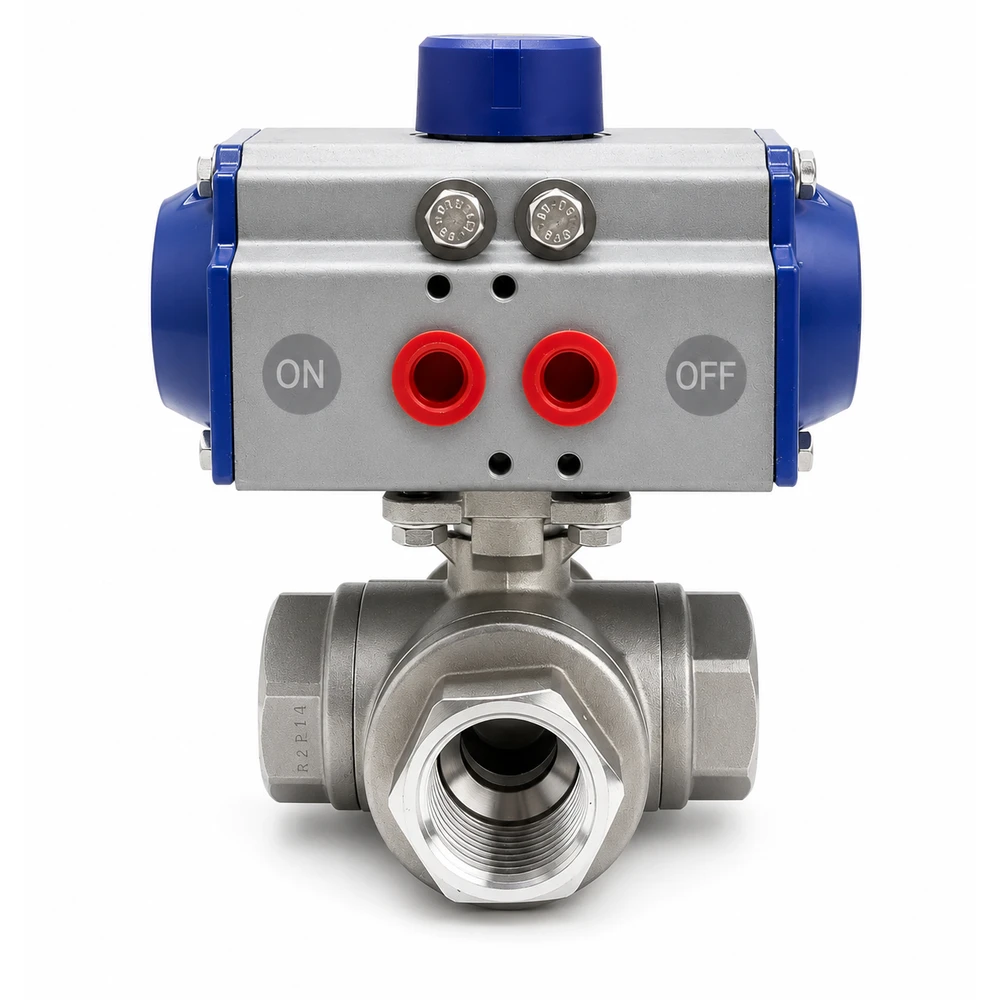
3-Way Pneumatic Ball Valve — 316 CF8M, L-Port or T-Port, 1000 WOG, 1/4″–2″ (MV-3DM)
Product Summary
A 3-way pneumatic ball valve in 316 stainless steel (CF8M), rated 1000 WOG, with an L-port or T-port ball for diverting or mixing flow. Sizes 1/4″–2″, PTFE seats, PT / NPT / PF threaded ends. Rack-and-pinion air actuator, double acting or spring return, direct-mounted on a high-platform ISO 5211 pad — no bracket, no coupling.
ISO 9001 · CE · Manufacturer since 1999 · Made in Taiwan
Product Description
This pneumatically actuated 3-way ball valve automates the diversion or mixing of fluids. The 316 stainless steel three-way body is paired with a rack-and-pinion air actuator (double acting or spring return) that rotates the ball 90° on a signal from your PLC or remote switch. The body uses a high-platform ISO 5211 pad, so the actuator bolts straight onto the valve — no bracket, no coupling, no alignment work.
Threaded PT, NPT or PF ends and a 1000 WOG rated body make this a drop-in automation upgrade for industrial piping. For hygienic lines, see our sanitary pneumatic 3-way ball valve. If you operate the valve by hand, see the manual 3-way ball valve.
L-Port or T-Port — Which One Do You Need?
This is the first decision to make, and it is the one buyers most often get wrong. The two ports look identical from the outside; the difference is the shape of the hole through the ball.
- L-Port (Diverter): the bore is bent 90°, connecting the inlet to one of two outlets at a time. Use it to switch flow from a common line to either of two destinations — for example, alternating between two storage tanks or two filter banks.
- T-Port (Mixing / Diverting): the bore is T-shaped, so it can connect the inlet to either outlet, or join two ports together. Use it to mix two streams into one, or to divert while keeping a branch live.
If you only need to send flow one way or the other, choose L-port. If you need to combine streams, choose T-port. Tell us the flow paths you need when you request a quote and we will confirm the port type.
Valve Specifications
| Item | Specification |
|---|---|
| Body material | ASTM A351 CF8M (316 stainless steel) |
| Port configuration | 3-way, L-port (diverting) or T-port (mixing / diverting) |
| Size range | 1/4″ – 2″ |
| Pressure rating | 1000 WOG (non-shock cold working pressure) |
| Seat material | PTFE |
| Temperature range | −20 °C to 180 °C (−4 °F to 356 °F) |
| End connection | Threaded — PT (BSPT), NPT or PF (G) |
| Actuator mounting | Dual ISO 5211 pad, direct mount (no bracket or coupling needed) |
Actuator Specifications
| Item | Specification |
|---|---|
| Type | Rack-and-pinion, aluminium alloy body |
| Action | Double Acting (DA) or Spring Return (SR) |
| Rotation | 90° |
| Air supply | 4 – 8 bar (approx. 60 – 116 psi) |
| Control | On/Off (standard); modulating with positioner (optional) |
| Options | Solenoid valve, limit switch box, positioner |
Which Actuator Do You Need? — Selection Table
The actuator size depends on the valve size and on whether you choose double acting or spring return. Spring return units are always one size larger than double acting, because part of the air pressure is used to compress the spring.
| Valve size | Double Acting (DA) | Spring Return (SR) |
|---|---|---|
| 1/4″ – 3/4″ | T50 | T63 |
| 1″ – 1-1/4″ | T63 | T75 |
| 1-1/2″ | T75 | T88 |
| 2″ | T88 | T100 |
Torque ratings for every actuator model and air pressure are available on request — tell us your line pressure and media and we will confirm the correct combination.
Advantages & Benefits
- One valve replaces three: a single 3-way body does the work of two or three 2-way valves plus the fittings between them — fewer joints, fewer leak points, less space in the skid.
- Direct mount, no bracket: the high-platform ISO 5211 pad takes the actuator directly. Nothing to machine, nothing to align.
- Spring return on air loss: SR units return to their preset position automatically when the air supply is lost. Tell us which position you need and we will build it that way.
- 316 stainless throughout: the molybdenum in 316 resists pitting from chloride-bearing media — the usual reason 304 fails in coastal or brine service.
Applications
- Chemical batching: switching automatically between ingredient lines.
- Temperature control: diverting fluid through a heat exchanger or around it, on a sensor signal.
- Water treatment: alternating between filtration banks without stopping the line.
FAQ
Can I add an actuator to a manual 3-way ball valve later?
Yes. The body has a high-platform ISO 5211 mounting pad, so the same valve can be supplied with a lever today and fitted with a pneumatic actuator later — no bracket, no coupling, no re-piping. Give us the ISO flange code from the table above (F03 to F07) and we will match the actuator.
What is the difference between an L-port and a T-port 3-way ball valve?
An L-port bore is bent 90° and connects the inlet to one of two outlets at a time — it diverts. A T-port bore is T-shaped and can connect the inlet to either outlet or join two ports together — it can mix as well as divert. Choose L-port for switching, T-port for mixing.
Which actuator size do I need for my valve?
For double acting: 1/4″–3/4″ uses T50, 1″–1-1/4″ uses T63, 1-1/2″ uses T75, 2″ uses T88. For spring return, go one size larger in each case. The full selection table is above.
Is a 3-way pneumatic ball valve the same as a solenoid valve?
No. A solenoid valve is operated directly by an electrical coil and is normally used on small, clean lines. This valve is a full-bore ball valve turned by an air actuator — it handles higher pressure, larger sizes and dirtier media. A solenoid valve is often used with it, as the pilot that switches the air supply to the actuator.
Double acting or spring return — which should I choose?
Double acting uses air to open and air to close, and holds its last position if air is lost. Spring return uses air one way and a spring the other, so it returns to its preset position when air is lost. Choose spring return when the line must not be left in an unknown state; choose double acting when you want the valve to hold position.
What thread types are available?
PT (BSPT), NPT and PF (G) threads are available. Tell us which standard your piping uses when you request a quote.
Sample Policy
We are happy to provide product samples for customers to evaluate quality or conduct testing. The process typically begins with a quotation based on the customer’s specifications.
If the pricing is acceptable, we can offer samples either free of charge or at a cost depending on the product type and availability.
Shipping fees are borne by the customer.
Order Process
After confirming the product requirements and other details with the customer, we will issue a Sales Confirmation for approval. Once confirmed, the customer is required to pay a 30% deposit to proceed with production.
When mass production is completed and the goods pass inspection, the customer must pay the remaining 70% balance before shipment is arranged.
Related Products
-
 Pneumatic Ball Valves
Stainless Steel Pneumatic Ball Valve, 2-Piece 316, ISO 5211 Direct Mount (V-2AM)
FAQ
A. How can I request a quote?
Please provide a detailed inquiry sheet including product specifications, materials, quantities, and any special requirements. We will offer a quotation based on your request.
B. What are your quotation terms?
Our quotations are typically based on FOB terms. However, we can also offer CFR, CIF, or other Incoterms upon request.
C. What is your Minimum Order Quantity (MOQ)?
MOQ depends on the product. We operate on a made-to-order basis, and trial orders are welcome. For smaller orders, freight is arranged and borne by the buyer.
D. What are your payment terms?
By T/T – 30% down payment upon order confirmation, and 70% balance before shipment.
E. What is your lead time?
Lead time depends on order quantity and specifications. We will confirm the exact schedule when you request a quote.
Want to know more?
If you’re interested in any of our products or services, simply fill out the form below. Our team will get in touch with you as soon as possible to provide the information you need.