
Last updated: 2026-06-19 · By the Yzng Trong International sales and engineering team — a
Taiwan-based manufacturer of stainless steel ball valves and pipe fittings, exporting to water
treatment, marine and OEM customers worldwide.
Key Takeaways
- 316 stainless fittings are made from grade 316 steel, which adds 2–3% molybdenum to the 304
recipe for far better corrosion resistance. - The molybdenum mainly buys protection against chlorides — seawater, pool chemicals, de-icing
salt and many acids. - Expect to pay roughly 20–40% more than 304 for the same part; the gap tracks the nickel and
molybdenum price. - For dry indoor air, clean water or general structural use, 304 is usually enough. For coastal,
chemical or marine duty, choose 316. - Always ask for a material test certificate (MTC) and check the thread standard before you
commit to an order.
A 316 stainless fitting is a threaded or welded pipe connector made from grade 316 austenitic
stainless steel — an alloy that takes the familiar 304 chemistry and adds 2–3% molybdenum to resist
chloride attack. That single change is the whole reason buyers pay more for it. If your line carries
salt water, brine, pool chemistry or aggressive process fluids, 304 will eventually pit and 316
will not. In this guide we walk through what 316 stainless fittings actually are, how grade 316
differs from 304, when the upgrade is worth it, what they cost, and how to make sure the part you
receive is genuinely 316 and not a relabelled 304.
What are 316 stainless fittings?
316 stainless fittings are pipe-connection components — couplings, elbows, tees, unions, nipples
and caps — machined or forged from grade 316 stainless steel. They do the same job as any fitting
(join, branch, turn or terminate a pipe run) but in an alloy chosen specifically for harsh, wet or
chemically loaded environments.
The 316 alloy in plain terms
Grade 316 is an austenitic stainless steel containing roughly 16–18% chromium, 10–14% nickel and
2–3% molybdenum, per the chemistry ranges published by the British Stainless Steel Association. The chromium forms the
passive oxide layer that makes any stainless steel “stainless”; the nickel keeps the structure
stable and formable; the molybdenum is the upgrade that 304 simply does not have. For fittings, that
translates into a part that keeps a clean, passive surface even when the water around it is salty
or acidic.
Common types of 316 stainless fittings
Most catalogues, including ours, cover the same core family: straight couplings, 90° and 45°
elbows, equal and reducing tees, hex nipples, unions and
pipe caps. The shape you need is dictated by the pipe layout; the grade you need is dictated by the
fluid and the environment. Mixing a 316 valve with 304 fittings on the same chloride-exposed line
is a common and avoidable mistake — the weakest grade on the line sets the corrosion life of the
whole assembly.
Which standards apply to 316 fittings?
Forged and threaded 316 fittings are typically produced to recognised dimensional and material
standards such as ASTM A182 (forged fittings) and ASTM A403 (wrought fittings), with the base
material chemistry defined under ASTM A240/A276. You can confirm the current scope of these on the
ASTM International website. Asking which standard a supplier
builds to is a fast way to separate engineered product from anonymous stock.
How is grade 316 different from grade 304?
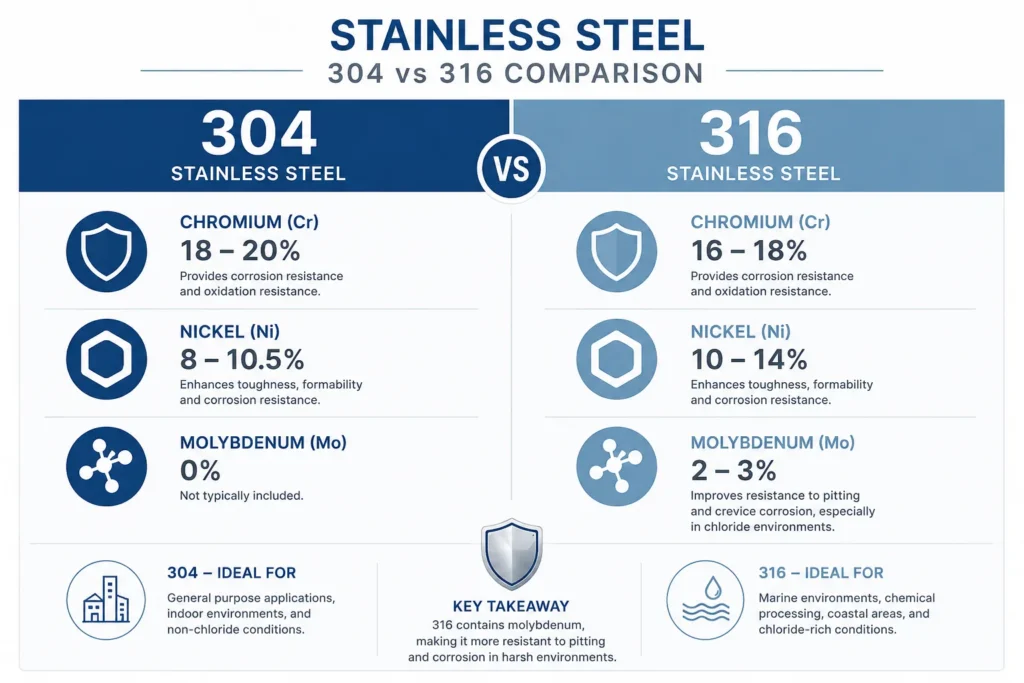
The short answer: 316 contains molybdenum and 304 does not, and that one difference governs how
each grade survives chlorides. Everything else — appearance, machinability, weldability, magnetic
behaviour — is broadly similar. Below is the comparison that actually matters when you are choosing
316 stainless fittings over 304.
| Property | Grade 304 | Grade 316 |
|---|---|---|
| Chromium | 18–20% | 16–18% |
| Nickel | 8–10.5% | 10–14% |
| Molybdenum | None | 2–3% |
| PREN (pitting resistance) | ~18–20 | ~24–26 |
| Chloride / salt resistance | Moderate | High |
| Relative cost | Baseline | ~20–40% higher |
Why molybdenum changes everything
Molybdenum is the reason a 316 fitting outlasts a 304 fitting in salt. According to the International Molybdenum Association, adding molybdenum to
austenitic stainless steel markedly raises its resistance to pitting and crevice corrosion in
chloride-bearing environments. Pitting is the failure mode that catches buyers out: the part looks
fine, then a pinhole leak appears at a threaded crevice months later. The Nickel Institute describes the same mechanism — the
passive film on 316 simply re-heals better where chlorides try to break through.
Reading the PREN number
If you want one figure to compare grades, use the Pitting Resistance Equivalent Number (PREN),
calculated as %Cr + 3.3 × %Mo + 16 × %N. On that scale 304 lands around 18–20 and 316 around 24–26.
A higher PREN means the steel tolerates more chloride before it starts to pit. It is not a guarantee
of service life, but it is the cleanest single-number way to explain to a non-metallurgist why 316
stainless fittings command a premium.
When should I choose 316 over 304?
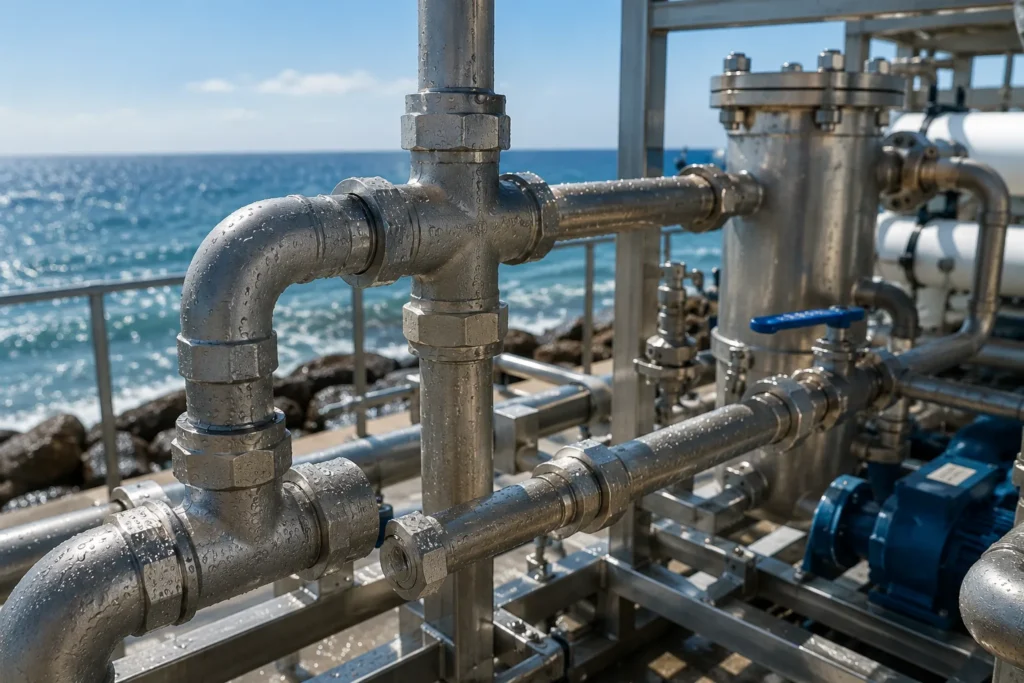
Choose 316 whenever chlorides, salt, acids or aggressive cleaning chemicals are in play; stay
with 304 when the environment is dry, clean or only mildly wet. Paying for 316 in a dry indoor air
line is wasted money, and specifying 304 on a coastal line is a leak waiting to happen. The deciding
factor is almost never the pressure — it is the chemistry around the fitting.
Marine and coastal environments
Salt spray is the classic case for 316. Anything within roughly a kilometre of the coast, on a
boat, or exposed to de-icing salt should be 316. The chloride load in marine air is high enough that
304 fittings will show tea-staining and pitting within a season, while 316 holds its surface for
years.
Chemical, water-treatment and pool systems
Chlorinated water, dosing skids and pool plant all carry the exact chemistry that 316 was
developed for. This is the segment where we see the most failed 304 parts returned. If your line
touches sodium hypochlorite, brine or process acids, 316 stainless fittings are the baseline, not
the upgrade.
Food, dairy and pharmaceutical lines
Hygienic processing favours 316 because the surface stays passive under repeated chloride-based
cleaning (CIP) and because it resists the organic acids in food. For sanitary layouts you would
normally pair 316 fittings with clamp-type connections rather than threads; for general process
piping, threaded or welded 316 is standard.
How much do 316 stainless fittings cost?
As a rough rule, expect a 316 fitting to cost 20–40% more than the identical part in 304. The
premium is not a margin game — it tracks the raw-material cost of the extra nickel and the
molybdenum, both of which trade at a premium to iron and chromium. When nickel and molybdenum prices
move, the 304-to-316 gap moves with them, which is why a quote you took six months ago may not hold
today.
Two things help control the cost. First, only specify 316 where the environment demands it — many
real systems are a sensible mix of 304 and 316. Second, buy the fitting family from one source so
threads, tolerances and material certificates are consistent; chasing the cheapest line-item across
several suppliers usually costs more once you add the failures and the mismatched threads.
What thread and connection types come on 316 fittings?
Most threaded 316 fittings use a tapered thread, because a taper seals on the thread flanks and
handles pressure better than a parallel thread. Our stainless steel fitting range is cut to PT
(tapered) thread; the main alternatives you will meet on the market are NPT (US tapered) and BSPT.
The important point for a buyer is consistency: a PT male will not seal reliably into a parallel
female, so confirm the thread standard on both sides before you order.
Threaded versus welded fittings
Threaded 316 fittings are quick to install and easy to service, which suits smaller bores and
maintenance-heavy lines. Welded (butt-weld or socket-weld) fittings give a crevice-free,
full-strength joint that suits larger bores and permanent runs. Both are available in 316; the
choice is about access and serviceability, not corrosion grade.
Matching fittings to your valves
If your system already runs stainless ball valves, keep the fittings in the same grade and thread
family so the whole assembly ages at the same rate. You can see how we keep grade and thread
consistent across our manual
ball valve and fittings ranges, which removes the mismatch risk on mixed orders.
How do I verify I’m actually getting 316?
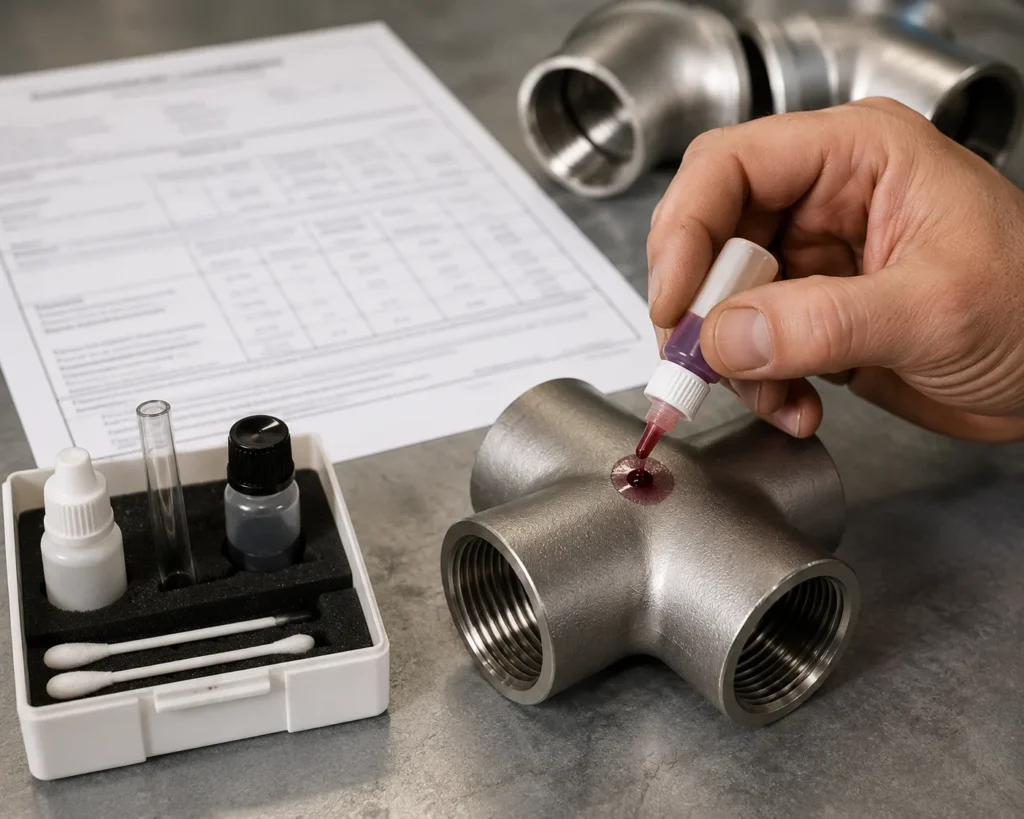
Ask for a material test certificate (MTC) and, if the stake is high, do a quick on-site check.
Because 304 and 316 look identical, relabelling is a real risk in commodity supply chains. The MTC
ties the specific batch to its measured chemistry, so you can confirm the molybdenum content is
actually there.
For a fast field test, a molybdenum spot-test kit will distinguish 316 from 304 in seconds, and a
handheld XRF analyser gives a full chemistry read if you have one. Reputable suppliers will not
flinch at either request. We supply our fittings with documented material traceability and hold ISO
9001 and CE, which is the documentation level a serious buyer should expect — guidance on corrosion
testing and material verification is also published by bodies such as AMPP (the former NACE).
Frequently asked questions about 316 stainless fittings
Are 316 stainless fittings magnetic?
In their annealed state, 316 stainless fittings are essentially non-magnetic, like 304. Cold
working — heavy threading or forming — can induce slight magnetism, so a weak magnetic pull does not
by itself prove a part is not 316. Use a material certificate or a molybdenum spot test rather than
a magnet to confirm grade.
Is 316 always worth the extra cost over 304?
No. 316 is worth the 20–40% premium only where chlorides, salt, acids or harsh cleaning chemicals
are present. For dry indoor air, clean potable water or general structural use, 304 performs just
as well at lower cost. Match the grade to the environment, not to a blanket “use the best” rule.
Can I mix 316 fittings with 304 pipe?
You can, but the corrosion life of the assembly is set by the weakest grade on the wetted path.
If the environment is aggressive enough to need 316 fittings, the pipe and valves on the same line
usually need to be 316 as well. Mixing grades is fine in mild conditions and risky in chloride-rich
ones.
What thread do your 316 stainless fittings use?
Our stainless steel fittings are cut to PT tapered thread. A taper seals on the thread flanks and
copes with pressure better than a parallel thread. If your existing system uses NPT or BSPT, tell
us before ordering so we can confirm compatibility on both the male and female sides.
How do I prove a fitting is genuine 316?
The reliable proof is a material test certificate (MTC) showing the measured chemistry, including
2–3% molybdenum. For on-the-spot checks, a molybdenum spot-test kit or a handheld XRF analyser will
separate 316 from 304 quickly. A supplier who cannot provide an MTC is a supplier to question.
Conclusion: getting 316 stainless fittings right
316 stainless fittings earn their premium in one specific situation: when chlorides, salt or
aggressive chemistry would eat a 304 part alive. The 2–3% molybdenum lifts the PREN from the high
teens to the mid-twenties, and that is what keeps a coastal, marine or chemical line leak-free for
years instead of months. Spend the money where the environment demands it, stay with 304 where it
does not, and always tie the order to a material certificate so you know the molybdenum is really
there. If you are speccing a system now, the simplest way to avoid mismatched grades and threads is
to source the whole fitting family from one manufacturer. Browse our full range of stainless steel pipe fittings to
match couplings, elbows, tees and unions in consistent 316 with PT thread, or talk to our team about
a mixed 304/316 package built around your actual line chemistry.