Stop Patching It: Ball Valve Leaking and the One Design Choice That Ends It

I have spent more years than I care to admit standing over a dripping valve with a flashlight in
one hand and a wrench in the other, so let me say the quiet part out loud: a ball valve leaking is
almost never a mystery. It feels like one at 2 a.m. when a pump skid is weeping onto the floor, but
in my experience the leak is usually telling you a very specific story. The trick is learning to
read it. Once you know whether the drip is coming from the seat, the stem, or the body joint, you
have already narrowed the cause from “everything” to “one of three things,” and that is most of the
battle.

This guide is written from the manufacturing side of the fence. I help design and build stainless
steel ball valves, so I see the failures that come back, the warranty photographs, the angry
emails, and occasionally the very satisfying ones where a customer realised the valve was fine and
the gasket downstream was the culprit. I am going to walk you through where these valves leak, why
they leak, how I diagnose a leak before I touch a tool, and how the design choices you make at
purchase time quietly decide whether you will ever be reading an article like this again. I will be
honest about the limits of any single product, including ours, and I will point you toward
alternatives when they fit better. That is the only kind of advice worth reading.

A quick note on who I am writing for, so you can calibrate everything that follows. We are a
stainless valve manufacturer that grew out of a precision machining shop, which means I look at
leaks through the lens of tolerances, materials, and sealing geometry rather than plumbing tape and
luck. I am not going to tell you to wrap more thread tape and hope. I am going to tell you what
physically failed and why, because that is the only knowledge that transfers from one leak to the
next. If you take the reasoning with you, you will diagnose your second leak in a fraction of the
time it took to read about your first.

Key Takeaways

  • A leaking ball valve fails in exactly one of three places: the seat (an internal pass when

    closed), the stem (an external weep at the shaft), or the body seam (an external weep at the

    joint).
  • Stem leaks are usually repairable in place; seat leaks may need the seats cleaned or replaced;

    body and seam leaks almost always mean replacing the valve.
  • Most “brand-new valve” leaks are installation errors, not defects: over-torqued stem packing,

    pipe strain, or incorrect thread sealing.
  • In chloride-bearing or marine service, specify 316 stainless over 304 to head off

    corrosion-driven leaks before they start.
  • The most durable prevention is a welded body, the construction we build our own economy and

    heavy-duty ball valves around, which removes the threaded seam, one of the three leak paths,

    entirely.

Why a Ball Valve Leaking Is Rarely Random

Here is the mental model I use. A ball valve is a deceptively simple machine: a polished sphere
with a hole through it, trapped between two soft seats, turned a quarter of a turn by a stem that
pokes out through the body. Fluid is supposed to go through the bore when the ball is open and stop
dead against the upstream seat when it is closed. Everything that can leak is one of those
interfaces failing to do its job. When a ball valve leaking shows up on your equipment, you are
watching one of three seals lose an argument with pressure.

The reason this matters is that “the valve is bad” is a useless diagnosis. It leads people to rip
out a perfectly good body and throw money at a replacement that fails the same way three months
later, because the real cause — a gritty fluid chewing the seats, an installer cranking the stem
packing, a thermal cycle the PTFE could not tolerate — is still sitting there waiting. Reading the
leak location first is what separates a fix that lasts from a fix that just resets the clock. If you
want the textbook overview of how the mechanism works before we get into the failures, the general reference on
ball valves
is a fair, vendor-neutral starting point.

One more framing point. Industrial buyers and home plumbers both type the same words into a
search bar, but they are looking at very different valves. A homeowner with a dripping shut-off
under the sink and an engineer with a weeping isolation valve on a chemical line are not fixing the
same problem, even though the physics rhymes. I write for the industrial and commercial side,
because that is what we build, but I will flag where the consumer case diverges so nobody wastes
their afternoon.

Where a Leak Actually Starts: The Three Failure Zones

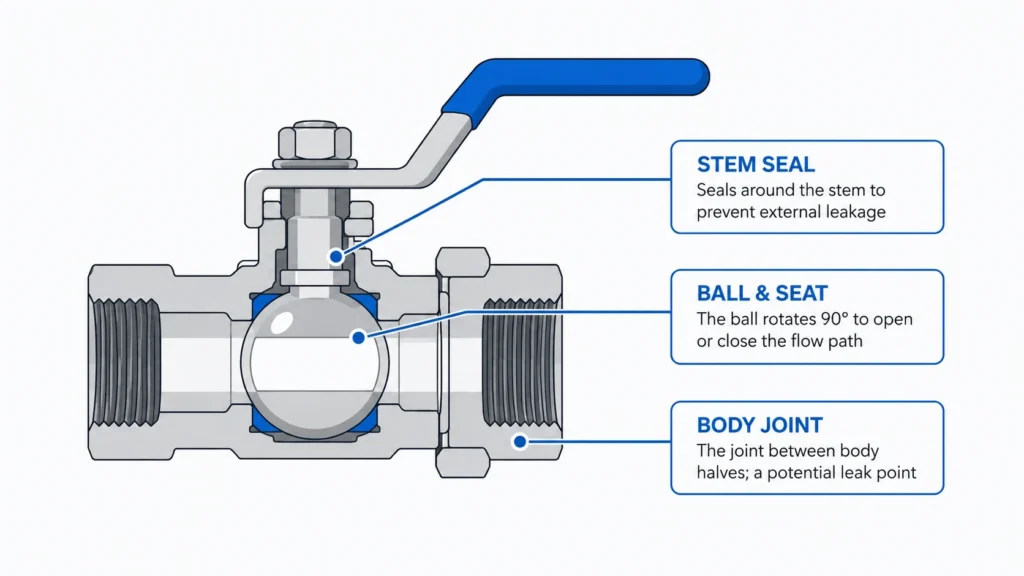
Ball valve leak zones diagram showing stem seal, ball and seat, and body joint

Short answer: a ball valve leaks in one of exactly three places, the seat, the stem, or
the body seam, and identifying which one must come before any repair.

Before you can fix anything, you have to localise it. I tell every new technician the same thing:
do not reach for a tool until you can point at the exact millimetre where fluid is escaping. There
are only three places it can be, and each one points at a different family of causes. Wipe the valve
completely dry, pressurise the line, and watch where the first bead of moisture appears. That
single observation is worth more than any amount of guessing.

Seat Leakage: When the Valve Will Not Hold Shut

Seat leakage is the classic “I closed it but fluid still trickles through” complaint. The ball is
shut, yet downstream you still see flow or pressure creeping up. The seats are the two soft rings —
usually PTFE or a reinforced PTFE blend — that the ball presses against to make a
bubble-tight shut-off. When they are scratched, embedded with grit, deformed by heat, or simply worn
after tens of thousands of cycles, the ball no longer seals and the valve passes fluid even when it
looks closed.

This is the failure people most often misread as a “broken valve,” when in fact the body is
structurally fine. It is also the one that hides the longest, because a slow seat pass does not drip
on the floor; it quietly fails to isolate a section you thought was safe to work on. That is the
dangerous kind. If you are using a valve to lock out a line for maintenance, a seat that passes is a
safety issue, not just an efficiency one. Soft-seated ball valves are designed for tight shut-off,
but they are sacrificial wear parts by nature, and no honest manufacturer will promise eternal zero
leakage from a soft seat in an abrasive service.

There is a useful test here that costs nothing. If you suspect a seat pass, isolate the valve,
open it once fully, cycle it a few times, and reclose it. A genuine seat that has simply trapped a
particle will often reseal once the debris clears; a seat that has been physically scored or
cold-flowed by heat will keep passing no matter how many times you cycle it. That one experiment
tells you whether you are looking at a five-minute flush or a seat replacement, and it stops you
from condemning a valve that just swallowed a fleck of pipe scale. I run it before I ever quote a
customer a new unit, because half the time the valve was fine and the line was dirty.

Stem Leakage: The Most Common Drip You Will See

Stem leakage is the bead of fluid that appears around the shaft where the handle meets the body.
This is, by a wide margin, the leak I get asked about most. The stem has to rotate, which means it
cannot be welded shut; instead it is sealed by stem packing and one or more O-rings or thrust seals.
Every time someone operates the valve, that seal works a little. Over-tightened packing crushes and
extrudes; under-tightened packing weeps; a stem scored by side-loading from a cheater bar tears the
seal on every turn.

The good news is that stem leaks are frequently the most fixable, because many designs allow you
to snug the gland nut or replace the packing without pulling the valve from the line. The bad news
is that people treat a weeping stem as cosmetic and ignore it until the packing fails outright and
the drip becomes a spray. A ball valve leaking at the stem is the early-warning light on your
dashboard. Do not tape over it.

If you do snug a gland, do it in small increments with the line at working pressure, and stop the
moment the weep stops. The instinct to crank it hard “so it never leaks again” is exactly what
scores the stem and guarantees a worse leak next month. Packing is meant to be lightly loaded, not
strangled. And if a valve needs its gland tightened repeatedly over a short span, stop adjusting and
start investigating, because that pattern usually means the stem is already scored or the packing
has extruded, and you are now just chasing a failure that wants a rebuild. Knowing when to stop
tightening is, oddly, one of the more valuable skills in this whole business.

Body and Seam Leakage: The One You Cannot Tighten Away

Body leakage is fluid escaping from the joint between the two halves of the valve body, or
through a casting flaw in the body itself. This is the most serious of the three, because unlike a
stem gland, you usually cannot adjust it back to health. On a conventional two-piece valve the two
halves are threaded together with a gasket or sealant at the joint. That threaded seam is a
deliberate leak path that the manufacturer is trusting a thread sealant and a gasket to close.
Vibration, thermal cycling, and corrosion all conspire against that joint over time.

This failure zone is exactly where design choices made years earlier come home to roost, and it
is the reason we build our economy valve the way we do. I will come back to that in the design
section, because eliminating a leak path entirely beats sealing it better. For now, the takeaway is
simple: a weeping body seam means the joint integrity is compromised, and the realistic fix is
replacement, not repair. The table below summarises how to read each zone at a glance.

Leak LocationWhat You SeeMost Likely CauseRealistic Fix
Seat (internal)Valve closed but fluid passes downstreamWorn, scratched, or grit-embedded seats; thermal deformationReseat or replace seats; replace valve if cycled heavily
StemBead of fluid around the shaft under the handleLoose or extruded packing; scored stem from over-torqueTighten gland nut or replace packing; often in-line
Body / seamWeeping from the joint between body halvesCompromised threaded joint, vibration, corrosion, casting flawReplace the valve; the joint cannot be re-sealed reliably

The Root Causes Behind a Leaking Ball Valve

Short answer: most leaks trace back to one of three root causes, wear from use,
installation error, or a chemistry and temperature mismatch, and real-world failures usually stack
two of them together.

Localising the leak tells you which seal failed. Understanding why it failed is what stops it
from happening again. In my experience the underlying causes cluster into three buckets: how the
valve was used, how it was installed, and what it was asked to handle chemically and thermally. Most
field failures I review are a combination of two of these, which is why a single-cause explanation
usually disappoints. Let me take them in turn.

Before I do, a word on the trap of the single cause. When a valve leaks, the human instinct is to
find the one thing to blame and move on, and vendors are happy to oblige because “it was installed
wrong” or “the valve was defective” are clean stories. Reality is messier and more useful. The valve
on the abrasive line was also slightly over-torqued at install; the corroded marine valve was also
cycled hard; the OEM skid that weeps was both thermally cycled and specified a touch under its real
pressure. Each factor on its own might have been survivable, but stacked together they crossed a
threshold. I mention this because the fix that lasts usually addresses the two largest contributors,
not the single most obvious one. Train yourself to ask “what else,” and your repairs stop bouncing
back.

Wear, Cycling, and the Honest Truth About Soft Seats

Every quarter turn rubs the ball against the seats. In a clean, room-temperature water line that
wear is glacial and the valve may outlive the building. Put the same valve on a slurry, a fluid
carrying weld spatter or pipe scale, or a line that is cycled hundreds of times a day, and the seats
erode far faster. Grit is the real enemy: a single hard particle dragged across a soft seat leaves
a scratch, and a scratch is a leak path that only grows. This is ordinary, expected wear, not a
defect, and it is the leading cause of seat-pass complaints I see.

The honest engineering position is that soft seats are consumables. If your service is abrasive
or high-cycle, you should be planning for periodic seat replacement or specifying a valve built for
the duty, not expecting a budget valve to defy physics. Pretending otherwise is how you end up with
a leaking ball valve and a surprised maintenance budget. Where cycle counts are genuinely punishing,
a metal-seated valve or a different valve type may be the right call, and I would rather tell you
that than sell you the wrong thing twice.

Installation Sins: Over-Torque, Pipe Strain, and Thread Sealant

I would estimate a large share of “new valve leaking” cases are installation problems wearing a
manufacturing-defect costume. The three repeat offenders are over-torque, pipe strain, and sloppy
thread sealing. Over-torquing the stem gland feels productive but crushes the packing and can score
the stem, guaranteeing a stem leak within weeks. Pipe strain — forcing a misaligned pipe into the
valve and bolting it down under load — distorts the body and can break the seat seal before the
system ever sees pressure.

Then there is the connection itself. On a threaded valve, too little sealant leaks immediately
and too much can split a female port. Tapered threads need the right turns of engagement and the
right tape or paste, applied in the right direction. None of this is exotic, but it is skipped
constantly. For a sense of how temperature and pressure ratings interact with these joints, the Engineering ToolBox
reference tables are a handy sanity check before you commit to a connection style. Get the
installation right and a startling number of “leaky valves” simply never happen.

Chemistry and Temperature: The Slow Killers

The third bucket is the one that bites months later. PTFE seats have a real temperature ceiling;
push past it and the seat takes a permanent set, then leaks once it cools. Thermal cycling —
repeatedly heating and cooling — loosens body joints and stem packing through simple expansion and
contraction. And chemistry quietly attacks the metal itself. This is where the choice between 304
and 316 stainless stops being a line item and starts being the difference between a dry valve and a
pitted one.

Chloride-bearing media are the classic trap. In the presence of chlorides, standard 304 stainless
is vulnerable to pitting and crevice corrosion, and a pit on a sealing surface is a leak waiting to
happen. The molybdenum in 316 gives meaningfully better resistance to chloride pitting, which is
why coastal, marine, and many chemical services specify it. For the corrosion engineering behind
that choice, the materials and corrosion community at AMPP (formerly NACE) is the authoritative reference. Choosing the
wrong alloy does not leak on day one; it leaks on day two hundred, which is exactly why it gets
overlooked at purchase.

How I Diagnose a Leak Before I Touch a Tool

Short answer: dry the valve, pressurise it, and watch where fluid first appears; then
establish whether the leak is internal (seat) or external (stem or body) before you decide to repair
or replace.

Diagnosis is where most repair attempts go wrong, because people start turning wrenches before
they understand the failure. My process is boring on purpose, and boring is what keeps you from
replacing a good valve. The goal of a ball valve leaking investigation is to answer two questions in
order: where is it leaking, and is the leak internal or external. Get those two right and the
correct action is usually obvious.

Step One: External Versus Internal

An external leak puts fluid on the outside of the valve — the floor, the insulation, your boots.
Those are stem and body leaks, and they are visible. An internal leak keeps all the fluid inside the
pipe but lets it pass when the valve is supposed to be closed; that is seat leakage, and you
confirm it by isolating downstream and watching for pressure rise or flow with the valve shut. Many
people chase a phantom “leak” that is actually a seat pass, and no amount of tightening the gland
will fix a seat. Separating these two cases first saves hours.

Dry everything, pressurise, and observe. If fluid appears around the shaft, it is the stem. If it
weeps from the centre joint, it is the body seam. If the outside stays bone dry but the isolated
section still fills, it is the seats. I keep a simple log of which valves leak where, because
patterns across a plant — say, every valve on one hot line leaking at the stem — point at a systemic
cause like thermal cycling rather than a string of coincidences.

A practical tip for finding the exact source on a busy skid: a paper towel beats your eyes. Wrap
a dry paper towel or a strip of tissue loosely around the stem, then around the body seam, run the
line, and check which one wets first. Fluid wicks and tracks along metal, so a drip that lands two
inches below the valve may have originated at the stem and run down the body, fooling you into
replacing the wrong thing. The towel localises the true origin instead of the place gravity
delivered it. On insulated or hard-to-see lines this five-cent trick has saved me from more than one
confident, wrong diagnosis, and it is the kind of habit that pays for itself the first time you
avoid pulling a healthy valve.

Step Two: Repair or Replace, Honestly

Once localised, the decision tree is short. A stem leak on a quality valve is often worth a
repair: snug the gland to spec, or replace the packing and O-rings if a kit exists. A seat pass can
sometimes be resolved by cleaning out trapped debris and cycling the valve, but if the seats are
scored or the valve has high mileage, replacement of the seats — or the valve — is the durable
answer. A body or seam leak is, with rare exceptions, a replace decision; I do not trust a re-sealed
structural joint on anything that matters.

There is also a pure economics layer that engineers forget. On a small, inexpensive valve, the
labour to diagnose, source a seat kit, and rebuild it frequently exceeds the cost of a new unit, and
the rebuild carries more risk. On a large or specialised valve, repair clearly wins. I weigh the
installed cost of downtime against the repair, and I am not precious about replacing a cheap valve
that has done its job. If you are comparing what a sound replacement looks like, our full stainless steel ball
valve range
lays out the connection and size options side by side.

Step Three: The Standards Sanity Check

Before I sign off on any valve in critical service, I check it against the relevant standard for
the duty, not just the catalogue. Pressure ratings, allowable leakage classes, and fire-safe
requirements are all codified. Bodies like the American
Petroleum Institute
and ASME publish the design and testing references that define what “acceptable”
leakage even means for a given class of valve. For leakage specifically, recognised test standards
such as API 598 (valve inspection and testing) and ISO 5208 (pressure testing of valves) define
allowable seat leakage rates by class, which gives you an objective yardstick for whether a valve is
genuinely “tight enough” for your duty rather than a subjective judgement call. I will be candid
here: our economy valve is built and pressure-tested to perform reliably at its rating, but it is
not marketed as a third-party fire-safe or API-certified product, and if your specification demands
a formal certification, you should buy a valve that carries it. Matching the valve to the standard
the job actually requires is part of preventing the next leak, and part of not overpaying for
certifications you do not need.

Designing the Leak Out: What I Wish Every Buyer Knew

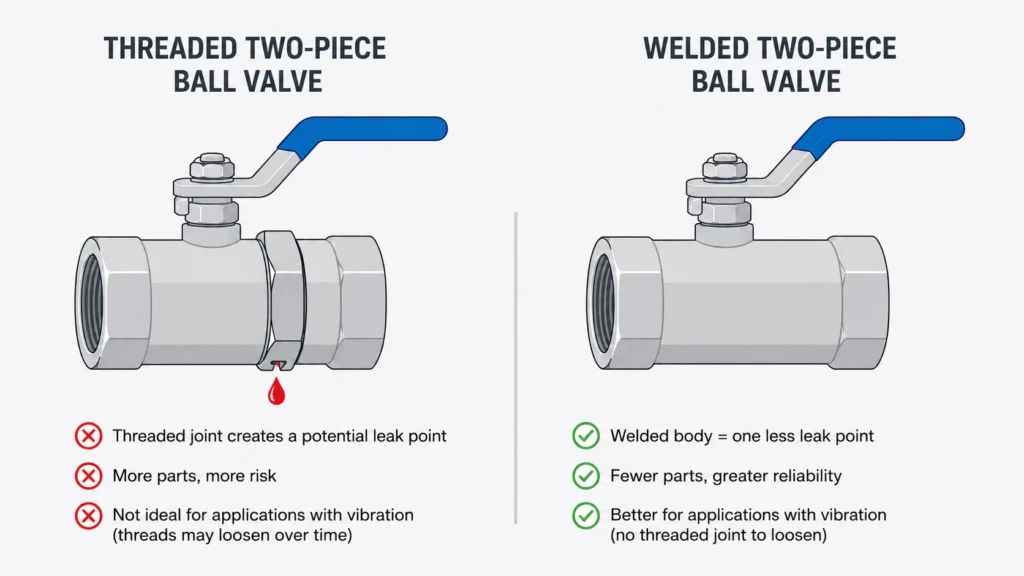
Threaded versus welded two-piece ball valve comparison, the welded body has one less leak point

Everything above is reactive. The most satisfying way to deal with a leak is to make it
structurally harder to happen in the first place, and that is a purchasing decision, not a
maintenance one. Two design levers do most of the work: how the body is joined, and what alloy the
wetted parts are made from. Get both right for your service and you remove whole categories of
failure from your future.

Start with the body joint, because it is the failure zone you cannot tighten away. A conventional
two-piece valve threads its two halves together and relies on a gasket and sealant at that seam. It
works, but it is a deliberate leak path subject to vibration and thermal loosening. This is
precisely why our two-piece economy ball valve, rated 1000 WOG, joins the two body
halves by welding rather than threading. Remove the threaded seam and you remove one of the three
classic leak zones entirely. There is simply nothing there to weep, loosen, or back out under
vibration. We also build it in two versions so you can match the valve to how hard the duty is: an
economy type for general service and a heavy-duty type for tougher conditions, both sharing the same
welded body. Most two-piece valves on the market still rely on a threaded seam, so building ours
with a welded body is a deliberate departure, and it is the first thing I point to when someone asks
what genuinely makes our valve different. It is a small design idea with an outsized effect on
long-term reliability, and it is the single change I most wish more buyers understood.

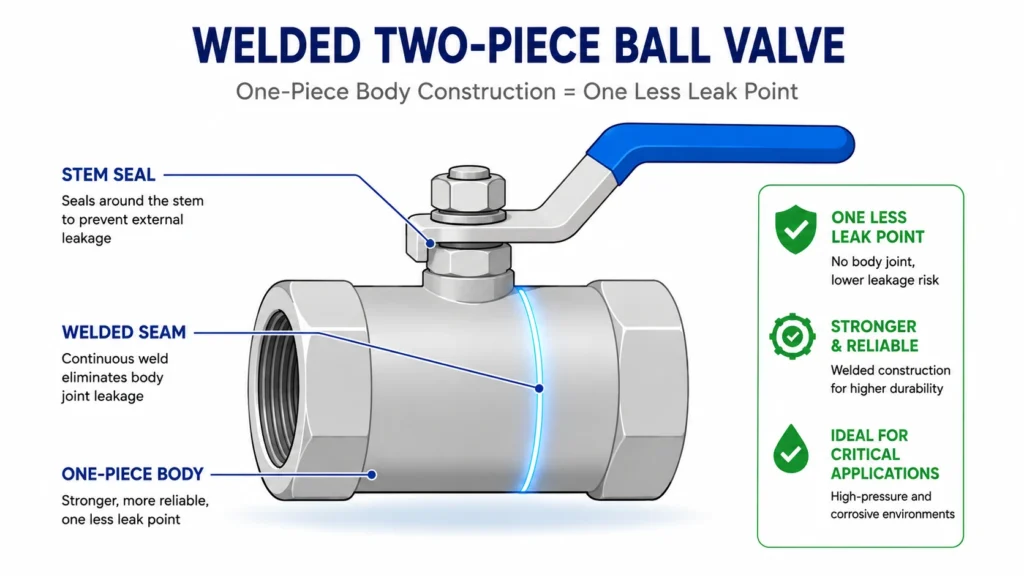
Welded two-piece ball valve with a one-piece body for one less leak point

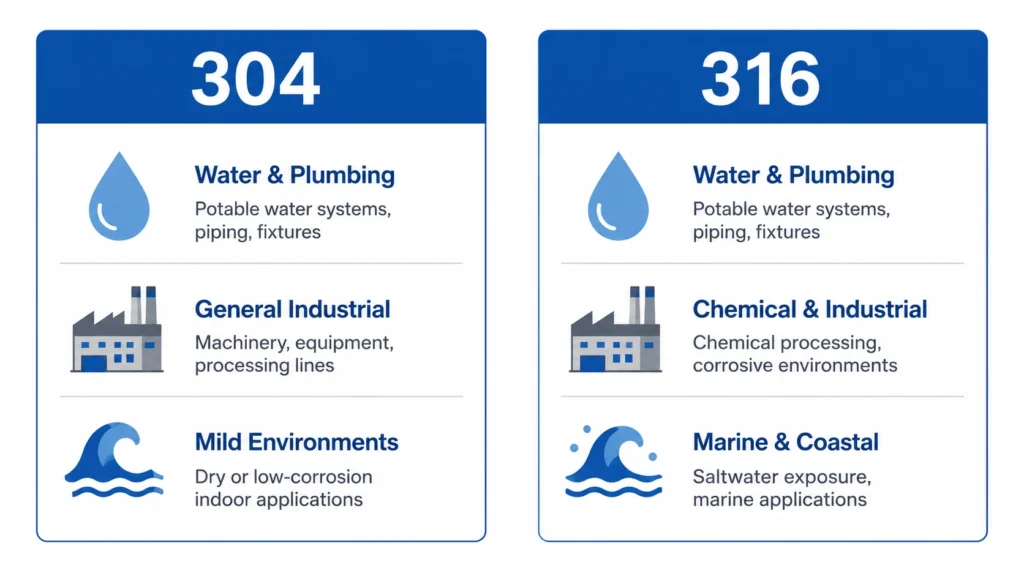
The alloy choice is the second lever, and it is where I see the most expensive mistakes. The
valve is offered in both 304 and 316 stainless so you can match the metal to the medium rather than
overbuying or underbuilding. For benign water and general industrial duty, 304 is sensible and
economical. The moment chlorides, brackish water, marine exposure, or aggressive chemistry enter the
picture, the molybdenum-bearing 316 earns its premium by resisting the pitting that turns sealing
surfaces into leak paths. Choosing deliberately here is one of the highest-leverage decisions you
can make, and the comparison table below lays out how I think about it.

Decision PointChoose 304 StainlessChoose 316 Stainless
Typical mediaClean water, air, oil, general industrial fluidsChloride-bearing, brackish, marine, many chemicals
Corrosion riskLow chloride / low pitting exposurePitting and crevice corrosion risk present
EnvironmentIndoor, dry, inlandCoastal, washdown, marine, food and beverage
Cost postureEconomical, right-sized for the dutyWorth the premium where chlorides are in play
304 vs 316 stainless ball valve material comparison for corrosion and leak resistance

It is worth being concrete about why removing a leak path is categorically better than sealing
one. A seal is a maintained condition; it depends on a gasket staying compressed, a sealant staying
intact, threads staying tight against vibration. Every one of those is a clock counting down. A weld
is a permanent condition; the two halves are now one piece of metal, and there is no compression to
relax and no thread to back out. When I say a welded body removes a failure zone, I mean it
literally drops the body seam out of the list of things that can ever leak, which on a three-zone
machine is a third of your exposure gone. That is not a marketing flourish; it is arithmetic, and it
is the reason this single construction choice shows up so consistently in the valves that simply
never come back.

One honest caveat so you do not over-apply my own product. A welded-body valve is, by design, not
meant to be split open and rebuilt in the field; you trade in-line serviceability for a permanently
sealed joint. For most isolation and OEM duties that is exactly the right trade. But if your
process genuinely requires routine in-line maintenance, seat swaps without removing the valve, or
inspection of internals, a serviceable design such as a three-piece ball valve is the better tool, and I would point you there without
hesitation. And at the small end — instrument runs, gauge lines, tight OEM assemblies — a welded one-piece body gives you the same no-threaded-seam advantage in a compact, reduced-port valve that fits where a larger body won’t. The right valve is the one that matches your maintenance reality, not the one with the cleverest marketing.

Matching the Valve to the Job: A Buyer’s Decision Framework

By now the pattern should be clear: most leaks are decided at the purchasing desk, long before a
technician ever sees a drip. So let me compress years of selection arguments into a framework you
can actually use. Think in three layers — pressure and size, connection style, and serviceability —
and resolve them in that order. Skipping a layer is how mismatched valves end up leaking.

Pressure and size come first because they are non-negotiable. A 1000 WOG (water, oil, gas) rated
valve covers a very broad band of general industrial service, but if your line genuinely operates
above that rating, no amount of good sealing saves you; you need a higher-rated valve. Size follows
the line and the flow you actually need, and a full-port valve minimises pressure drop where flow
matters. Do not oversize out of habit and do not undersize to save a few dollars; both create their
own problems.

Connection style is the second layer, and it should follow your piping system’s standard rather
than a vague sense of “high” or “low” pressure. Threaded, welded, flanged, and other end connections
each suit a different installation discipline. The right question is not “which is strongest” but
“which matches the rest of my system and the people who will install it.” A connection that fights
your standard practice is a future leak. Serviceability is the third layer, and it is the
welded-versus-three-piece decision I described above: permanently sealed reliability, or
field-serviceable flexibility. Choose based on your maintenance reality. If your duty is heavy
industrial isolation, our notes on industrial applications walk through how these layers play out on real lines.

A quick word on provenance, because it matters more than buyers think. We did not start as a
valve brand; we grew out of a precision CNC machining workshop and moved into building our own
stainless valves, which is why the machining tolerances on the ball and stem are something I will
happily defend. You can read that history on our about us page. I mention it not to boast but because tight,
consistent machining is one of the unglamorous reasons a valve seals well on day one and stays
sealed, and it is exactly the kind of thing that does not show up in a spec sheet.

Real-World Leak Scenarios I See Most Often

Theory is useful, but patterns are what actually train your eye. After enough years of reading
warranty photographs and walking customer plants, you start to recognise the same handful of stories
repeating across very different industries. The fluid changes, the pipe sizes change, but the
failure mode rhymes. Below are the three scenarios that account for the majority of the leaks I get
pulled into, along with what is really going on beneath the surface and what I would do differently
next time. If you recognise your own plant in one of these, you are already ahead, because you know
where to look before the drip even starts.

The High-Cycle, Abrasive Line

This is the line that cycles a valve dozens or hundreds of times a shift, often carrying a fluid
that is not perfectly clean: cooling water with scale, a process stream with fines, anything that
drags hard particles across a soft seat. The complaint always arrives the same way, a seat that used
to shut bubble-tight now passes a little, then a lot. Owners are tempted to read this as a defect,
but it is textbook abrasive wear, and it is the single most common driver behind a leaking ball
valve on heavy-duty service. The seats did exactly what soft seats do under grit; they wore.

What I would change is expectation and specification, not just the part. On a genuinely abrasive,
high-cycle duty, plan for seat replacement as a maintenance interval rather than treating it as a
surprise, filter the line during commissioning to keep weld spatter and scale out, and consider
whether the duty has outgrown a budget soft-seated valve entirely. Sometimes the honest answer is a
heavier valve or a different seat material. Pretending a low-cost valve will shrug off sand forever
is how a maintenance budget gets ambushed, and it is the conversation I have most often.

The Coastal and Marine Installation

Here the valve looks fine for months, then starts weeping or passing, and when you look closely
the sealing surfaces are pitted. This is chloride attack, and it is brutally common anywhere near
salt water, washdown environments, or brackish supply. A valve specified in 304 stainless because it
was cheaper at purchase quietly corrodes where it matters most, on the surfaces that have to seal.
By the time it shows, the damage is done; you cannot polish a pit back into a sealing face.

The fix is almost always upstream of the failure, at the purchasing decision. In any
chloride-bearing or marine service I specify 316 stainless without much debate, because the
molybdenum content buys real resistance to the pitting that creates these leaks. The premium over
304 is small set against an unplanned shutdown and a corroded valve. Our notes on the marine industry walk through why the alloy choice dominates everything else in
that environment. If you operate near salt, treat 316 as the default and make 304 justify itself,
not the other way around.

The Thermal-Cycling OEM Skid

The third recurring story comes off packaged equipment and OEM skids, where valves see repeated
heating and cooling as the machine runs and rests. Thermal cycling is relentless on threaded body
seams and stem packing alike; metal expands and contracts, and over hundreds of cycles a joint that
was tight on the test bench works itself loose. The symptom is a seam or stem that begins to weep
with no obvious abuse, just time and temperature swings. OEMs feel this acutely because a leak in
the field becomes their warranty problem, not the end user’s.

This is exactly the scenario where eliminating a leak path beats sealing it better. This is one
reason our welded-body ball valve suits OEM integration so well: with no threaded seam to loosen
under thermal cycling, there is simply one less thing to come back from the field. For machine
builders I also push for the right alloy and a sensible pressure margin, because an OEM cannot
afford to relitigate the same leak across an entire production run. Designing the joint out at the
build stage is far cheaper than chasing it across a fleet of installed machines later.

Frequently Asked Questions

Why is my brand-new ball valve leaking right after installation?

Nine times out of ten, a new leak is an installation issue rather than a faulty valve. The usual
suspects are over-torqued stem packing, pipe strain from forcing a misaligned connection, or thread
sealant applied incorrectly on a threaded port. Before you blame the valve, dry it off,
depressurise, and check the connection and the gland nut against the manufacturer’s torque guidance.
If the leak is at a welded-body seam on a new unit, that is genuinely unusual and worth raising
with your supplier. You can see the construction details of our welded-body design, available in
economy and heavy-duty versions, on the economy 1000 WOG ball valve page to compare against what you
received.

Is a ball valve leaking from the stem dangerous or just annoying?

Treat it as an early warning, not a cosmetic flaw. A small stem weep means the packing has
started to fail, and ignored long enough it progresses from a bead to a spray, especially on hot or
hazardous media. The fix is often simple — snug the gland nut to spec, or replace the packing with a
kit — and frequently doable in line. The danger is complacency: a stem leak on a flammable or toxic
service is a real hazard, so do not tape over it and walk away. If the valve is also being used to
isolate a line for maintenance, verify it actually shuts off, because stem and seat problems
sometimes travel together.

Can I repair a leaking ball valve, or should I replace it?

It depends entirely on where it leaks. Stem leaks are often repairable in place by adjusting or
repacking the gland. Seat passes can sometimes be cleared by flushing trapped debris and cycling the
valve, but scored or worn seats mean replacing the seats or the valve. Body and seam leaks are
almost always a replace decision, because a compromised structural joint cannot be re-sealed
reliably. On small, inexpensive valves the labour of a rebuild often exceeds the price of a new
unit, so replacement wins; on large or specialised valves, repair makes sense. Browse comparable
options in our product
range
if replacement is the call.

Does choosing 316 over 304 stainless actually prevent leaks?

Indirectly, yes, in the right service. Leaks frequently start as corrosion pits on a sealing
surface, and in chloride-bearing media standard 304 stainless is prone to pitting and crevice
corrosion. The molybdenum in 316 resists that pitting far better, so in coastal, marine,
brackish-water, or many chemical services, specifying 316 genuinely heads off a class of
corrosion-driven leaks that 304 would eventually develop. In clean inland water or general service,
304 is perfectly sound and more economical. The point is to match the alloy to the medium rather
than defaulting to one. Both options are available on the economy 1000 WOG valve for exactly this reason.

How do I stop a ball valve from leaking in the long term?

Prevention is part installation discipline and part purchasing strategy. On installation: avoid
pipe strain, do not over-torque the gland, seal threads correctly, and keep abrasive debris out of
the line during commissioning. On purchasing: match pressure rating and size to the duty, pick the
alloy to suit the chemistry, and choose a body design that removes a leak path rather than just
sealing it. A welded-body valve eliminates the threaded seam entirely, which is one of the most
durable ways to keep a leak from ever starting. If you want a recommendation for your specific
service, our team is happy to help through the contact page; tell us the medium, temperature, and pressure and
we will point you at the right configuration.

Quick Answers to Common Ball Valve Leak Questions

These are the short, direct answers I give most often, written so an engineer, or a search
engine, can lift the one that fits without reading the whole guide.

Why does a ball valve leak only when closed?

A leak that shows up only when the valve is closed is seat leakage: the ball is no longer sealing
against its soft seats, usually because they are worn, scratched, or holding debris. Cycle the
valve fully to clear trapped particles; if it still passes, the seats need replacing.

Why does a ball valve leak when it is open?

A leak that appears when the valve is open is almost always external, at the stem or the body
seam rather than the seats. Watch the shaft and the centre joint while the line is flowing to
pinpoint which one.

Can Teflon tape or thread sealant fix a leaking valve?

Thread sealant only cures leaks at the threaded connection to the pipe, not at the stem, the
seats, or a welded body. If the leak is at the pipe joint, reseal the threads correctly; if it is
anywhere else, tape will not help and just delays the real fix.

What does 1000 WOG mean, and does it affect leaking?

1000 WOG means the valve is rated for 1000 psi on water, oil, and gas service. Operating a line
above its WOG rating overstresses the seals and invites leaks, so always confirm your working
pressure sits within the rating.

How long should a ball valve last before it leaks?

There is no fixed figure; service life depends on cycle count, media cleanliness, temperature,
and material match. A clean, low-cycle water line can run for many years, while an abrasive,
high-cycle duty may wear the seats in months. Match the valve to the duty and the life follows.

Is a small weep at the stem normal?

A brief weep on a brand-new valve sometimes settles once the packing beds in, but a persistent
stem weep is not normal and means the packing needs adjusting or replacing. Treat it as a
maintenance item, never as background noise.

Does a full-bore ball valve leak less than a reduced-bore one?

Bore size affects flow and pressure drop, not sealing integrity. Both designs seal the same way,
so choose full bore for flow performance, not as a cure for leaks.

Final Thoughts: Read the Leak, Then Fix the Cause

If you remember one thing from all of this, make it this: a ball valve leaking is a message, not
a verdict. The valve is telling you which of its three seals lost, and your job is to listen before
you reach for a wrench. Localise the leak to the seat, the stem, or the body. Separate internal
passing from external weeping. Then make the repair-or-replace call honestly, weighing the cost of
the rebuild against the cost of doing it again.

And then close the loop where it actually pays off, at the next purchase. Most of the leaks I see
were quietly decided years earlier by an alloy chosen without thinking about chlorides, a pressure
rating shaved too thin, or a threaded body seam installed into a vibrating line. You cannot un-make
those choices, but you can make the next ones deliberately. Match the valve to the standard the job
requires, match the metal to the medium, and where it fits your maintenance reality, let a welded
body take an entire leak path off the table. Do that consistently and the dripping-valve-at-2-a.m.
genre of war story slowly disappears from your plant. That, more than any single repair, is how you
win.

There is a wider lesson in all of this that goes beyond valves. Reliability is rarely won at the
moment of failure; it is won at the moment of decision, when nobody is watching and the consequences
are invisible. The alloy you pick on a quiet Tuesday, the pressure margin you refuse to shave, the
body design you choose because it removes a risk rather than manages one, those quiet decisions are
what your future self either thanks you for or curses. A leak is just the delayed invoice for a
choice made earlier. The engineers whose plants run dry are not luckier than the rest; they are
simply the ones who paid attention at the boring stage, before there was any drama to react to.

If you are weighing a replacement or speccing a new line and want a second opinion on
configuration, alloy, or connection style, reach out through our contact page. Tell us the
medium, the temperature, the pressure, and how the valve will be maintained, and we will steer you
toward the configuration that keeps you out of this article next time. I would rather help you
choose right once than help you fix the same leak twice.

Leave a Comment

Your email address will not be published. Required fields are marked *

Scroll to Top