

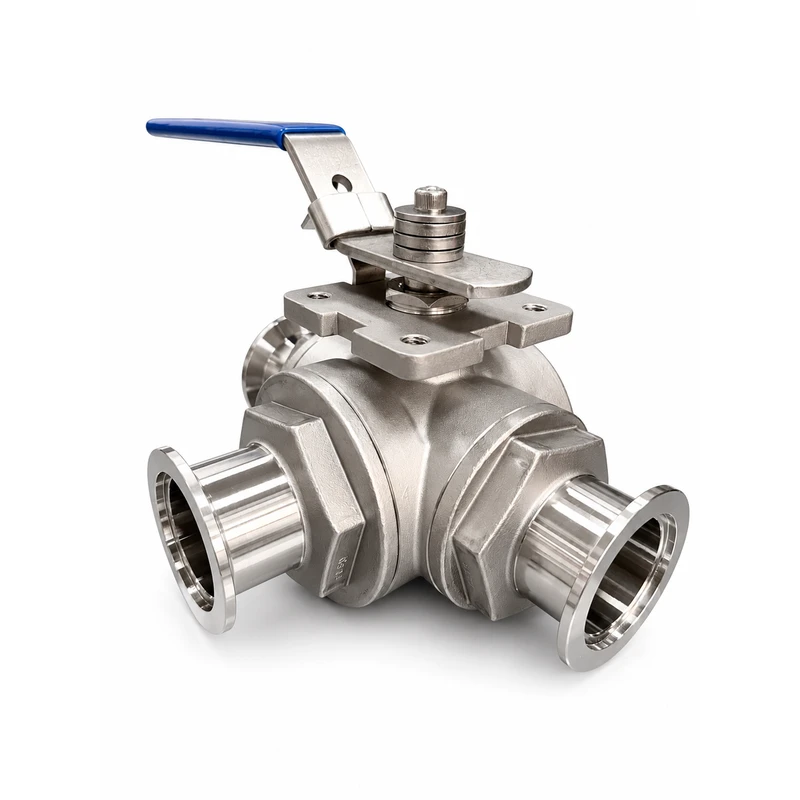
Product Name
3-Way Vacuum Ball Valve – Manual or Pneumatic, KF NW40 / NW50, 316, L-Port or T-Port (V-3WV / V-3WVM)
Product Summary
A 3-way vacuum ball valve for switching a vacuum line: one pump shared between two systems, or one line isolated or connected from a single valve. Polished cast 316 (CF8M) body, PTFE seats, full port, L-port or T-port, on KF (NW) clamp flanges NW40 (1-1/2″) and NW50 (2″). Two builds on one body: the V-3WV with a stainless lever and locking plate, and the V-3WVM with a rack-and-pinion air actuator (DA or SR, 4–8 bar) on an ISO 5211 pad. For pump-side switching on forelines, backing lines and traps, not as a high-vacuum chamber gate.
ISO 9001 · CE · Manufacturer since 1999 · Made in Taiwan
Manual or Pneumatic? One 3-Way Vacuum Ball Valve, Two Builds (V-3WV / V-3WVM)
This 3-way vacuum ball valve switches a vacuum line: one pump shared between two systems, or one line isolated or connected from a single valve. The body is cast 316 stainless steel (ASTM A351 CF8M) with a polished surface and PTFE seats, on KF (NW) clamp flanges in NW40 (1-1/2″) and NW50 (2″). The same body comes in two builds. The V-3WV has a stainless quarter-turn lever with a locking plate. The V-3WVM carries a rack-and-pinion air actuator on an ISO 5211 pad, so a PLC or solenoid does the switching and no one has to stand at the valve.
| V-3WV (manual) | V-3WVM (pneumatic) | |
|---|---|---|
| Operation | Quarter-turn stainless lever with locking plate | Rack-and-pinion air actuator, double acting (DA) or spring return (SR), 4–8 bar |
| Control options | — | Solenoid valve, limit switch box, positioner |
| Best for | Switching points operated by hand a few times a day | Lines switched on a signal, sequenced by a PLC, or cycled often |
L-Port or T-Port 3-Way Ball Valve for Vacuum Lines
The ball is bored L-port or T-port. Both patterns are available in NW40 and NW50; tell us which one you need when you request a quote.
| L-port 3-way ball valve | T-port 3-way ball valve | |
|---|---|---|
| Flow path | Connects the common port to one of the two other ports at a time; the third port is always closed | Connects two ports, or all three ports at once |
| Typical duty | Selector: one pump, one line at a time | Combining two lines, or keeping a second path open while switching |
Key Technical Specifications
| Type | 3-way vacuum ball valve, full port, on/off duty |
| Models | V-3WV (manual lever) / V-3WVM (pneumatic actuator) |
| Sizes | NW40 (1-1/2″) and NW50 (2″) |
| End connections | KF (NW) vacuum flange with clamp and centering ring, no bolts |
| Port pattern | L-port or T-port |
| Body & ball | ASTM A351 CF8M (cast 316 stainless steel), polished, as standard; CF8 (cast 304) made to order |
| Seat | PTFE |
| Bore | Full port, unrestricted bore through the valve |
| Operating temperature | Valve body −20 °C to +180 °C (set by the PTFE seats); actuator −20 °C to +80 °C |
| Manual operation | V-3WV: quarter-turn stainless lever with locking plate |
| Actuator | V-3WVM: rack-and-pinion, aluminum alloy body, double acting (DA) or spring return (SR), air supply 4–8 bar (about 58–116 psi), ISO 5211 direct mount |
| Control options | Solenoid valve, limit switch box, positioner |
| Service | Switching and isolating vacuum lines. On/off duty, not for throttling |
| Dimension sheets | See the PDF downloads above (NW40, NW50) |
Why a Ball Valve for Switching a Vacuum Line
A quarter turn moves the ball from one path to the other, and in either position the full-port bore leaves nothing in the gas path, so the valve does not choke the pumping speed of the line it sits in. That is the job this valve is built for: choosing which line the pump sees, or shutting a line in or out. It is not a regulating valve.
The PTFE seats wipe across the ball every time it turns, which is why ball valves hold up in lines that carry deposits or particles better than a bellows-sealed valve would. The seats set the temperature limit of the body, −20 °C to +180 °C.
KF NW40 / NW50 Ends
KF (also written NW, QF or ISO-KF) is the small quick-clamp vacuum flange: a centering ring with an O-ring sits between two flanges and a hand-closed clamp holds them together, no bolts and no tools. This valve is made in NW40 and NW50, the two largest KF sizes, matching 1-1/2″ and 2″ vacuum lines. For KF16 to KF50 two-way isolation see the manual vacuum valve; for larger ISO-K DN80 / DN100 lines see the vacuum rated ball valve, pneumatic. Both are linked under Applications below.
Applications
Where a 3-way vacuum ball valve of this type is actually used:
- Sharing one pump between two systems: the valve sits on the backing line of a rotary vane, scroll or diaphragm pump and selects which of two lines the pump serves: laboratory vacuum stations and electron-microscope sample-preparation lines.
- Thin-film coating and semiconductor support lines: switching, combining or splitting flow around reactors, traps, scrubbers and exhaust lines on coating, etching and abatement tools, including the “dirty” MOCVD, PVD and CVD processes where the wiping PTFE seats tolerate deposits.
- Foreline and trap duty: isolating or connecting a line on the pump side of a system, where a rugged PTFE-seated ball valve is the usual choice at rough-vacuum pressures.
- Points that will be automated later: start with the V-3WV lever version and move to the V-3WVM when the line goes to PLC control; the same body and flanges stay in the line.
Related: for two-way isolation on the same KF flanges see the manual vacuum valve (KF NW16–NW50 & ISO80) or the vacuum rated ball valve, pneumatic (NW50 KF & ISO-K DN80 / DN100); the same ISO-K sizes with a lever are the manual vacuum ball valve, ISO-K DN80 / DN100. KF/NW centering rings are stocked to match. For non-vacuum service see the 3 way pneumatic ball valve, or browse all vacuum valves.
FAQ
What is the difference between L-port and T-port?
L-port connects the common port to one of the other two ports at a time, with the third port closed. It works as a selector. T-port can connect two ports, or all three at once, so it can combine lines or keep a second path open while switching. Tell us which pattern you need when you order.
Manual or pneumatic — which should I choose?
Choose the V-3WV lever version for switching points operated by hand. Choose the V-3WVM if the valve is switched on a signal, sequenced by a PLC, or cycled often; its rack-and-pinion actuator mounts on an ISO 5211 pad and takes a solenoid valve, limit switch box or positioner.
Double acting or spring return — which should I choose?
Double acting (DA) uses air for both strokes and stays in its last position if air is lost. Spring return (SR) uses springs for the return stroke, so on air loss the springs drive the valve to its preset position. That matters where a vacuum line must default to a known path.
Can I add a solenoid valve or limit switch?
Yes. The V-3WVM actuator accepts a solenoid valve for control, a limit switch box for position feedback, and a positioner if your control scheme calls for one. Tell us your setup when you request a quote.
Which sizes and flanges are available?
NW40 (1-1/2″) and NW50 (2″), both on KF (NW) vacuum flanges with clamp and centering ring. For KF16 to KF50 two-way isolation see the manual vacuum valve. For larger ISO-K DN80 / DN100 lines see the vacuum rated ball valve, pneumatic, or its manual version. All three are linked above.
What is the operating temperature?
Valve body −20 °C to +180 °C, set by the PTFE seats. The pneumatic actuator on the V-3WVM is rated −20 °C to +80 °C.
Is it available in 304 stainless?
316 (cast CF8M) is standard. 304 (cast CF8) is made to order. Tell us the size, port pattern and quantity when you request a quote.
Can the manual version be automated later?
Yes. The same body is offered with the pneumatic actuator fitted as the V-3WVM, so a line that starts on the lever version can move to the actuated version without changing the flanges or piping.
Is there a minimum order quantity?
No. We have no MOQ. Tell us what you need and we will quote it.
Sample Policy
We are happy to provide product samples for customers to evaluate quality or conduct testing. The process typically begins with a quotation based on the customer’s specifications.
If the pricing is acceptable, we can offer samples either free of charge or at a cost depending on the product type and availability.
Shipping fees are borne by the customer.
Order Process
After confirming the product requirements and other details with the customer, we will issue a Sales Confirmation for approval. Once confirmed, the customer is required to pay a 30% deposit to proceed with production.
When mass production is completed and the goods pass inspection, the customer must pay the remaining 70% balance before shipment is arranged.
Related Products

FAQ
A. How can I request a quote?
Please provide a detailed inquiry sheet including product specifications, materials, quantities, and any special requirements. We will offer a quotation based on your request.
B. What are your quotation terms?
Our quotations are typically based on FOB terms. However, we can also offer CFR, CIF, or other Incoterms upon request.
C. What is your Minimum Order Quantity (MOQ)?
MOQ depends on the product. We operate on a made-to-order basis, and trial orders are welcome. For smaller orders, freight is arranged and borne by the buyer.
D. What are your payment terms?
By T/T – 30% down payment upon order confirmation, and 70% balance before shipment.
E. What is your lead time?
Lead time depends on order quantity and specifications. We will confirm the exact schedule when you request a quote.
Want to know more?
If you’re interested in any of our products or services, simply fill out the form below. Our team will get in touch with you as soon as possible to provide the information you need.