
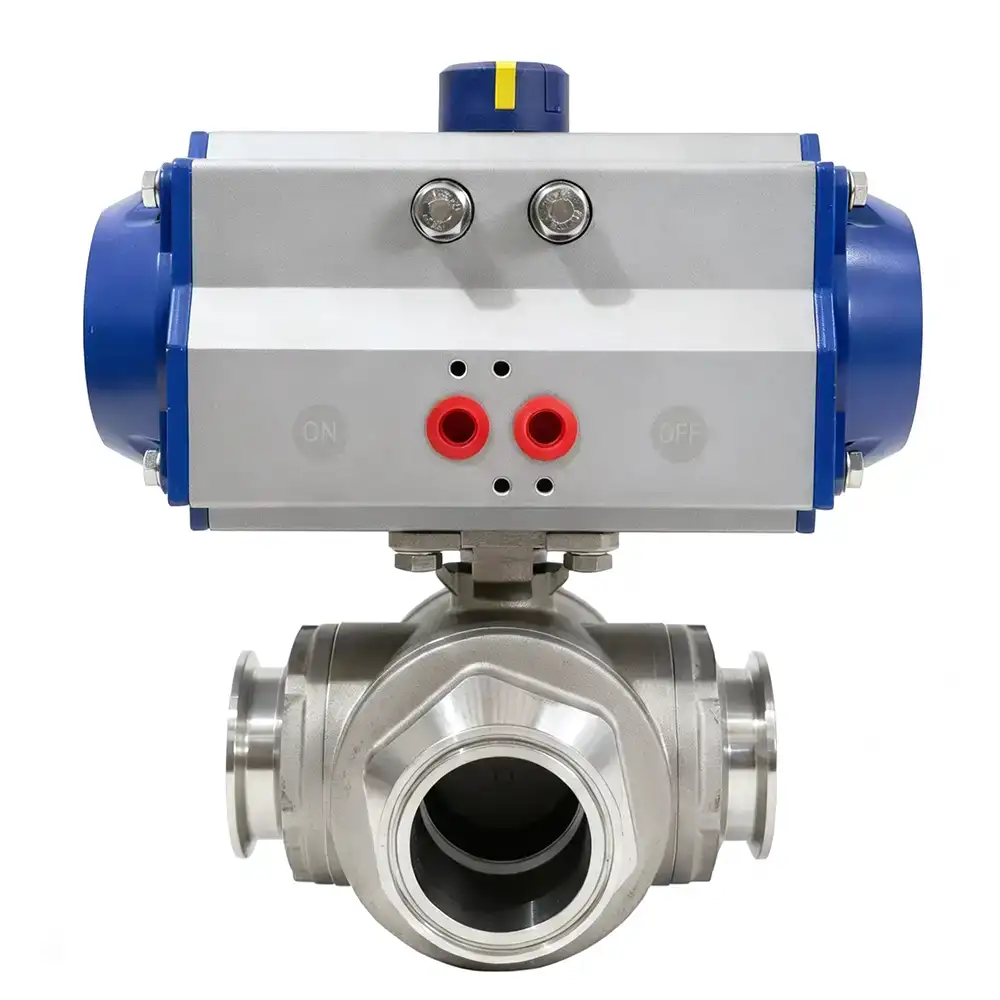
製品名
Sanitary Diverter Valve — Pneumatic 3-Way Ball Valve, Tri-Clamp, L-Port or T-Port, 316 (MV-3M-TC)
製品概要
Sanitary diverter valve — a 3-way ball valve with a pneumatic actuator. 316 stainless, polished, Tri-Clamp ends, 1/2″ to 2″, 1000 WOG.
Two decisions you make when you order:
- Lポート (diverts to one outlet または the other) vs Tポート (can feed two at once)
- Fully encapsulated seat (−20 °C to +80 °C, no dead space for product) vs semi-encapsulated (−20 °C to +180 °C)
Double acting or spring return, ISO 5211 mount, 4–8 bar air. Tell us what the valve has to do and we will tell you which to order.
For the hand-lever version, see the 衛生用3方ボールバルブ取扱説明書.
ISO 9001 · CE · Manufacturer since 1999 · Made in Taiwan
製品説明
A sanitary diverter valve built as a 3-way ball valve in polished 316 stainless steel, driven by a rack-and-pinion pneumatic actuator (double acting or spring return). Tri-Clamp ends let you break the line without tools, and the ball is available with an Lポート to divert flow between two destinations, or a Tポート to mix two streams into one.
The part that matters in hygienic service is what happens behind the ball — see below.
The Cavity Problem — and What a Fully Encapsulated Seat Does About It
In a standard ball valve there is a small gap between the ball and the body. When the valve closes, product sits in that gap. On a water line nobody cares. On a line carrying food, beverage or process chemicals, that trapped product is where the last batch contaminates the next one, and where a sugar syrup crystallises solid.
A fully encapsulated seat fills that space with PTFE. The ball touches nothing but the seat — there is no cavity, so there is nothing to trap product. This is what the industry means by a non-retention ball valve.
It is not free, though: filling the cavity with PTFE lowers the temperature ceiling. Choose with your process temperature in front of you.
| Seat design | What happens behind the ball | 温度範囲 | Choose it for |
|---|---|---|---|
| Partial (standard) | A small cavity remains behind the ball. Media can sit in it when the valve is closed. | −20 °C ~ +180 °C | Water, air, and media where a trace of residue is not a problem. |
| Fully encapsulated | PTFE fills the space around the ball. No cavity, nothing to trap product. | −20 °C to +80 °C | Food, beverage, process chemicals, and viscous or crystallising media that must not stay behind in the valve. |
← テーブルをスワイプしてすべての列を表示 →
The judgement is not “food versus water” — it is whether your medium can be left sitting in a cavity, and how hot your line runs. A crystallising chemical needs a full seat as much as a sugar syrup does. A hot wash cycle above 80 °C rules a full seat out. Tell us the medium and the temperature when you request a quote and we will confirm which seat you need.
バルブの仕様
| 品目 | 仕様 |
|---|---|
| 本体素材 | ASTM 316 stainless steel, polished sanitary finish (304 to order) |
| Port configuration | 3-way, L-port (diverting) or T-port (mixing / diverting) |
| 接続を終了する | Tri-Clamp (quick clamp) sanitary ends |
| 耐圧定格 | 1000 WOG |
| サイズ範囲 | 1/2インチ – 2インチ |
| シートの素材 | PTFE — partial or fully encapsulated (see the seat table above) |
| 温度範囲 | −20 °C to +180 °C with a partial seat; −20 °C to +80 °C with a fully encapsulated seat |
| Cleaning | Clean-out-of-place (COP) — the body bolts open so the ball and seats can be removed and cleaned |
| アクチュエータの取り付け | ISO 5211 |
アクチュエータの仕様
| 品目 | 仕様 |
|---|---|
| 種類 | ラック・アンド・ピニオン式、アルミニウム合金製ボディ |
| アクション | 複動式(DA)またはスプリングリターン式(SR) |
| スプリングの復帰位置 | Returns to the port you nominate when the air supply is lost — specify when ordering |
| 動作温度 | −20 °C to +80 °C |
| 回転 | 90° |
| 空気供給 | 4 – 8 bar (approx. 60 – 116 psi) |
| 制御 | オン/オフ(標準);ポジショナーによる変調(オプション) |
| オプション | 電磁弁、リミットスイッチボックス、ポジショナー |
Cleaning: This Valve Comes Apart
The body bolts open. Undo the clamps, take the ball and the seats out, clean them, put it back — clean-out-of-place (COP). You can see the parts you cleaned, which is more than can be said for a valve you can only flush from the outside.
Every product-contact surface — ball, seats, body bore — can be reached by hand, cleaned and inspected before the valve goes back on the line. Spare seats are stocked, so a seat that has done its hours gets replaced rather than nursed.
L-Port or T-Port: Two Ways to Build a Sanitary Diverter Valve
- Lポート(ダイバータ): the bore is bent 90°, connecting the inlet to one of two outlets at a time. Use it to switch a line between two tanks, two fillers or two filter banks.
- T-Port (Mixing / Diverting): the bore is T-shaped, so it can join two ports together or feed either outlet. Use it to blend two streams into one.
Related: the same 3-way body in a threaded (non-sanitary) version is our 空圧式3方ボールバルブ; the hand-operated sanitary version is the 衛生用3方ボールバルブ取扱説明書. For a two-way sanitary valve, see the 衛生用空気式ボールバルブ.
アプリケーション
- Batch changeover: switching a filler between two product tanks without cross-contaminating the next batch.
- Blending: combining two ingredient streams into one line with a T-port.
- Viscous and crystallising media: syrups, sauces and concentrates that would set solid in a standard valve cavity.
- Semiconductor chemical and slurry loops: holding a polishing slurry in a recirculation loop and switching it to the tool only when it is called for — solids drop out the moment a line stands still.
- Paint, ink and pigment colour change: keeping pigment moving in a ring main, then diverting to the dispense head; low dead space is what stops the last colour turning up in the next one.
- Remote switching on a PLC signal: the flow path changes from the panel, so nobody has to walk out to the line to turn a handle.
よくある質問
What is a non-retention (fully encapsulated) ball valve?
It is a ball valve in which PTFE fills the space around the ball, so there is no cavity behind it for product to sit in. Nothing is trapped when the valve closes — no residue, no crystallised syrup, nothing left for the next batch to pick up. The trade-off is temperature: our fully encapsulated seat is rated −20 °C to +80 °C, against −20 °C to +180 °C for the standard partial seat.
Should I choose a partial seat or a fully encapsulated seat?
Ask two questions. First: can my medium be left sitting in a small cavity when the valve is closed? If it crystallises, sets solid, separates, or would contaminate the next batch, you need a fully encapsulated seat. Second: how hot does the line run? Above 80 °C the fully encapsulated seat is out, and you take the partial seat. Tell us the medium and the temperature and we will confirm.
どうやって掃除すればいいですか?
You take it off the line and open it. Undo the clamps, lift the ball and the seats out, clean them, put it back — clean-out-of-place (COP). Every surface the product touched is in your hand while you do it, so you can see the result instead of assuming it.
What is the difference between an L-port and a T-port?
An L-port bore is bent 90° and connects the inlet to one of two outlets at a time — it diverts. A T-port bore is T-shaped and can join two ports together — it can mix as well as divert. Choose L-port for switching, T-port for blending.
What sizes and end connections are available?
1/2″ to 2″, with Tri-Clamp (quick clamp) sanitary ends. The body is polished 316 stainless steel.
What happens if the air supply fails?
It depends which actuator you order. A spring return (SR) unit drives the valve back to the port you nominated when you ordered it — tell us which flow path the line must fall back to and we build it that way. A double acting (DA) unit stays where it was when the air stopped.
What certifications do you hold?
ISO 9001 and CE, and we have been manufacturing stainless steel valves in Taiwan since 1999.
The valve itself: a polished 316 stainless body, PTFE seats (partial or fully encapsulated), no threads anywhere in the wetted path, and a body that bolts open so every product-contact surface can be reached, cleaned and inspected.
サンプル・ポリシー
お客様の品質評価やテストのために、製品サンプルを喜んでご提供いたします。プロセスは通常、お客様の仕様に基づいたお見積もりから始まります。
価格設定にご納得いただければ、製品の種類や在庫状況に応じて、無料または有償でサンプルをご提供いたします。
送料はお客様のご負担となります。
ご注文の流れ
製品の要件やその他の詳細をお客様と確認した後、承認のための販売確認書を発行します。確認後、30%デポジットをお支払いいただき、生産を開始します。
大量生産が完了し、商品が検査に合格した場合、お客様は出荷手配前に残金70%を支払う必要があります。
関連商品
-
 サニタリーボールバルブ(トライクランプ)
Sanitary Butterfly Valve — Pneumatic Wafer Body, 304 Stainless, Tri-Clamp
-
 サニタリーボールバルブ(トライクランプ)
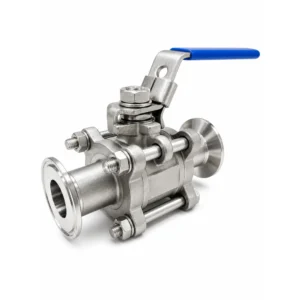
Sanitary 3 Way Ball Valve — Manual, L-Port or T-Port, Tri-Clamp, 316 (MV-3N)
よくある質問
A.見積もり依頼の方法を教えてください。
製品仕様、材料、数量、特別なご要望を含む詳細なお問い合わせシートをご提示ください。お客様のご要望に基づき、お見積もりをさせていただきます。
B.見積条件は何ですか?
私たちの見積もりは通常、以下の内容に基づいています。 本船渡し条件.しかし、我々はまた、提供することができる CFR、CIFまたはご要望に応じて他のインコタームズ。
C.最小発注量(MOQ)はいくらですか?
MOQ depends on the product. We operate on a made-to-order basis, and trial orders are welcome. For smaller orders, freight is arranged and borne by the buyer.
D.支払条件を教えてください。
T/T - 注文確認時に30%の頭金を支払い、出荷前に70%の残金を支払う。
E.リードタイムはどのくらいですか?
納期は注文数量や仕様によって異なります。お客様からご連絡をいただいた際に、正確なスケジュールをご確認させていただきます。 お見積りをご依頼ください。.
もっと知りたい?
当社の製品やサービスにご興味をお持ちの方は、下記のフォームにご記入ください。 必要な情報を提供するために、私たちのチームができるだけ早くご連絡させていただきます。