
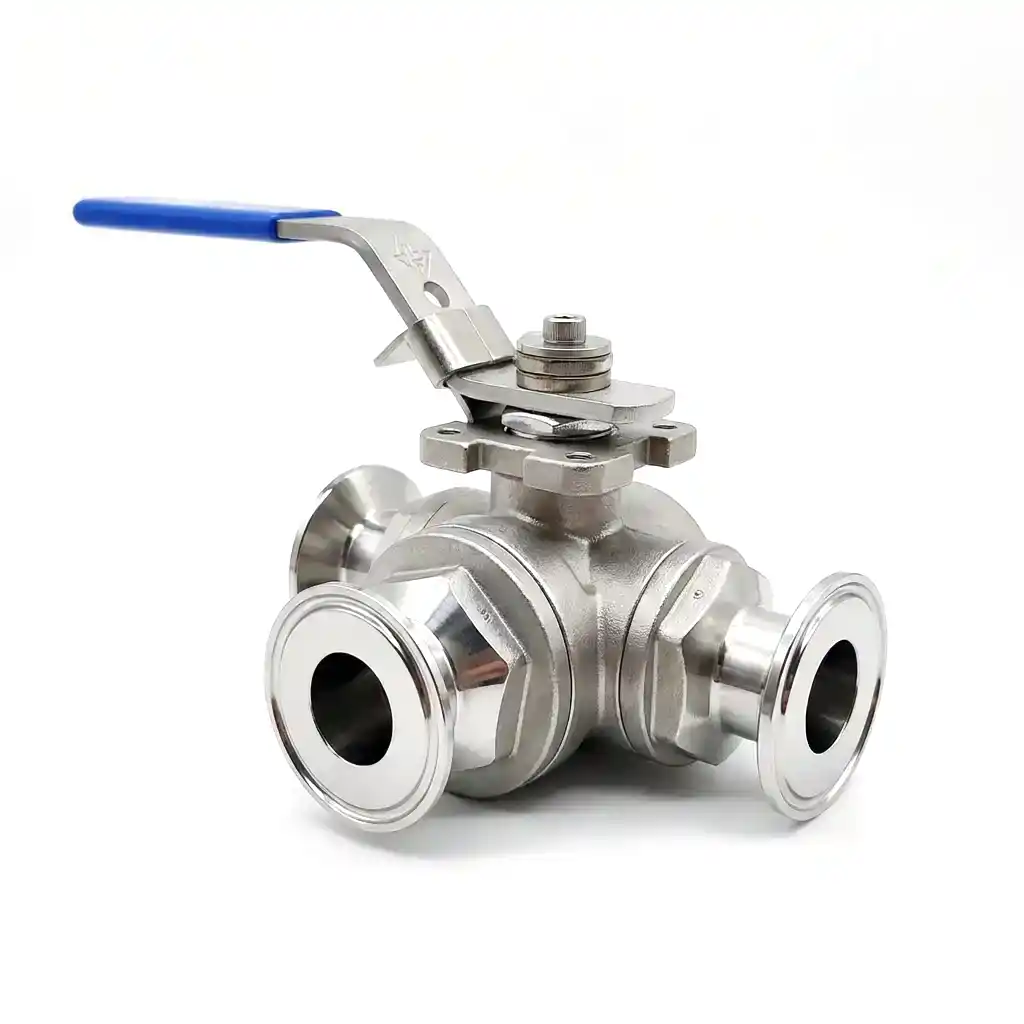
Nom du produit
Sanitary 3 Way Ball Valve — Manual, L-Port or T-Port, Tri-Clamp, 316 (MV-3N)
Résumé du produit
Sanitary 3 way ball valve, manual. 316 stainless, polished, Tri-Clamp ends, 1/2″ to 2″, 1000 WOG.
Two decisions you make when you order:
- Port L (diverts to one outlet ou the other) vs Port T (can feed two at once)
- Fully encapsulated seat (−20 °C to +80 °C, no dead space for product) vs semi-encapsulated (−20 °C to +180 °C)
Both are explained below. Tell us what the valve has to do and we will tell you which to order.
Hand lever operation. For automated lines, see the pneumatic version.
ISO 9001 · CE · Manufacturer since 1999 · Made in Taiwan
Sanitary 3 Way Ball Valve — Manual, 316, Tri-Clamp
A robinet à bille sanitaire à 3 voies, hand operated. 316 stainless steel, polished, Tri-Clamp ends, 1/2″ to 2″, rated 1000 WOG. Turn the lever and the flow goes somewhere else: no air line, no wiring, no PLC. You will also see this valve called a hygienic 3-way ball valve, a 3 way sanitary ball valve or a tri clamp 3 way ball valve. Same valve.
316 is what we stock. 304 we can make to order.
Two things decide whether this valve works for you, and both of them are decisions you make when you order, not afterwards. L-port or T-portet which seat. Both port types are stock builds, and both are explained below.
L-Port or T-Port? This Is Where People Buy the Wrong Valve
They look identical from the outside. Inside, the hole through the ball is a different shape, and they do completely different jobs.
| Port L | Port T | |
|---|---|---|
| Fonctionnalités | Diverts. Sends the inlet to one outlet ou the other. | Mixes or distributes. Can feed two ports at once. |
| Buy it when | You are switching a line between two destinations: filler A or filler B, product or return loop, tank 1 or tank 2. | You are combining two streams into one, or splitting one into two at the same time. |
| The mistake | Buying L when you needed to feed both lines together. It cannot. | Buying T when you needed a clean either/or. It will leak flow to the port you thought was shut. |
← Faites glisser votre doigt sur le tableau pour afficher toutes les colonnes →
One structural point worth knowing before you specify a T-port: in every handle position it keeps at least two ports connected.
If you are not sure which one your line needs, describe what the valve has to do and we will tell you. It takes us one email and saves you a valve.
The Seat Decides Your Temperature Limit
The seat is PTFE either way. What changes is how much of the ball it wraps.
| Siège | Température de fonctionnement | Choose it when |
|---|---|---|
| Fully encapsulated (PTFE wraps the ball fully) |
−20 °C to +80 °C | Food and beverage lines, and anything where product must not sit in a crevice. The PTFE closes off the space around the ball, so there is nothing for product to lodge in. |
| Semi-encapsulated (PTFE wraps part of the ball) |
de −20 °C à +180 °C | Hot water and hot process lines, anything running above 80 °C. It takes far more heat, but leaves more space around the ball. |
← Faites glisser votre doigt sur le tableau pour afficher toutes les colonnes →
This is a real trade-off, not a marketing choice. If you are running product that must not be trapped, take the fully encapsulated seat and live with 80 °C. If your line runs hot, take the semi-encapsulated seat. Send us the medium and the working temperature, and we will specify the seat.
Caractéristiques techniques
| Article | Spécifications |
|---|---|
| Type de vanne | Sanitary 3 way ball valve, manual |
| Port | Port L (diverting) or Port T (mixing). Both in stock |
| Corps | 316 stainless steel, sanitary polish. 304 to order |
| Pression nominale | 1000 WOG |
| Siège | PTFE. Fully encapsulated (−20 °C to +80 °C) or semi-encapsulated (−20 °C to +180 °C) |
| Raccords d'extrémité | Tri-Clamp |
| Gamme de tailles | 1/2″ – 2″ |
| Fonctionnement | Hand lever. No actuator mounting pad — the pneumatic version covers automated lines |
| Service media | Water, oil, compressed air |
| Pays d'origine | Fabriqué à Taïwan |
Taking It Apart for Cleaning
Undo the clamps and the valve comes off the line. Undo the body bolts and it comes apart in your hands: ball out, seats out, everything you need to inspect and swab. Nothing needs cutting, and nothing needs a special tool.
The fully encapsulated seat is the one that matters here. By filling the space around the ball it leaves the bore smooth, with no crevice for product to lodge in and no pocket for a swab to miss.
À sa place
- Switching a line between two destinations (L-port). One inlet, two outlets: tank 1 or tank 2, filler A or filler B, product line or return loop. One valve and one 90° turn does what two shut-off valves and a tee would do, with fewer fittings and one movement instead of two.
- Combining two feed streams into one line (T-port). Two ingredient lines meeting before a mixing tank or a common header, blended in the pipe instead of merged by hand.
- Bypass for maintenance (L-port). Route the line around a section that has to come out for service, then switch it back, without shutting the whole run down and without a second operator remembering to close a second valve.
- Sampling point on a process line. The third port takes product to a sample outlet while the main run keeps going.
- Product changeover on viscous or crystallising lines (L-port, fully encapsulated seat). Chocolate, syrups, sauces and concentrates collect in the space around a standard ball and dry or crystallise there. Filling that space is what makes changeover on these products manageable.
FAQ
What is a sanitary 3 way ball valve?
A three-port ball valve in polished 316 stainless with Tri-Clamp ends, built so it can be taken off the line and opened for cleaning. The ball is drilled either L-shaped, to send one inlet to one of two outlets, or T-shaped, to feed two ports at once. It does the work of a tee plus two shut-off valves, with fewer fittings to install and one handle to turn instead of two.
L-port or T-port — which one do I need?
L-port diverts: it sends the inlet to one outlet or the other. T-port mixes or distributes: it can feed two ports at once. If you are switching a line between two destinations, you want L-port. If you are combining two streams, or splitting one into two at the same time, you want T-port. Describe what the valve has to do and we will tell you which one.
What is the maximum temperature?
It depends on the seat. The fully encapsulated seat runs −20 °C to +80 °C. The semi-encapsulated seat runs −20 °C to +180 °C. Tell us the temperature of your line and we will fit the right one.
Which seat should I choose?
Fully encapsulated if product must not sit in a crevice: the PTFE fills the space around the ball, so the bore stays smooth. Semi-encapsulated if the line runs above 80 °C. It is a genuine trade-off between temperature and dead space, and we will help you pick.
I need this valve automated — what do you offer?
Buy the sanitary pneumatic 3-way ball valve. Same valve, same L-port or T-port choice, with a rack-and-pinion air actuator fitted on top, double acting or spring return.
What end connections do you offer?
Tri-Clamp.
Quelles tailles proposez-vous ?
1/2″ to 2″.
Can I get it in 304?
Yes, to order. 316 is what we stock.
How do I clean it?
Undo the clamps to take the valve off the line, then undo the body bolts and it comes apart by hand: ball out, seats out, everything reachable. No cutting, no special tools.
Quelle est la pression nominale ?
1 000 WOG.
Do you supply a material certificate?
Yes. Ask for the mill certificate with your order and we will send it with the shipment.
Avez-vous un volume minimum de commande ?
Non. Dites-nous ce dont vous avez besoin et nous vous ferons un devis.
Exemple de politique
Nous sommes heureux de fournir des échantillons de produits aux clients pour qu'ils puissent évaluer la qualité ou effectuer des tests. Le processus commence généralement par un devis basé sur les spécifications du client.
Si le prix est acceptable, nous pouvons proposer des échantillons gratuits ou payants en fonction du type de produit et de sa disponibilité.
Les frais d'expédition sont à la charge du client.
Processus de commande
Après avoir confirmé les exigences du produit et d'autres détails avec le client, nous émettons une confirmation de vente pour approbation. Une fois la confirmation obtenue, le client doit verser un acompte de 30% pour lancer la production.
Lorsque la production de masse est achevée et que les marchandises ont passé l'inspection, le client doit payer le solde 70% avant que l'expédition ne soit organisée.
Produits apparentés
-
 Robinets à bille sanitaires (Tri-Clamp)
Sanitary Butterfly Valve — Pneumatic Wafer Body, 304 Stainless, Tri-Clamp
-
 Robinets à bille sanitaires (Tri-Clamp)
Sanitary Diverter Valve — Pneumatic 3-Way Ball Valve, Tri-Clamp, L-Port or T-Port, 316 (MV-3M-TC)
-
 Robinets à bille sanitaires (Tri-Clamp)
Sanitary Pneumatic Ball Valve – 3-Piece 316, Tri-Clamp or OD-Tube Butt Weld, ISO 5211 High-Mount, DA or SR (V-3NM / V-3NM-L3)
-
 Robinets à bille sanitaires (Tri-Clamp)
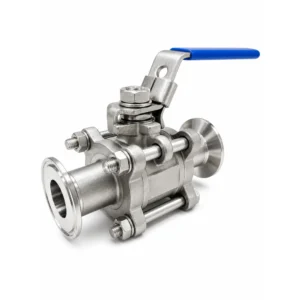
Tri Clamp Ball Valve – Manual 3-Piece Sanitary, 316, Full Port, Tri-Clamp or OD-Tube Butt Weld (V-3N / V-3N-L3)
FAQ
A. Comment puis-je demander un devis ?
Veuillez fournir une demande détaillée comprenant les spécifications du produit, les matériaux, les quantités et toute exigence particulière. Nous vous proposerons un devis sur la base de votre demande.
B. Quelles sont les conditions de votre devis ?
Nos devis sont généralement basés sur Conditions FOB. Cependant, nous pouvons également offrir CFR, CIFou d'autres Incoterms sur demande.
C. Quelle est votre quantité minimale de commande (QMC) ?
MOQ depends on the product. We operate on a made-to-order basis, and trial orders are welcome. For smaller orders, freight is arranged and borne by the buyer.
D. Quelles sont vos conditions de paiement ?
Par T/T - 30% d'acompte à la confirmation de la commande, et 70% de solde avant l'expédition.
E. Quel est votre délai de livraison ?
Le délai de livraison dépend de la quantité commandée et des spécifications. Nous vous confirmerons le calendrier précis lorsque vous demander un devis.
Vous voulez en savoir plus ?
Si vous êtes intéressé par l'un de nos produits ou services, il vous suffit de remplir le formulaire ci-dessous. Notre équipe prendra contact avec vous dans les plus brefs délais pour vous fournir les informations dont vous avez besoin.