


Produktname
Manual Vacuum Valve – 3-Piece Vacuum Isolation Ball Valve, KF NW16–NW50 & ISO-K ISO80, 316, Lever or ISO 5211 Pad (V-3A / V-3AM)
Produktübersicht
A manual vacuum valve in a three-piece 316 stainless ball design: full port, PTFE seats, KF clamp flanges NW16 / NW25 / NW40 / NW50 (1/2″–2″) or ISO-K ISO80 (2-1/2″). Two builds on one body — the V-3A with a stainless lever, and the V-3AM with an ISO 5211 pad that takes a pneumatic or electric actuator with no bracket. The body unbolts for cleaning without cutting the valve out of the line. For fore-line, roughing-line and pump isolation, not as a high-vacuum chamber gate.
ISO 9001 · CE · Manufacturer since 1999 · Made in Taiwan
Manual Vacuum Valve or Direct-Mount? Two Builds, One Body (V-3A / V-3AM)
This manual vacuum valve is a three-piece 316 stainless ball valve with KF (NW16–NW50) or ISO-K (ISO80) clamp flanges, built to isolate a section of vacuum line by hand. The same body comes in two builds: the V-3A with a stainless lever, and the V-3AM with an ISO 5211 mounting pad so a pneumatic or electric actuator can be bolted on later without a bracket. Pick by how the line will be operated — now and after the next upgrade.
| V-3A (manual) | V-3AM (direct-mount) | |
|---|---|---|
| Betrieb | Quarter-turn stainless lever with locking plate | ISO 5211 pad for a pneumatic or electric actuator — lever included for manual use |
| Stem seal | PTFE packing | Viton O-ring plus PTFE packing |
| Am besten geeignet für | Hand-operated isolation points on pump lines and manifolds | Lines that are — or may later be — automated |
Wichtige technische Spezifikationen
| Typ | Manual vacuum valve — three-piece vacuum isolation ball valve, full port |
| Models | V-3A (manual lever) / V-3AM (ISO 5211 direct-mount pad, lever included) |
| Größenauswahl | 1/2″ – 2-1/2″ |
| Endanschlüsse | KF clamp flange: NW16 (KF16) at 1/2″, NW25 (KF25) at 1″, NW40 (KF40) at 1-1/4″, NW50 (KF50) at 1-1/2″ and 2″. ISO-K flange: ISO80 at 2-1/2″. |
| Lauf, Zündkapsel und Kugel | ASTM A351 CF8M (cast 316 stainless steel) as standard; CF8 (cast 304) made to order |
| Seat & gaskets | PTFE |
| Vorbau | ASTM A276 SS316; V-3AM adds a Viton O-ring for a reinforced stem seal |
| Hafen | Full port — unrestricted bore through the valve |
| Betriebstemperatur | −20 °C to +180 °C (valve body, set by the PTFE seats) |
| Service | Vacuum and negative-pressure isolation — on/off duty, not for throttling |
| Befestigung des Stellantriebs | V-3AM: ISO 5211 pad, direct mount, no bracket |
| Dimension sheets | See the PDF downloads above (V-3A KF / ISO-K, V-3AM NW) |
Isolation Valve Design: Why a Three-Piece Ball Valve
A ball valve is the plain answer for an isolation point on a fore-line, roughing line or manifold: a quarter turn opens or closes it, and in the open position the full-port bore leaves nothing in the gas path, so the valve does not choke the pumping speed of the line it sits in. That is the job this valve is built for — shutting a section in or out — not regulating flow.
The three-piece body is the service advantage. The two end caps stay clamped in the line while the centre section unbolts, so seats and ball can be inspected, cleaned or replaced without cutting the valve out or disturbing the flanges on either side. On a KF or ISO-K line that is an afternoon job with hand tools, not a rebuild.
Seats and gaskets are PTFE, the stem is SS316, and the V-3AM adds a Viton O-ring on the stem for a reinforced seal where an actuator will be cycling it. The body, cap and ball are cast 316 (CF8M) as standard, with 304 (CF8) available to order.
KF NW16–NW50 or ISO-K ISO80 Ends
KF (also written NW, QF or ISO-KF) is the small quick-clamp vacuum flange: a centering ring with an O-ring sits between two flanges and a clamp closed by hand holds them together, no bolts and no tools. This valve covers KF16, KF25, KF40 and KF50 — the sizes vacuum lines are built from — at 1/2″ to 2″.
ISO-K is the larger clamp-flange standard that takes over where KF ends. The 2-1/2″ size here uses ISO80, held with clamps and a centering ring. Match the valve to the flange already on your line; the same three-piece body and the same lever or ISO 5211 pad sit behind either end.
Anwendungen
Where a manual vacuum valve of this type is actually used, and why a ball valve is the right tool there:
- Foreline and roughing-line isolation: between the backing pump and the system, so the pump can be serviced or vented while the line upstream stays under vacuum.
- Sample-entry locks: a low-cost load lock: open to pump down, close to vent and change the sample; the full bore keeps pump-down fast.
- Coating and heat-treating equipment: isolation points on vacuum coaters and furnaces, and on their leak-testing and gas-analysis lines.
- “Dirty” process lines: CVD / PVD chambers, scrubbers and particulate traps, where a PTFE-seated ball valve tolerates deposits better than a bellows-sealed valve because the seats wipe the ball each time it turns.
- Helium leak-detection setups: the on/off valve between a calibrated leak or test piece and the detector, on KF flanges that connect and disconnect by hand.
- Gauge isolation and gas inlet / vent points: blocking a gauge so it can be fitted or removed, or admitting and venting gas on laboratory systems; the locking plate on the lever guards against accidental operation.
- Chambers that get disconnected and moved: for example glovebox-integrated coating systems, where a valve at each end lets the chamber be closed off, unclamped and carried across under vacuum.
- Points that will be automated later: the V-3AM’s ISO 5211 pad takes a pneumatic or electric actuator when the line moves to PLC control; a quarter-turn on/off valve is the natural fit for that.
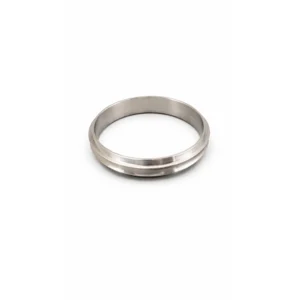
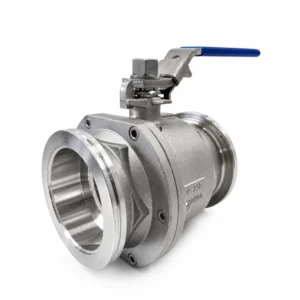
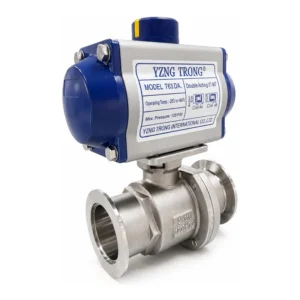
Related: for a pneumatic version of this valve see the vacuum rated ball valve, pneumatic (KF & ISO-K); for switching between two vacuum lines see the 3-way vacuum ball valve, manual or pneumatic (KF NW40 / NW50). For the larger ISO-K sizes in a hand-operated two-piece body see the vacuum isolation valve, ISO-K DN80/DN100. KF/NW centering rings are stocked to match. Browse all Vakuumventile.
Häufig gestellte Fragen
What is the difference between KF (NW) and ISO-K flanges?
Both are clamp-style vacuum flanges. KF (also written NW or QF) covers the small sizes — NW16 to NW50 on this valve — sealed with a centering ring and clamped by hand. ISO-K is the larger series; the 2-1/2″ size here uses ISO80. Match the flange to the fittings your system already uses.
Manual or direct-mount — which should I choose?
Choose the V-3A lever version for hand-operated isolation points. Choose the V-3AM if the valve is — or may later be — automated: its ISO 5211 pad takes a pneumatic or electric actuator directly, with no bracket to fabricate. The V-3AM ships with a lever too, so it works by hand until the actuator goes on.
Ist es ein Full-Port?
Yes. The bore is unrestricted through the valve, so in the open position the valve does not reduce the conductance of the line it sits in. Bore diameters for each size are on the dimension sheet PDF above.
Can the valve be serviced?
Yes. The three-piece body unbolts while the end caps stay clamped in the line, so the seats and ball can be inspected, cleaned or replaced without cutting the valve out.
What seals are used?
PTFE seat, gaskets and packing on both builds; the V-3AM adds a Viton O-ring on the stem for a reinforced seal under vacuum.
Gibt es eine Mindestbestellmenge?
Nein. Wir haben keine Mindestbestellmenge. Teilen Sie uns einfach mit, was Sie benötigen, und wir erstellen Ihnen ein Angebot.
Wie groß ist der Betriebstemperaturbereich?
Valve body −20 °C to +180 °C, set by the PTFE seats.
Is it available in 304 stainless?
316 (cast CF8M) is standard. 304 (cast CF8) is made to order — tell us the size, flange and quantity when you request a quote.
Musterpolitik
Wir stellen unseren Kunden gerne Produktmuster zur Verfügung, um die Qualität zu bewerten oder Tests durchzuführen. Der Prozess beginnt in der Regel mit einem Angebot auf der Grundlage der Spezifikationen des Kunden.
Wenn der Preis akzeptabel ist, können wir je nach Produkttyp und Verfügbarkeit kostenlose oder kostenpflichtige Muster anbieten.
Die Versandgebühren gehen zu Lasten des Kunden.
Bestellvorgang
Nachdem wir die Produktanforderungen und andere Details mit dem Kunden abgestimmt haben, stellen wir eine Verkaufsbestätigung zur Genehmigung aus. Nach der Bestätigung muss der Kunde eine 30%-Anzahlung leisten, um mit der Produktion fortzufahren.
Wenn die Massenproduktion abgeschlossen ist und die Waren die Inspektion bestehen, muss der Kunde den Restbetrag 70% bezahlen, bevor der Versand veranlasst wird.
Verwandte Produkte

Häufig gestellte Fragen
A. Wie kann ich ein Angebot anfordern?
Bitte fügen Sie ein detailliertes Anfrageformular mit Produktspezifikationen, Materialien, Mengen und besonderen Anforderungen bei. Wir werden Ihnen ein Angebot auf der Grundlage Ihrer Anfrage unterbreiten.
B. Wie lauten Ihre Angebotsbedingungen?
Unsere Kostenvoranschläge basieren in der Regel auf FOB-Bedingungen. Wir können aber auch anbieten CFR, CIFoder andere Incoterms auf Anfrage.
C. Wie hoch ist Ihre Mindestbestellmenge (MOQ)?
MOQ depends on the product. We operate on a made-to-order basis, and trial orders are welcome. For smaller orders, freight is arranged and borne by the buyer.
D. Wie lauten Ihre Zahlungsbedingungen?
per Überweisung - 30% Anzahlung bei Auftragsbestätigung, und 70% Restbetrag vor Versand.
E. Wie lange ist Ihre Vorlaufzeit?
Die Lieferzeit hängt von der Bestellmenge und den Spezifikationen ab. Wir werden Ihnen den genauen Zeitplan bestätigen, sobald Sie Ein Angebot anfordern.
Möchten Sie mehr erfahren?
Wenn Sie sich für eines unserer Produkte oder eine unserer Dienstleistungen interessieren, füllen Sie einfach das unten stehende Formular aus. Unser Team wird sich so schnell wie möglich mit Ihnen in Verbindung setzen und Ihnen die gewünschten Informationen zukommen lassen.