

Produktname
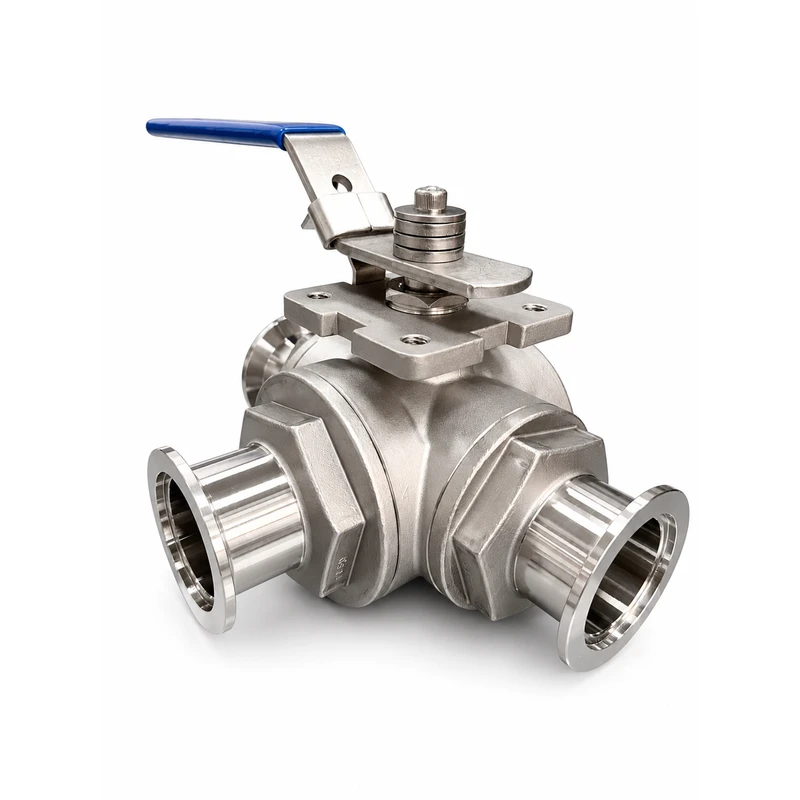
3-Way Vacuum Ball Valve – Manual or Pneumatic, KF NW40 / NW50, 316, L-Port or T-Port (V-3WV / V-3WVM)
Produktübersicht
A 3-way vacuum ball valve for switching a vacuum line: one pump shared between two systems, or one line isolated or connected from a single valve. Polished cast 316 (CF8M) body, PTFE seats, full port, L-port or T-port, on KF (NW) clamp flanges NW40 (1-1/2″) and NW50 (2″). Two builds on one body: the V-3WV with a stainless lever and locking plate, and the V-3WVM with a rack-and-pinion air actuator (DA or SR, 4–8 bar) on an ISO 5211 pad. For pump-side switching on forelines, backing lines and traps, not as a high-vacuum chamber gate.
ISO 9001 · CE · Manufacturer since 1999 · Made in Taiwan
Manual or Pneumatic? One 3-Way Vacuum Ball Valve, Two Builds (V-3WV / V-3WVM)
This 3-way vacuum ball valve switches a vacuum line: one pump shared between two systems, or one line isolated or connected from a single valve. The body is cast 316 stainless steel (ASTM A351 CF8M) with a polished surface and PTFE seats, on KF (NW) clamp flanges in NW40 (1-1/2″) and NW50 (2″). The same body comes in two builds. The V-3WV has a stainless quarter-turn lever with a locking plate. The V-3WVM carries a rack-and-pinion air actuator on an ISO 5211 pad, so a PLC or solenoid does the switching and no one has to stand at the valve.
| V-3WV (manual) | V-3WVM (pneumatic) | |
|---|---|---|
| Betrieb | Quarter-turn stainless lever with locking plate | Rack-and-pinion air actuator, double acting (DA) or spring return (SR), 4–8 bar |
| Control options | — | Magnetventil, Endschalterkasten, Stellungsregler |
| Am besten geeignet für | Switching points operated by hand a few times a day | Lines switched on a signal, sequenced by a PLC, or cycled often |
L-Port or T-Port 3-Way Ball Valve for Vacuum Lines
The ball is bored L-port or T-port. Both patterns are available in NW40 and NW50; tell us which one you need when you request a quote.
| L-port 3-way ball valve | T-port 3-way ball valve | |
|---|---|---|
| Flow path | Connects the common port to one of the two other ports at a time; the third port is always closed | Connects two ports, or all three ports at once |
| Typische Aufgabe | Selector: one pump, one line at a time | Combining two lines, or keeping a second path open while switching |
Wichtige technische Spezifikationen
| Typ | 3-way vacuum ball valve, full port, on/off duty |
| Models | V-3WV (manual lever) / V-3WVM (pneumatic actuator) |
| Größen | NW40 (1-1/2″) und NW50 (2″) |
| Endanschlüsse | KF (NW) vacuum flange with clamp and centering ring, no bolts |
| Port pattern | L-port or T-port |
| Körper & Ball | ASTM A351 CF8M (cast 316 stainless steel), polished, as standard; CF8 (cast 304) made to order |
| Sitz | PTFE |
| Bohrung | Full port, unrestricted bore through the valve |
| Betriebstemperatur | Valve body −20 °C to +180 °C (set by the PTFE seats); actuator −20 °C to +80 °C |
| Manueller Betrieb | V-3WV: quarter-turn stainless lever with locking plate |
| Stellantrieb | V-3WVM: rack-and-pinion, aluminum alloy body, double acting (DA) or spring return (SR), air supply 4–8 bar (about 58–116 psi), ISO 5211 direct mount |
| Control options | Magnetventil, Endschalterkasten, Stellungsregler |
| Service | Switching and isolating vacuum lines. On/off duty, not for throttling |
| Dimension sheets | See the PDF downloads above (NW40, NW50) |
Why a Ball Valve for Switching a Vacuum Line
A quarter turn moves the ball from one path to the other, and in either position the full-port bore leaves nothing in the gas path, so the valve does not choke the pumping speed of the line it sits in. That is the job this valve is built for: choosing which line the pump sees, or shutting a line in or out. It is not a regulating valve.
The PTFE seats wipe across the ball every time it turns, which is why ball valves hold up in lines that carry deposits or particles better than a bellows-sealed valve would. The seats set the temperature limit of the body, −20 °C to +180 °C.
KF NW40 / NW50 Ends
KF (also written NW, QF or ISO-KF) is the small quick-clamp vacuum flange: a centering ring with an O-ring sits between two flanges and a hand-closed clamp holds them together, no bolts and no tools. This valve is made in NW40 and NW50, the two largest KF sizes, matching 1-1/2″ and 2″ vacuum lines. For KF16 to KF50 two-way isolation see the manual vacuum valve; for larger ISO-K DN80 / DN100 lines see the vacuum rated ball valve, pneumatic. Both are linked under Applications below.
Anwendungen
Where a 3-way vacuum ball valve of this type is actually used:
- Sharing one pump between two systems: the valve sits on the backing line of a rotary vane, scroll or diaphragm pump and selects which of two lines the pump serves: laboratory vacuum stations and electron-microscope sample-preparation lines.
- Thin-film coating and semiconductor support lines: switching, combining or splitting flow around reactors, traps, scrubbers and exhaust lines on coating, etching and abatement tools, including the “dirty” MOCVD, PVD and CVD processes where the wiping PTFE seats tolerate deposits.
- Foreline and trap duty: isolating or connecting a line on the pump side of a system, where a rugged PTFE-seated ball valve is the usual choice at rough-vacuum pressures.
- Points that will be automated later: start with the V-3WV lever version and move to the V-3WVM when the line goes to PLC control; the same body and flanges stay in the line.
Related: for two-way isolation on the same KF flanges see the manual vacuum valve (KF NW16–NW50 & ISO80) or the vacuum rated ball valve, pneumatic (NW50 KF & ISO-K DN80 / DN100); the same ISO-K sizes with a lever are the manual vacuum ball valve, ISO-K DN80 / DN100. KF/NW centering rings are stocked to match. For non-vacuum service see the 3-Wege-Kugelhahn mit pneumatischem Antrieb, oder alle anzeigen vacuum valves.
Häufig gestellte Fragen
Was ist der Unterschied zwischen einem L-Port und einem T-Port?
L-port connects the common port to one of the other two ports at a time, with the third port closed. It works as a selector. T-port can connect two ports, or all three at once, so it can combine lines or keep a second path open while switching. Tell us which pattern you need when you order.
Manual or pneumatic — which should I choose?
Choose the V-3WV lever version for switching points operated by hand. Choose the V-3WVM if the valve is switched on a signal, sequenced by a PLC, or cycled often; its rack-and-pinion actuator mounts on an ISO 5211 pad and takes a solenoid valve, limit switch box or positioner.
Doppeltwirkend oder federrückstellend – wofür soll ich mich entscheiden?
Double acting (DA) uses air for both strokes and stays in its last position if air is lost. Spring return (SR) uses springs for the return stroke, so on air loss the springs drive the valve to its preset position. That matters where a vacuum line must default to a known path.
Kann ich ein Magnetventil oder einen Endschalter hinzufügen?
Yes. The V-3WVM actuator accepts a solenoid valve for control, a limit switch box for position feedback, and a positioner if your control scheme calls for one. Tell us your setup when you request a quote.
Welche Größen und Flansche sind erhältlich?
NW40 (1-1/2″) and NW50 (2″), both on KF (NW) vacuum flanges with clamp and centering ring. For KF16 to KF50 two-way isolation see the manual vacuum valve. For larger ISO-K DN80 / DN100 lines see the vacuum rated ball valve, pneumatic, or its manual version. All three are linked above.
Wie hoch ist die Betriebstemperatur?
Valve body −20 °C to +180 °C, set by the PTFE seats. The pneumatic actuator on the V-3WVM is rated −20 °C to +80 °C.
Is it available in 304 stainless?
316 (cast CF8M) is standard. 304 (cast CF8) is made to order. Tell us the size, port pattern and quantity when you request a quote.
Can the manual version be automated later?
Yes. The same body is offered with the pneumatic actuator fitted as the V-3WVM, so a line that starts on the lever version can move to the actuated version without changing the flanges or piping.
Gibt es eine Mindestbestellmenge?
Nein. Wir haben keine Mindestbestellmenge. Teilen Sie uns einfach mit, was Sie benötigen, und wir erstellen Ihnen ein Angebot.
Musterpolitik
Wir stellen unseren Kunden gerne Produktmuster zur Verfügung, um die Qualität zu bewerten oder Tests durchzuführen. Der Prozess beginnt in der Regel mit einem Angebot auf der Grundlage der Spezifikationen des Kunden.
Wenn der Preis akzeptabel ist, können wir je nach Produkttyp und Verfügbarkeit kostenlose oder kostenpflichtige Muster anbieten.
Die Versandgebühren gehen zu Lasten des Kunden.
Bestellvorgang
Nachdem wir die Produktanforderungen und andere Details mit dem Kunden abgestimmt haben, stellen wir eine Verkaufsbestätigung zur Genehmigung aus. Nach der Bestätigung muss der Kunde eine 30%-Anzahlung leisten, um mit der Produktion fortzufahren.
Wenn die Massenproduktion abgeschlossen ist und die Waren die Inspektion bestehen, muss der Kunde den Restbetrag 70% bezahlen, bevor der Versand veranlasst wird.
Verwandte Produkte

Häufig gestellte Fragen
A. Wie kann ich ein Angebot anfordern?
Bitte fügen Sie ein detailliertes Anfrageformular mit Produktspezifikationen, Materialien, Mengen und besonderen Anforderungen bei. Wir werden Ihnen ein Angebot auf der Grundlage Ihrer Anfrage unterbreiten.
B. Wie lauten Ihre Angebotsbedingungen?
Unsere Kostenvoranschläge basieren in der Regel auf FOB-Bedingungen. Wir können aber auch anbieten CFR, CIFoder andere Incoterms auf Anfrage.
C. Wie hoch ist Ihre Mindestbestellmenge (MOQ)?
MOQ depends on the product. We operate on a made-to-order basis, and trial orders are welcome. For smaller orders, freight is arranged and borne by the buyer.
D. Wie lauten Ihre Zahlungsbedingungen?
per Überweisung - 30% Anzahlung bei Auftragsbestätigung, und 70% Restbetrag vor Versand.
E. Wie lange ist Ihre Vorlaufzeit?
Die Lieferzeit hängt von der Bestellmenge und den Spezifikationen ab. Wir werden Ihnen den genauen Zeitplan bestätigen, sobald Sie Ein Angebot anfordern.
Möchten Sie mehr erfahren?
Wenn Sie sich für eines unserer Produkte oder eine unserer Dienstleistungen interessieren, füllen Sie einfach das unten stehende Formular aus. Unser Team wird sich so schnell wie möglich mit Ihnen in Verbindung setzen und Ihnen die gewünschten Informationen zukommen lassen.