
Nom du produit
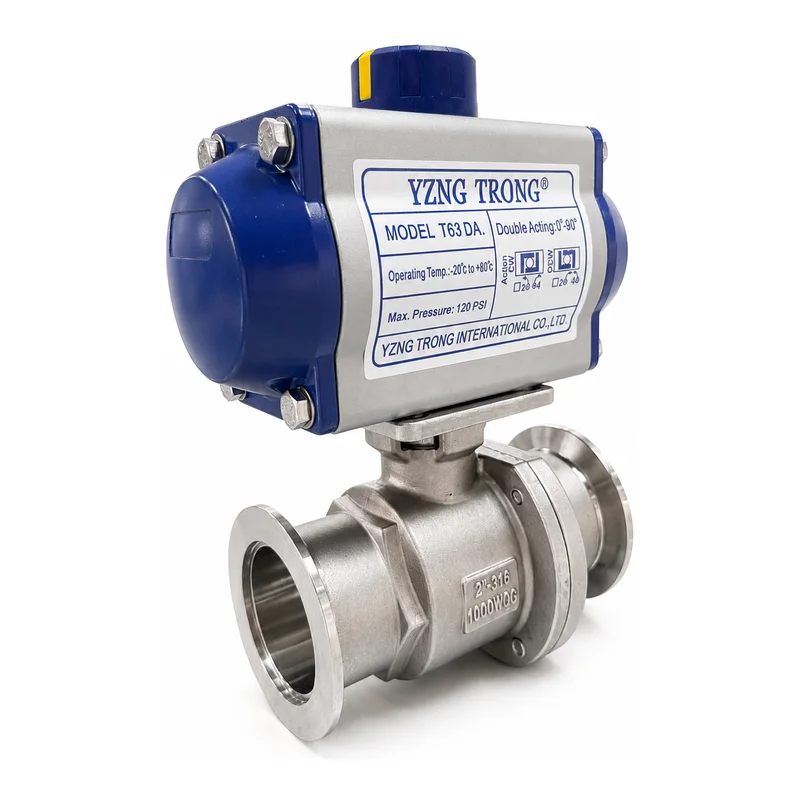
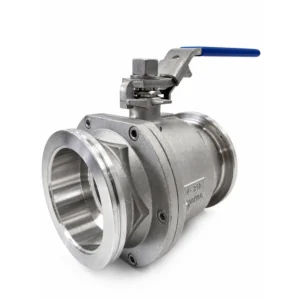
Vacuum Rated Ball Valve, Pneumatic – NW50 KF (2″), ISO-K DN80 / DN100, 316 Two-Piece (V-2VN / V-2BN-ISOK)
Résumé du produit
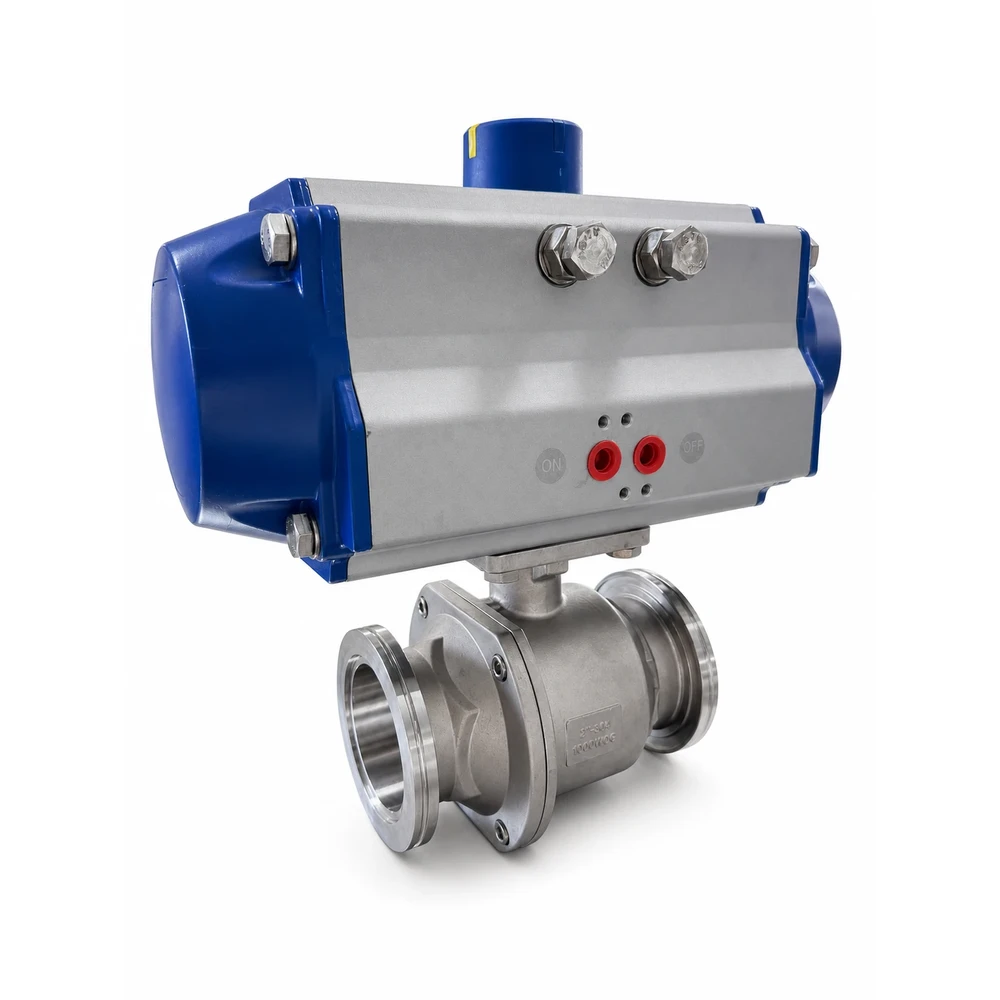
A vacuum rated ball valve with a pneumatic actuator: two-piece 316 stainless body, full port, PTFE seats, ISO 5211 direct mount. Choose NW50 (ISO-KF / KF50) clamp ends at 2″ or ISO-K flanges at DN80 (3″) and DN100 (4″). The rack-and-pinion actuator, double acting or spring return, opens and closes the line on a signal. For fore-line and pump isolation, not as a high-vacuum chamber gate.
ISO 9001 · CE · Manufacturer since 1999 · Made in Taiwan
This vacuum rated ball valve is a two-piece 316 stainless steel pneumatic ball valve built for vacuum lines. It comes with two end styles: NW50 (ISO-KF / KF50) clamp flanges at 2″ (model V-2VN), or ISO-K flanges at ISO80 (DN80, 3″) and ISO100 (DN100, 4″) (model V-2BN-ISOK). Both share the same full-port body, PTFE seats and an ISO 5211 pad that takes a rack-and-pinion air actuator, double acting (DA) or spring return (SR), so the valve opens and closes on a signal instead of by hand.
Where This Vacuum Pump Isolation Valve Belongs in the System
A vacuum ball valve has a clear place in a vacuum system: on the pump side. Here is where this valve is used and what it does there.
| Position in the system | What the valve does there |
|---|---|
| Fore-line / roughing line isolation | Between the pump and the chamber, on the roughing or backing line: this is what a vacuum ball valve is for. |
| Vacuum pump isolation | Shutting a pump out of the line so it can be serviced or swapped without venting the whole system. |
| Gauge isolation | Protecting a vacuum gauge during rough-down or venting. |
← Faites glisser votre doigt sur le tableau pour afficher toutes les colonnes →
For isolating a pump, a fore-line or a gauge, a ball valve is the straightforward, fast, full-bore answer, and with a pneumatic actuator it does that on a signal.
Caractéristiques techniques principales
| Article | Spécifications |
|---|---|
| Type | Two-piece vacuum ball valve, pneumatically actuated (V-2VN / V-2BN-ISOK) |
| Matériau de la carrosserie | ASTM A351 CF8M (316 stainless steel) |
| Connexion | NW50 (ISO-KF / KF50) clamp flange — 2″ (V-2VN) ISO-K vacuum flange — ISO80 (DN80, 3″) or ISO100 (DN100, 4″) (V-2BN-ISOK) |
| Port | Full port on all sizes |
| Siège et joint | PTFE |
| Température de fonctionnement | Valve −20 °C to +180 °C · Actuator −20 °C to +80 °C |
| Actionneur | Rack-and-pinion, aluminium alloy body, double acting (DA) or spring return (SR) |
| Alimentation en air | 4 à 8 bars (environ 58 à 116 psi) |
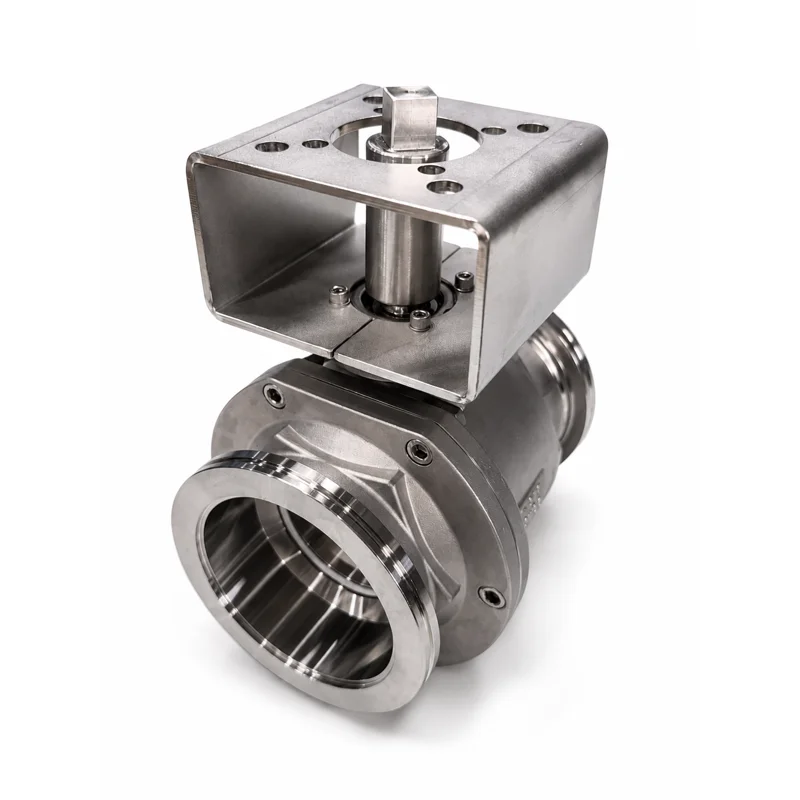
| Fixation de l'actionneur | ISO 5211 — the actuator bolts straight onto the valve, no bracket or coupling |
| Position de retour du ressort | Normalement fermé ou normalement ouvert — à préciser lors de la commande |
| Options | Électrovanne, boîtier de fin de course, positionneur |
| Service | Automated isolation and sequencing on vacuum lines |
Vacuum Rated Valve Design: Why a Pneumatic Ball Valve
- Speed: vacuum sequences are timed. A hand valve makes the operator the bottleneck; an air actuator does not.
- Direct mount: the valve body carries an ISO 5211 pad, so the actuator bolts on with no bracket, no coupling, nothing to align.
- Spring return on air loss: an SR unit moves to the position you specified when the air supply goes. Tell us whether that position is open or closed and we will build it that way.
- À fond : nothing narrows the line, so conductance is not sacrificed to the valve.
- Acier inoxydable 316, sièges en PTFE : a clean, corrosion-resistant combination for vacuum service.
Pneumatic Vacuum Valve Ends: NW50 KF or ISO-K
NW50 (ISO-KF / KF50), 2″ — V-2VN. The KF clamp flange seals with a single clamp and a centring ring, no bolts, so the valve connects straight into a standard KF line and opens tool-free for service. The dimension sheet above gives face-to-face length, height to actuator top, flange O.D. and tube O.D.
ISO-K ISO80 (DN80, 3″) and ISO100 (DN100, 4″) — V-2BN-ISOK. The ISO-K flange clamps straight into a standard ISO-K line, no adapter needed, for the larger fore-lines and pump connections where KF sizes run out.
Applications
- Vacuum pump isolation — shutting a pump out of the line for service without venting the system.
- Roughing and backing lines — isolating rotary-vane or scroll pumps from the chamber.
- Freeze-drying systems — isolating the vacuum line between the freeze dryer and its pump.
- Vacuum ovens — shutting off chamber vacuum before the pump is switched off.
- Laboratory vacuum piping — automated on/off on KF and ISO-K lines under PLC control.
Related: the hand-operated version of this valve is our vanne à dépression manuelle; for diverting between two vacuum lines, see the Vanne à bille à 3 voies à dépression. KF/NW centering rings are here.
FAQ
What flange sizes are available?
NW50 (ISO-KF / KF50) clamp flange at 2″ (V-2VN), and ISO-K in ISO80 (DN80, 3″) and ISO100 (DN100, 4″) (V-2BN-ISOK). Each clamps straight into its standard line — no adapter needed.
What is the difference between the NW50 KF version and the ISO-K version?
The valve, seats, actuator and ISO 5211 mounting are the same. The difference is the flange: KF is a small clamp flange that seals with one clamp and a centring ring, used for the 2″ size; ISO-K is the larger flange standard used for the 3″ and 4″ sizes. Choose by the flange already on your line.
Double effet ou retour par ressort : lequel choisir ?
Le système à double effet utilise de l'air pour s'ouvrir et de l'air pour se fermer, et conserve sa dernière position en cas de coupure d'alimentation en air. Le système à retour par ressort utilise de l'air dans un sens et un ressort dans l'autre ; il revient donc à une position prédéfinie en cas de coupure d'alimentation en air. Indiquez-nous si cette position doit être ouverte ou fermée, et nous le fabriquerons en conséquence.
What is the operating temperature range?
Valve −20 °C to +180 °C, set by the PTFE seats. Actuator −20 °C to +80 °C.
Does the actuator need a bracket?
No. The valve body has an ISO 5211 mounting pad, so the actuator bolts straight on — nothing to machine, nothing to align.
Puis-je ajouter une électrovanne ou un interrupteur de fin de course ?
Oui. L'actionneur peut être équipé d'une électrovanne pour la commande, d'un boîtier de fin de course pour le retour d'information de position et d'un positionneur pour le fonctionnement en modulation. Veuillez nous indiquer votre configuration de commande lorsque vous demandez un devis.
Y a-t-il une quantité minimale de commande ?
Non. Nous n'imposons pas de quantité minimale de commande. Dites-nous ce dont vous avez besoin et nous vous établirons un devis.
Exemple de politique
Nous sommes heureux de fournir des échantillons de produits aux clients pour qu'ils puissent évaluer la qualité ou effectuer des tests. Le processus commence généralement par un devis basé sur les spécifications du client.
Si le prix est acceptable, nous pouvons proposer des échantillons gratuits ou payants en fonction du type de produit et de sa disponibilité.
Les frais d'expédition sont à la charge du client.
Processus de commande
Après avoir confirmé les exigences du produit et d'autres détails avec le client, nous émettons une confirmation de vente pour approbation. Une fois la confirmation obtenue, le client doit verser un acompte de 30% pour lancer la production.
Lorsque la production de masse est achevée et que les marchandises ont passé l'inspection, le client doit payer le solde 70% avant que l'expédition ne soit organisée.
Produits apparentés


FAQ
A. Comment puis-je demander un devis ?
Veuillez fournir une demande détaillée comprenant les spécifications du produit, les matériaux, les quantités et toute exigence particulière. Nous vous proposerons un devis sur la base de votre demande.
B. Quelles sont les conditions de votre devis ?
Nos devis sont généralement basés sur Conditions FOB. Cependant, nous pouvons également offrir CFR, CIFou d'autres Incoterms sur demande.
C. Quelle est votre quantité minimale de commande (QMC) ?
MOQ depends on the product. We operate on a made-to-order basis, and trial orders are welcome. For smaller orders, freight is arranged and borne by the buyer.
D. Quelles sont vos conditions de paiement ?
Par T/T - 30% d'acompte à la confirmation de la commande, et 70% de solde avant l'expédition.
E. Quel est votre délai de livraison ?
Le délai de livraison dépend de la quantité commandée et des spécifications. Nous vous confirmerons le calendrier précis lorsque vous demander un devis.
Vous voulez en savoir plus ?
Si vous êtes intéressé par l'un de nos produits ou services, il vous suffit de remplir le formulaire ci-dessous. Notre équipe prendra contact avec vous dans les plus brefs délais pour vous fournir les informations dont vous avez besoin.