
Produktname
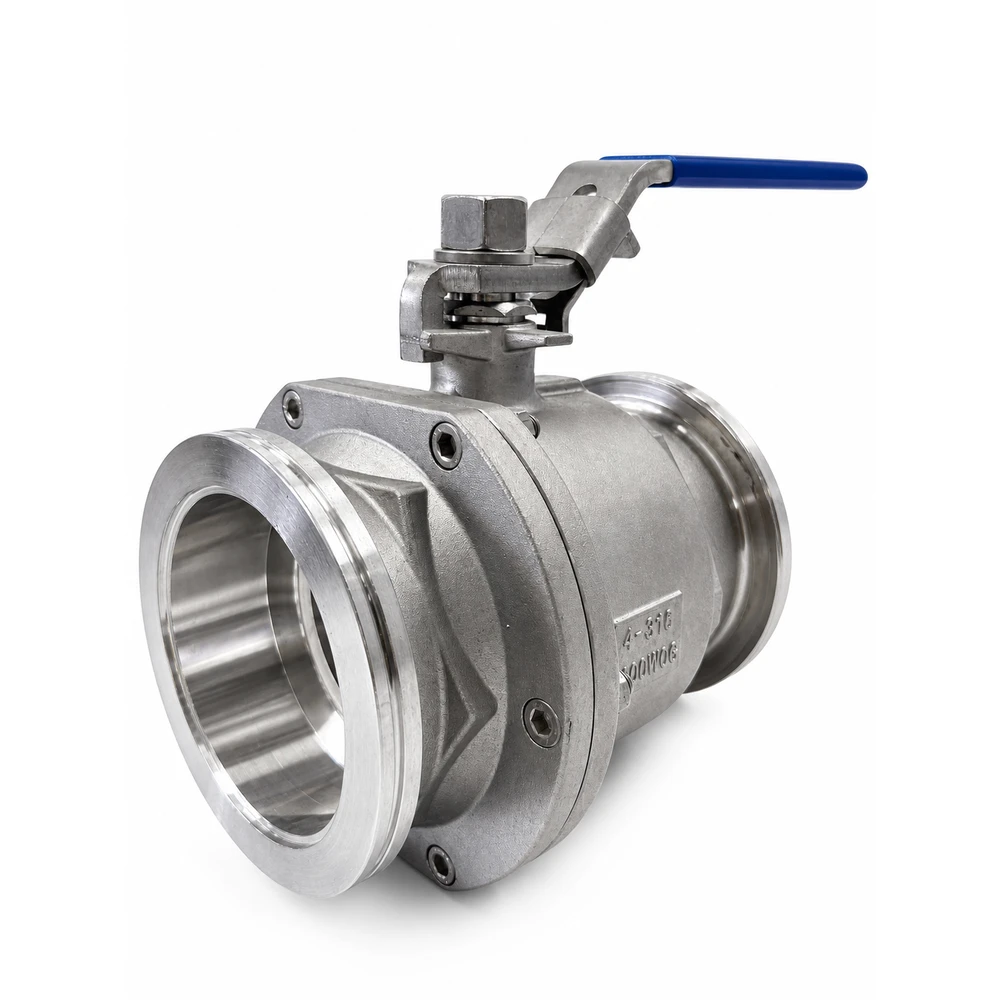
Vacuum Isolation Valve – Manual Two-Piece Ball Valve, ISO-K ISO80 / ISO100 (DN80 / DN100), 316, Lever Handle (V-2V)
Produktübersicht
A manual vacuum isolation valve in a two-piece 316 stainless ball design: full port, PTFE seats and PTFE vacuum seals, ISO-K clamp flanges ISO80 (DN80, 3″) or ISO100 (DN100, 4″), stainless lever handle. A quarter turn shuts a large ISO-K vacuum line in or out by hand, and the compact body drops straight into a standard ISO-K line with no adapters. For pump, fore-line and manifold isolation on DN80 and DN100 lines, not as a high-vacuum chamber gate.
ISO 9001 · CE · Manufacturer since 1999 · Made in Taiwan
Vacuum Isolation Valve for Large ISO-K Lines: Where the V-2V Fits
The V-2V is a manual vacuum isolation valve in a two-piece 316 stainless ball design, built for the large ISO-K clamp flanges: ISO80 (DN80, 3″) and ISO100 (DN100, 4″). A quarter turn of the stainless lever shuts a section of vacuum line in or out by hand, and the full bore leaves nothing in the gas path when open. It is the hand-operated valve for the big pump lines and manifolds that KF sizes do not reach. Pick by flange size and by how the line is operated:
| This valve (V-2V) | Three-piece (V-3A / V-3AM) | Pneumatic (V-2BN-ISOK / V-2VN) | |
|---|---|---|---|
| Flange sizes | ISO-K ISO80 / ISO100 (DN80 / DN100) | KF NW16–NW50 and ISO-K ISO80 | KF NW50 and ISO-K DN80 / DN100 |
| Betrieb | Stainless lever, quarter-turn | Lever, or ISO 5211 pad for a later actuator | Pneumatic actuator, double acting or spring return |
| Am besten geeignet für | Hand-operated isolation on large ISO-K pump lines and manifolds | Small KF lines; body unbolts for service | Lines switched by a PLC or a control signal |
Wichtige technische Spezifikationen
| Typ | Manual vacuum isolation valve: two-piece ball valve, full port |
| Modell | V-2V |
| Größen | DN80 (3″) and DN100 (4″) |
| Endanschlüsse | ISO-K clamp flange: ISO80 on DN80, ISO100 on DN100 |
| Körper & Ball | CF8M (cast 316 stainless steel) as standard; CF8 (cast 304) made to order |
| Sitze und Dichtungen | PTFE seats and PTFE vacuum seals |
| Hafen | Full port: unrestricted bore through the valve |
| Betrieb | Stainless steel lever handle, quarter-turn; manual only |
| Betriebstemperatur | −20 °C to +180 °C (valve body, set by the PTFE seats) |
| Service | Vacuum and negative-pressure isolation: on/off duty, not for throttling |
| Automated version | Same ISO-K body with a pneumatic actuator: see the vacuum rated ball valve, pneumatic |
Why a Two-Piece Ball Valve as a Vacuum Isolation Valve
An isolation valve has one job: shut a section of the system in or out, fully open or fully closed. A ball valve does that with a quarter turn, and in the open position the full-port bore puts nothing in the gas path, so the valve does not choke the pumping speed of the line it sits in. On a DN80 or DN100 line that matters: the whole point of a large ISO-K flange is conductance, and a valve with a reduced bore would give part of it back.
The two-piece body keeps the valve short and compact for its flange size. The body and end cap close around the ball and seats, with an ISO-K flange on either end, so the valve drops straight into a standard ISO-K line with claw clamps and a centering ring, no adapters and no welding. Seats and vacuum seals are PTFE; body and ball are cast 316 (CF8M) as standard, with 304 (CF8) made to order.
ISO-K ISO80 and ISO100 Ends: a DN80 or DN100 Ball Valve for Vacuum Lines
ISO-K is the clamp-flange standard for vacuum lines larger than the KF (NW) series. The flange has a grooved outer edge that claw clamps grip, and the seal is a centering ring with an O-ring held between the two flanges: no bolts through the flange, no threads, no welding, and the joint opens with hand tools for maintenance. ISO80 is the DN80 (3″) size and ISO100 the DN100 (4″) size. Match the valve to the flange already on your line; for the smaller KF sizes and ISO80 in a three-piece body, see the manual vacuum valve, KF and ISO80.
Anwendungen
Where a manual isolation valve of this size and type is actually used on vacuum systems, and why a ball valve is the right tool there:
- Fore-line and roughing-line isolation: between the backing pump and the system on DN80 and DN100 lines, so the pump can be serviced or vented while the line upstream stays under vacuum.
- Messgerät-Isolierung: blocking a gauge port so the gauge can be fitted, removed or kept off the line while a section is vented.
- Deposition-heavy process lines: roughing and exhaust piping on PVD, CVD, ALD and sputtering systems, where the PTFE seats wipe the ball clean on every turn and the full 3″ or 4″ bore keeps the conductance a large line was built for.
- Points that will be automated later: the same ISO-K body is made with a pneumatic actuator, so a manual valve here can be swapped for the pneumatic version when the line moves to PLC control.
Not for throttling, since a ball valve is an on/off device, and not as the main isolation valve on a large coater or sputter chamber, where vacuum systems use pendulum or gate valves instead.
Related: for the same ISO-K body with a pneumatic actuator see the vacuum rated ball valve, pneumatic (KF & ISO-K); for switching between two vacuum lines see the 3-Wege-Vakuum-Kugelhahn. KF/NW centering rings are stocked to match. Browse all Vakuumventile.
Häufig gestellte Fragen
ISO80 or ISO100: which should I order?
Match the ISO-K flange size your line already uses: ISO80 is DN80 (3″), ISO100 is DN100 (4″). Both are available; state the size when you request a quote.
What is the difference between this and the three-piece vacuum valve?
This valve is a compact two-piece body for the large ISO-K flanges, ISO80 and ISO100. The three-piece manual vacuum valve covers the smaller KF sizes (NW16–NW50) plus ISO80, and its body unbolts in the line for servicing.
What is an ISO-K flange?
A clamp-style vacuum flange standard for larger bores. The flange has a grooved edge that claw clamps grip, sealing on a centering ring: no threads, no welding, and quick to open for maintenance.
What seals are used?
PTFE, for both the seats and the vacuum seals, on a cast 316 stainless body.
Ist es ein Full-Port?
Yes. The bore is unrestricted through the valve, so in the open position it does not reduce the conductance of the DN80 or DN100 line it sits in.
Can this valve be automated?
Not this build: the V-2V is manual only. If the line is or may later be automated, use the pneumatic vacuum rated ball valve (ISO-K DN80/DN100), which is the same body with an actuator.
Wie groß ist der Betriebstemperaturbereich?
Valve body −20 °C to +180 °C, set by the PTFE seats.
Is it available in 304 stainless?
316 (cast CF8M) is standard. 304 (cast CF8) is made to order; tell us the size, flange and quantity when you request a quote.
Wie hoch ist der Mindestbestellwert?
No minimum order quantity. We accept orders of any size, including small trial orders; tell us what you need and we will quote it.
Musterpolitik
Wir stellen unseren Kunden gerne Produktmuster zur Verfügung, um die Qualität zu bewerten oder Tests durchzuführen. Der Prozess beginnt in der Regel mit einem Angebot auf der Grundlage der Spezifikationen des Kunden.
Wenn der Preis akzeptabel ist, können wir je nach Produkttyp und Verfügbarkeit kostenlose oder kostenpflichtige Muster anbieten.
Die Versandgebühren gehen zu Lasten des Kunden.
Bestellvorgang
Nachdem wir die Produktanforderungen und andere Details mit dem Kunden abgestimmt haben, stellen wir eine Verkaufsbestätigung zur Genehmigung aus. Nach der Bestätigung muss der Kunde eine 30%-Anzahlung leisten, um mit der Produktion fortzufahren.
Wenn die Massenproduktion abgeschlossen ist und die Waren die Inspektion bestehen, muss der Kunde den Restbetrag 70% bezahlen, bevor der Versand veranlasst wird.
Verwandte Produkte


Häufig gestellte Fragen
A. Wie kann ich ein Angebot anfordern?
Bitte fügen Sie ein detailliertes Anfrageformular mit Produktspezifikationen, Materialien, Mengen und besonderen Anforderungen bei. Wir werden Ihnen ein Angebot auf der Grundlage Ihrer Anfrage unterbreiten.
B. Wie lauten Ihre Angebotsbedingungen?
Unsere Kostenvoranschläge basieren in der Regel auf FOB-Bedingungen. Wir können aber auch anbieten CFR, CIFoder andere Incoterms auf Anfrage.
C. Wie hoch ist Ihre Mindestbestellmenge (MOQ)?
MOQ depends on the product. We operate on a made-to-order basis, and trial orders are welcome. For smaller orders, freight is arranged and borne by the buyer.
D. Wie lauten Ihre Zahlungsbedingungen?
per Überweisung - 30% Anzahlung bei Auftragsbestätigung, und 70% Restbetrag vor Versand.
E. Wie lange ist Ihre Vorlaufzeit?
Die Lieferzeit hängt von der Bestellmenge und den Spezifikationen ab. Wir werden Ihnen den genauen Zeitplan bestätigen, sobald Sie Ein Angebot anfordern.
Möchten Sie mehr erfahren?
Wenn Sie sich für eines unserer Produkte oder eine unserer Dienstleistungen interessieren, füllen Sie einfach das unten stehende Formular aus. Unser Team wird sich so schnell wie möglich mit Ihnen in Verbindung setzen und Ihnen die gewünschten Informationen zukommen lassen.