
Nom du produit
Memory Stop Ball Valve — 304 Stainless, Graduated 0–90° Handle
Résumé du produit
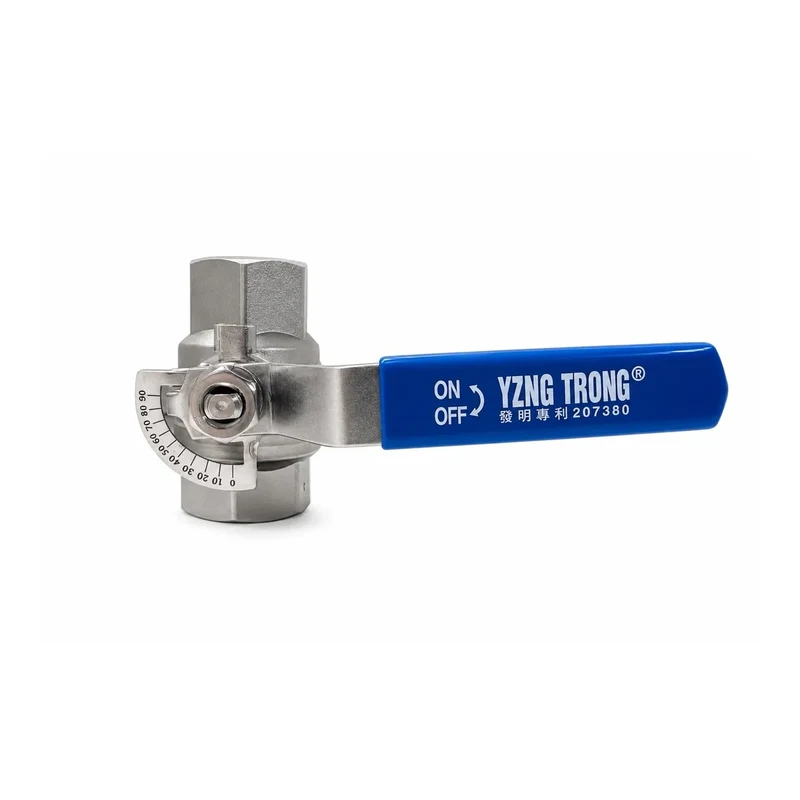
A memory stop ball valve in 304 stainless steel — the graduated plate under the handle is marked from 0° to 90° in 10° steps, and a locking pin holds the lever at the step you pick, so the same flow setting comes back every time.
Also called a flow control ball valve when it is used to set and hold a partial opening. The handle is made for our own ball valve series — tell us your valve model when ordering.
ISO 9001 · CE · Manufacturer since 1999 · Made in Taiwan
Description du produit
A memory stop ball valve gives you the shut-off of a standard ball valve plus a setting you can come back to. A scale plate marked from 0° to 90° in 10° increments sits under the handle, and a locking pin secures the lever at the notch you choose — 30°, 50°, or any other step, so the valve reopens to the same flow every time.
Pour les applications simples de régulation du débit, cette solution s'avère bien moins coûteuse qu'une vanne de régulation automatisée : un seul accessoire en acier inoxydable 304 au lieu d'un actionneur, d'un positionneur et d'un câblage.
Fonctionnement de la goupille de verrouillage
- Ensemble : Tournez la poignée jusqu'à l'angle souhaité, puis enclenchez la goupille de blocage dans l'encoche correspondante de la plaque graduée.
- Mise en attente : Lorsque la goupille est enclenchée, la poignée résiste aux vibrations de la canalisation et aux mouvements induits par le débit en fonctionnement normal ; pour modifier sa position, il faut désengager la goupille de manière délibérée.
- Répétez : operators can note a setting (“notch 3”) and return the valve to exactly the same flow after maintenance or flushing.
Caractéristiques techniques principales
| Matériau | Acier inoxydable ASTM 304 |
|---|---|
| Échelle | 0° – 90°, par paliers de 10° |
| Mécanisme | Goupille de verrouillage sur une plaque graduée |
| Convient à | Notre gamme de vannes à bille — veuillez nous indiquer le modèle de votre vanne lors de votre commande |
| SKU | HG-304 |
Robinet à boisseau sphérique + poignée graduée vs. vanne de régulation
Cette poignée convient à équilibrage manuel: les applications où l'on règle un débit une seule fois et où le système le maintient. Si votre processus nécessite un ajustement automatique en continu, c'est là qu'interviennent les vannes de régulation ; en revanche, pour les lignes de remplissage, de refroidissement ou de mélange qui ne nécessitent qu'un réglage reproductible, la poignée graduée fait l'affaire à un coût bien moindre.
Où est-il utilisé ?
- Équilibrage des systèmes de chauffage, de ventilation et de climatisation — réguler le débit d'eau chaude et d'eau froide vers les serpentins.
- Lignes de mélange — régler manuellement le rapport entre deux fluides.
- Contrôle des processus — en maintenant un débit constant pour le remplissage ou le refroidissement.
Quelle poignée vous faut-il ?
| Poignée | Choisissez-le quand |
|---|---|
| Poignée graduée (cette page) | Vous devez réguler le débit et bloquer la vanne dans une position reproductible. |
| Poignée verrouillable | La vanne doit être cadenassée dans le cadre de la procédure de verrouillage et d'étiquetage. |
| Poignée ovale | Vous recherchez une poignée confortable, facile à manipuler même avec des gants, pour une utilisation fréquente, ou une poignée de rechange. |
| Poignée allongée | La vanne est montée sur un tuyau isolé et la poignée doit ne pas toucher l'isolation. |
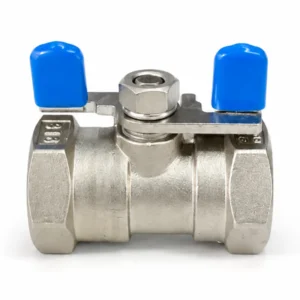
| Poignée papillon | You prefer a compact stainless T-shaped grip. |
Questions fréquemment posées
Un robinet à boisseau sphérique peut-il vraiment servir à réguler le débit ?
Pour un réglage manuel simple, oui. La plaque graduée vous permet de régler une ouverture partielle et de la bloquer à l'aide de la goupille de verrouillage. Pour les processus nécessitant un réglage continu et automatique, utilisez une vanne de régulation dédiée — cette poignée constitue la solution économique pour les applications de type « régler et maintenir ».
Quels sont les incréments de l'échelle ?
The plate is marked from 0° to 90° in 10° increments, so the valve locks at any of the ten positions.
Sur quelles vannes s'adapte-t-il ?
Our own ball valve series. The handle is made to match our valve stems, so we do not guarantee fit on other brands’ valves — include your valve model when ordering.
Est-ce que cela revient à un « memory stop » ?
Yes — this is a memory stop, with more than one position. A conventional memory stop limits the handle to a single preset opening; the graduated plate locks the lever at any 10° step from 0° to 90°, so you can record a setting and return to it whenever you want.
Les vibrations risquent-elles de modifier la position de la vanne ?
La goupille de verrouillage maintient la poignée dans l'encoche de la plaque, ce qui permet au dispositif de résister aux vibrations de la canalisation et à la pression du débit en fonctionnement normal. Pour modifier la position, l'opérateur doit délibérément retirer la goupille.
Comment puis-je obtenir un devis ?
Indiquez-nous la quantité et le modèle de vanne auquel la poignée est destinée. Nous répondons à toutes les demandes dans un délai de 24 heures.
Exemple de politique
Nous sommes heureux de fournir des échantillons de produits aux clients pour qu'ils puissent évaluer la qualité ou effectuer des tests. Le processus commence généralement par un devis basé sur les spécifications du client.
Si le prix est acceptable, nous pouvons proposer des échantillons gratuits ou payants en fonction du type de produit et de sa disponibilité.
Les frais d'expédition sont à la charge du client.
Processus de commande
Après avoir confirmé les exigences du produit et d'autres détails avec le client, nous émettons une confirmation de vente pour approbation. Une fois la confirmation obtenue, le client doit verser un acompte de 30% pour lancer la production.
Lorsque la production de masse est achevée et que les marchandises ont passé l'inspection, le client doit payer le solde 70% avant que l'expédition ne soit organisée.
Produits apparentés
-
 Accessoires pour vannes à bille
Oval Valve Handle — 304 Stainless Ball Valve, Vinyl-Coated Loop Grip, 1/4″–1″
-
 Accessoires pour vannes à bille
Ball Valve Handle Extension — 304 Stainless Ball Valve, Handle Raised 50 mm
-
 Accessoires pour vannes à bille
Locking Handle Ball Valve — 304 Stainless, Padlock Hole, Lockable Open or Closed
-
 Accessoires pour vannes à bille
Butterfly Handle Ball Valve — 304 Stainless T-Handle Grip
-
 Accessoires pour vannes à bille
Valve Actuator Mounting Kit — ISO 5211 Bracket & Stem Coupling, 304 Stainless
FAQ
A. Comment puis-je demander un devis ?
Veuillez fournir une demande détaillée comprenant les spécifications du produit, les matériaux, les quantités et toute exigence particulière. Nous vous proposerons un devis sur la base de votre demande.
B. Quelles sont les conditions de votre devis ?
Nos devis sont généralement basés sur Conditions FOB. Cependant, nous pouvons également offrir CFR, CIFou d'autres Incoterms sur demande.
C. Quelle est votre quantité minimale de commande (QMC) ?
MOQ depends on the product. We operate on a made-to-order basis, and trial orders are welcome. For smaller orders, freight is arranged and borne by the buyer.
D. Quelles sont vos conditions de paiement ?
Par T/T - 30% d'acompte à la confirmation de la commande, et 70% de solde avant l'expédition.
E. Quel est votre délai de livraison ?
Le délai de livraison dépend de la quantité commandée et des spécifications. Nous vous confirmerons le calendrier précis lorsque vous demander un devis.
Vous voulez en savoir plus ?
Si vous êtes intéressé par l'un de nos produits ou services, il vous suffit de remplir le formulaire ci-dessous. Notre équipe prendra contact avec vous dans les plus brefs délais pour vous fournir les informations dont vous avez besoin.