
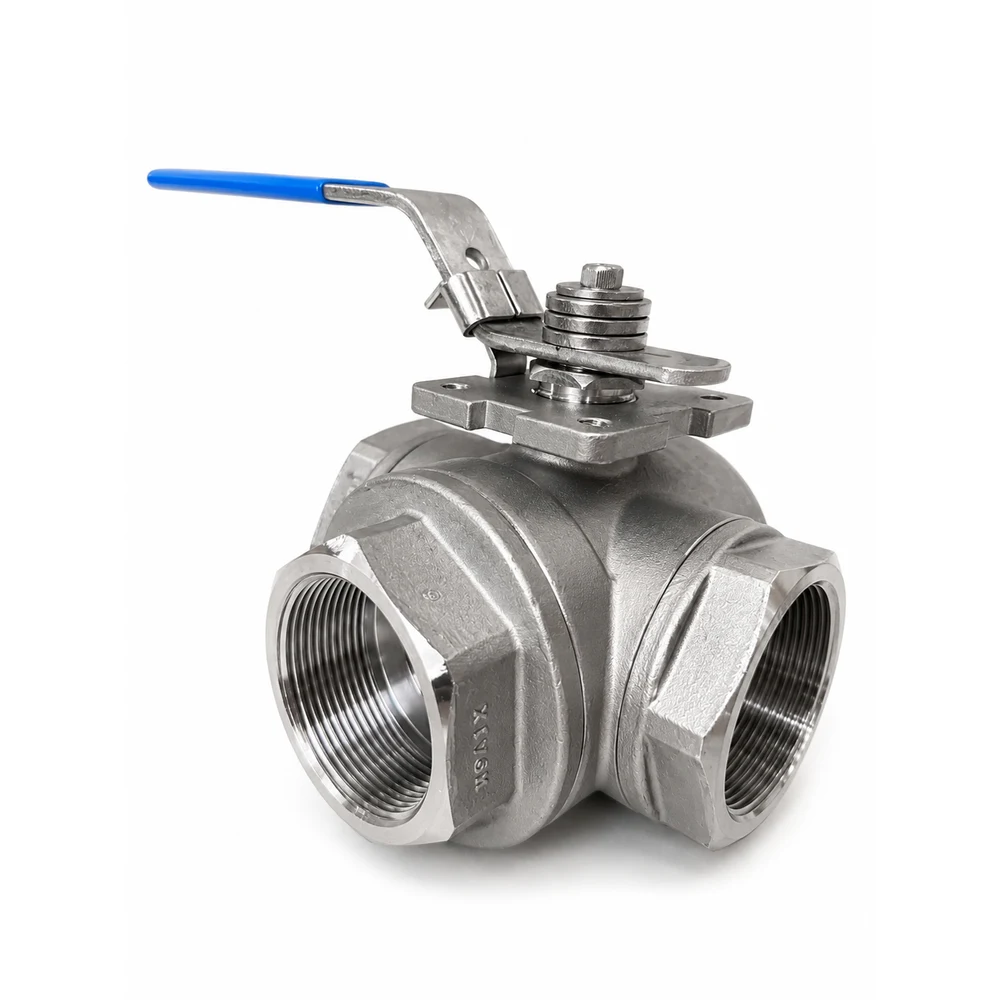
Nom du produit
Stainless Steel 3-Way Ball Valve – Manual, L-Port or T-Port, 316 CF8M, 1000 WOG, PT 1/4″–2″ (MV-3M)
Résumé du produit
A stainless steel 3-way ball valve in 316 (CF8M body), rated 1000 WOG, sizes 1/4″ to 2″. Choose a T-port ball to mix two lines or run straight through, or an L-port ball to divert flow 90° between two outlets — both in stock. PT threads in stock; NPT and PF made to order. PTFE seats, −20 °C to +180 °C, for water, oil and compressed air, and an ISO-style mounting pad so the same valve can be automated later.
ISO 9001 · CE · Fabricant depuis 1999
Description du produit
This stainless steel 3-way ball valve replaces two shut-off valves and a tee fitting with one body: divert flow between two lines with an L-port ball, or mix two streams into one with a T-port ball. Both ball types are stock builds — 3L and 3T of the same MV-3M series — in ASTM A351 CF8M, the cast form of 316 stainless steel; CF8 (cast 304) is made to order.
Sizes run 1/4″, 3/8″, 1/2″, 3/4″, 1″, 1-1/4″, 1-1/2″ and 2″ with female PT threads in stock; NPT and PF are made to order. Rated 1000 WOG with PTFE seats, −20 °C to +180 °C, for water, oil and compressed air. An ISO-style mounting pad is cast into the top, so the same valve can take a pneumatic or electric actuator later without re-piping.
Need automation now? See our vanne à bille pneumatique à 3 voies. For food and biotech lines, see the sanitary 3-way ball valve (Tri-Clamp).
T-Port vs L-Port — Which One Do You Need?
L-Port (Diverter) : directs flow from the bottom port to either the left or right port (or OFF). Ideal for switching between two tanks, two pumps or two supply lines — one valve does the changeover.
Port en T (mélangeur/diffuseur) : can connect all three ports simultaneously (mixing two lines into one), or direct flow straight through or at 90 degrees. Ideal for blending duty and bypass loops around strainers, meters or heat exchangers. Note that a T-port ball keeps at least two ports open in every handle position — it is a switching and mixing valve rather than a shut-off valve.
Both port types are in stock. For a full walkthrough with flow-path diagrams for every handle position, see our L-port vs T-port guide.
Caractéristiques techniques principales
| Type | Stainless steel 3-way ball valve — manual, L-port or T-port |
| Modèle | 3L (L-port) / 3T (T-port) — both in stock |
| Gamme de tailles | 1/4″, 3/8″, 1/2″, 3/4″, 1″, 1-1/4″, 1-1/2″, 2″ |
| Body, caps & ball | ASTM A351 CF8M — la version moulée de l'acier inoxydable 316 — en stock ; CF8 (304 moulé) fabriqué sur commande |
| Tige | SS316 |
| Sièges et joints | PTFE |
| Pression nominale | 1000 WOG |
| Température de fonctionnement | de −20 °C à +180 °C |
| Service media | Water, oil, compressed air |
| Fin de la connexion | Female PT (taper) threads in stock; NPT and PF made to order |
| Top mounting | ISO-style pad, actuator-ready — dimensions on the MV-3M dimension sheet (PDF) |
| Fonctionnement | Manual lever handle with position stopper |
Avantages et bénéfices
- System simplification: replaces multiple 2-way valves and T-fittings, reducing installation cost and space.
- Versatile flow management: mixing or diverting flow depending on the port configuration chosen.
- Actuator-ready: the ISO-style top pad means you can automate the same valve later — no re-piping.
- Corrosion resistance: 316 stainless steel with added molybdenum resists pitting from chloride-bearing media, indoors or outdoors.
Applications
A 3-way ball valve earns its place wherever an operator has to send flow one way or the other, or blend two streams. Typical duties:
- Tank-to-tank source switching (L-port): selecting which of two storage tanks feeds a line, or routing product from one tank to another, with a single valve instead of two shut-offs.
- Duty / standby pump switching (L-port): connecting either the duty or the standby pump to the downstream line, so operators can change pumps without re-piping.
- Bypass around a filter or heat exchanger (L-port): routing flow around equipment taken offline for service in general industrial plants, instead of operating several isolation valves.
- Sample and stream selection: switching between process streams to send one to a sampling point or analyser, or purging a sample line before analysis.
- Duplex strainer changeover (T-port): switching between two strainer or filter vessels so the offline side can be serviced without stopping flow.
- Hot and cold water blending (T-port): mixing two supply streams in variable proportion to hit a target outlet temperature in building HVAC and process water loops.
- Chemical blending and dispense/recirculation switching (T-port): proportioning two liquid streams, or switching a feed line between a dispense path and a recirculation loop in chemical processing.
- Compressed air routing: directing plant air to one of two downstream lines or tools, or venting one line while supplying another.
Not for potable water, fuel gas (natural gas or LPG), steam, oxygen or cryogenic service — those duties need valves certified or built for them.
FAQ
L-port or T-port — which should I choose? Choose L-port to switch flow between two destinations (two tanks, two pumps, two lines). Choose T-port to mix two lines into one, run straight through, or divert to a third port. Both are in stock.
Can a 3-way ball valve shut off flow completely? Treat a 3-way as a switching valve rather than an isolation valve: a T-port ball keeps at least two ports connected in every handle position. Where a line needs positive isolation as well as switching, pair it with a two-way ball valve upstream, which we build in the same 316 body. Tell us your switching pattern and we will confirm the build.
Can this valve be automated later? Yes. It has an ISO-style top mounting pad, so a pneumatic or electric actuator mounts directly. If you want it supplied automated, see our vanne à bille pneumatique à 3 voies.
Quelles sont les normes de filetage disponibles ? Female PT (taper) threads are in stock, sizes 1/4″–2″. NPT and PF are made to order — tell us which standard your piping uses when you request a quote.
What is the working temperature range? −20 °C to +180 °C (−4 °F to +356 °F), limited by the PTFE seats. The valve is not rated for steam service.
304 ou 316 — lequel choisir ? The standard valve is CF8M (cast 316), in stock — its molybdenum content resists pitting from chlorides. CF8 (cast 304) is made to order for general water and air duty.
Exemple de politique
Nous sommes heureux de fournir des échantillons de produits aux clients pour qu'ils puissent évaluer la qualité ou effectuer des tests. Le processus commence généralement par un devis basé sur les spécifications du client.
Si le prix est acceptable, nous pouvons proposer des échantillons gratuits ou payants en fonction du type de produit et de sa disponibilité.
Les frais d'expédition sont à la charge du client.
Processus de commande
Après avoir confirmé les exigences du produit et d'autres détails avec le client, nous émettons une confirmation de vente pour approbation. Une fois la confirmation obtenue, le client doit verser un acompte de 30% pour lancer la production.
Lorsque la production de masse est achevée et que les marchandises ont passé l'inspection, le client doit payer le solde 70% avant que l'expédition ne soit organisée.
Produits apparentés
-
 Vannes à bille manuelles
90 Degree Ball Valve – Elbow Body, 316 CF8M, Full Port, 1000 WOG, PT 1/2″–2″ (V-2D)
-
 Vannes à bille manuelles
Camlock Valve – Stainless Steel Ball Valve with Male Camlock Adapter, 1-1/2″ & 2″, 1000 WOG
-
 Vannes à bille manuelles
2000 WOG Ball Valve – Two-Piece 316 Stainless, High Pressure, Full Port, PT 1/4″–2″ (V-2NF)
FAQ
A. Comment puis-je demander un devis ?
Veuillez fournir une demande détaillée comprenant les spécifications du produit, les matériaux, les quantités et toute exigence particulière. Nous vous proposerons un devis sur la base de votre demande.
B. Quelles sont les conditions de votre devis ?
Nos devis sont généralement basés sur Conditions FOB. Cependant, nous pouvons également offrir CFR, CIFou d'autres Incoterms sur demande.
C. Quelle est votre quantité minimale de commande (QMC) ?
MOQ depends on the product. We operate on a made-to-order basis, and trial orders are welcome. For smaller orders, freight is arranged and borne by the buyer.
D. Quelles sont vos conditions de paiement ?
Par T/T - 30% d'acompte à la confirmation de la commande, et 70% de solde avant l'expédition.
E. Quel est votre délai de livraison ?
Le délai de livraison dépend de la quantité commandée et des spécifications. Nous vous confirmerons le calendrier précis lorsque vous demander un devis.
Vous voulez en savoir plus ?
Si vous êtes intéressé par l'un de nos produits ou services, il vous suffit de remplir le formulaire ci-dessous. Notre équipe prendra contact avec vous dans les plus brefs délais pour vous fournir les informations dont vous avez besoin.