
In my 35 years at Yzng Trong International, I have seen our valves installed in some of the most advanced factories on Earth, but nothing satisfies me more than seeing our technology applied to the soil. We are currently living through a global agricultural revolution where water is no longer seen as an infinite resource, but as a “liquid asset” that must be managed with absolute precision. This is where Industrial Valves for Smart Agriculture play their most critical role. For decades, agricultural irrigation was a matter of turning a manual wheel and letting gravity do the rest. Today, we are moving toward a future of “Smart Farming,” where sensors in the ground tell a computer exactly when a plant is thirsty, and that computer signals an automated valve to deliver a precise milliliter of water.
This transition from manual to digital farming has fundamentally changed the requirements for the valves we manufacture. In the past, a “farm valve” just had to be cheap and rugged. Today, Industrial Valves for Smart Agriculture must be rugged, but they must also be precise, automation-ready, and capable of operating in remote environments with minimal maintenance. At Yzng Trong, we have embraced this challenge, adapting our high-quality stainless steel and UPVC valve lines to meet the unique stresses of the agricultural world—from the corrosive chemicals in liquid fertilizers to the high-sediment water found in rural irrigation canals. My journey has taken me from the vast grain fields of the USA to the intensive aquaculture farms of Southeast Asia, and in every location, the story is the same: the right valve is the key to a sustainable and profitable harvest. This guide is a reflection of that experience, sharing how we bridge the gap between traditional farming and the digital future.
Cultivating the Future: My 35-Year Experience with Industrial Valves for Smart Agriculture
When I first started in the industry in 1990, “agricultural valves” usually meant simple cast-iron gates that were prone to rust and leaking. I remember visiting a massive citrus grove where they were losing nearly 30% of their water through faulty connections and inefficient manual control. It was a wake-up call. I realized that if we could apply the same standards of precision we used in the chemical industry to the farm, we could change the world’s water footprint. This led to the development of our specific line of Industrial Valves for Smart Agriculture. We focused on creating valves that could handle the grit of unfiltered well water while offering the mounting pads (ISO 5211) necessary for remote actuation.
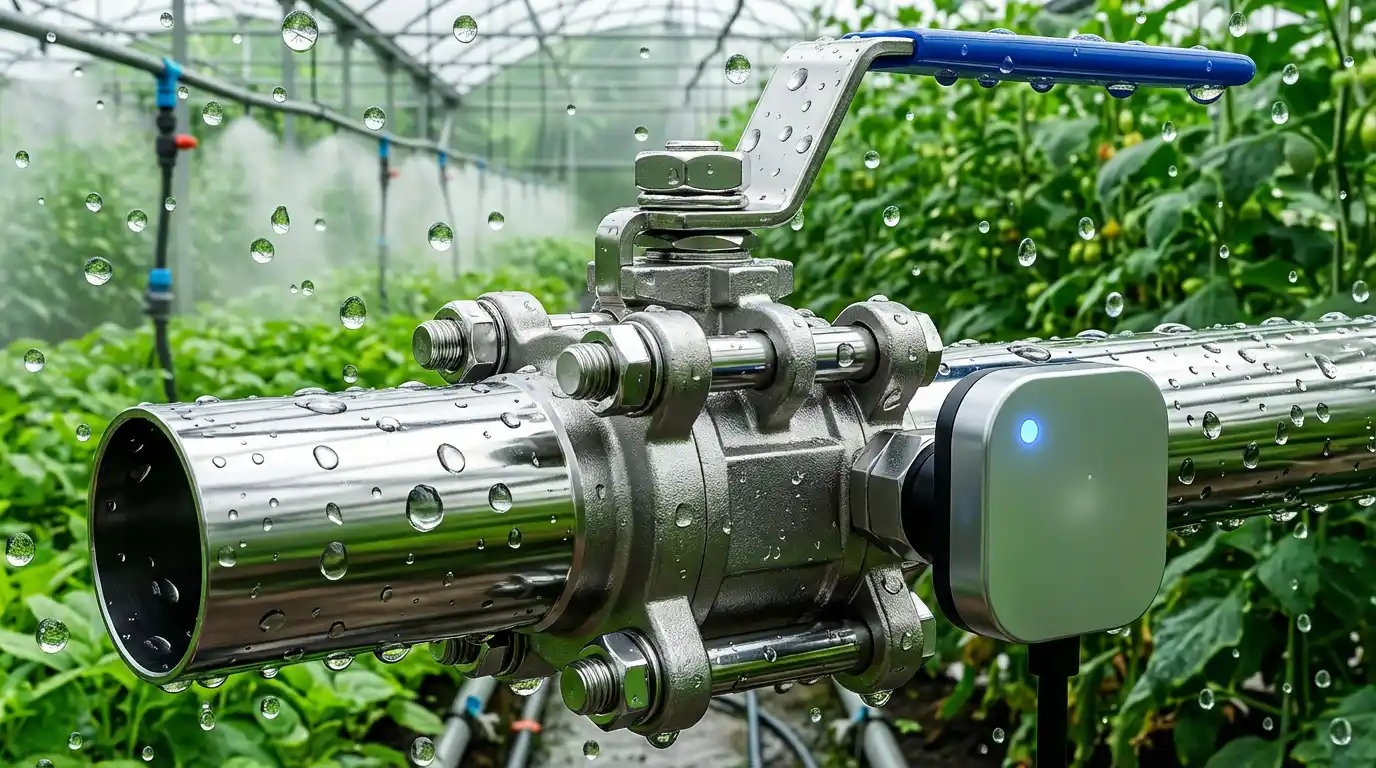
Over the years, the feedback from farmers has been our greatest source of innovation. A farmer doesn’t care about the “metallurgy” in the abstract; they care that the valve doesn’t seize up after six months of being buried in a damp field. That’s why we moved toward Grade 304 and 316 stainless steel for our premium Industrial Valves for Smart Agriculture. These materials provide the corrosion resistance needed to survive the salts and minerals found in agricultural runoff. I’ve personally supervised installations in smart greenhouses where our valves are integrated into IoT (Internet of Things) networks, allowing a farmer to control their entire irrigation system from a smartphone in their kitchen. Seeing that level of efficiency—where every drop of water is accounted for—is what motivates us at Yzng Trong to keep pushing the boundaries of what a valve can do for the planet.
The Evolution of Irrigation: From Manual Gates to Precision Control
The most significant shift in the history of Industrial Valves for Smart Agriculture is the move away from “all or nothing” flow control toward “proportional” control. In the old days, you either had the water on or you had it off. This led to over-saturation in some areas and drought in others. Modern smart agriculture uses automated valves equipped with positioners that can open to a specific percentage—say, 15%—to maintain a constant, low-flow drip. This level of control is essential for modern drip irrigation systems, which are the gold standard for water conservation. At Yzng Trong, we’ve engineered our valves to handle these fine adjustments without the “chatter” or vibration that often plagues lesser-quality products.
Integrating IoT and Sensors with Automated Valve Systems
The magic of Industrial Valves for Smart Agriculture happens when they are connected to a network of soil moisture sensors and weather stations. In my recent projects, we have integrated our pneumatic and electric actuated valves into systems that automatically adjust based on the local evapotranspiration rate. If the sensors detect that the soil is reaching its “wilting point,” the system opens the valves. If the weather forecast predicts heavy rain, the system keeps the valves closed to prevent runoff. This “demand-based” irrigation is only possible if the valves are reliable enough to operate without human intervention for months at a time. We ensure that our automated Industrial Valves for Smart Agriculture have low power consumption and high IP (Ingress Protection) ratings, making them ideal for the solar-powered control hubs often found in remote fields.
Managing Water Rights through Digital Flow Regulation
Water rights and water allocation are becoming contentious issues in many parts of the world, from the Murray-Darling Basin in Australia to the Central Valley of California. In these regions, Industrial Valves for Smart Agriculture are being used as “meters” to ensure that each farm is taking only its allotted share of water. By using valves equipped with flow meters and digital feedback loops, water authorities can monitor usage in real-time. My 35 years of experience have shown me that “integrity” in water management starts with the hardware. If a valve leaks or can be easily bypassed, the entire water management system collapses. At Yzng Trong, we provide the tamper-proof, high-precision valves that make fair and sustainable water allocation possible. We aren’t just selling a valve; we are selling the transparency and trust that modern agricultural communities need to survive.
Material Resilience in Agricultural Environments
One of the most difficult challenges for Industrial Valves for Smart Agriculture is the sheer diversity of the environment. A valve on a farm might be exposed to UV radiation, extreme temperature fluctuations, abrasive sand, and aggressive chemicals like nitrogen and phosphorus fertilizers. I’ve seen valves that worked perfectly in a clean lab environment fail within weeks when exposed to “fertigation”—the process of injecting fertilizers directly into the irrigation water. This chemical cocktail is highly corrosive to standard metals. That is why at Yzng Trong, we often recommend a mix of materials, such as our stainless steel ball valves for high-pressure lines and our UPVC or PVDF valves for chemical injection points.
Choosing the right material for Industrial Valves for Smart Agriculture is a matter of balancing cost with lifecycle. While a plastic valve might be cheaper initially, it can degrade under intense UV light or crack in freezing temperatures. Conversely, a high-grade 316 stainless steel valve provides a lifetime of service but requires a higher upfront investment. My role in the last 35 years has been to help farmers find that “sweet spot.” We’ve developed specialized coatings and seal materials, like EPDM and Viton, that are resistant to the specific chemicals found in modern pesticides and fertilizers. By ensuring the material resilience of our Industrial Valves for Smart Agriculture, we help farmers avoid the costly and frustrating task of replacing failed equipment in the middle of a growing season. We build our valves to be as tough as the farmers who use them.
Specialized Applications: Aquaculture and Hydroponics
Beyond traditional field crops, Industrial Valves for Smart Agriculture are finding critical roles in the booming sectors of aquaculture (fish farming) and hydroponics. In these systems, water is the lifeblood, and any disruption in flow or water quality can lead to a total loss of the “crop” within hours. In a large-scale recirculating aquaculture system (RAS), valves are used to manage oxygenation, filtration, and waste removal. I have consulted on projects for indoor salmon farms where our valves are cycled hundreds of times a day to maintain the perfect water chemistry. In these environments, “reliability” is not a luxury—it is the difference between life and death for thousands of fish.
Maintaining Dissolved Oxygen and Nutrient Balance in Fish Farming
In aquaculture, Industrial Valves for Smart Agriculture are often used to control the injection of pure oxygen into the water tanks. If the oxygen levels drop, the fish will suffocate; if they are too high, it can be toxic. Our precision ball and needle valves allow for the micro-adjustment of these gas flows. My experience has taught me that the “seal integrity” in these valves is paramount. Even a tiny leak of oxygen can lead to an explosion risk in an enclosed facility. We provide the certified, oil-free Industrial Valves for Smart Agriculture that these sensitive environments require. By ensuring a steady and precise flow of oxygen and nutrients, we help aquaculture producers achieve faster growth rates and healthier fish, contributing to global food security in an increasingly crowded world.
Corrosive Resistance for Liquid Fertilizer and Chemical Distribution
Hydroponic and aeroponic systems are essentially “chemical flow systems” where plants are grown without soil. The water is a nutrient-rich solution that is constantly recirculated. Because this solution is often acidic or contains high concentrations of mineral salts, it is incredibly aggressive toward standard industrial equipment. This is where our high-performance Industrial Valves for Smart Agriculture excel. We provide valves that are designed with “full-port” flow to prevent the buildup of nutrient salts that can clog smaller orifices. I remember a hydroponic lettuce farm that was struggling with “clogged valves” that were stopping their nutrient flow. We swapped their standard valves for our Y-pattern and ball-type Industrial Valves for Smart Agriculture, and their maintenance calls dropped by 80%. It’s this practical, problem-solving approach that has made Yzng Trong a leader in the precision agriculture space.
Strategic Comparison: Choosing Valves for Agricultural Systems
To help farmers and irrigation engineers make the best choice for their specific needs, I’ve compiled a comparison table of the most common Industrial Valves for Smart Agriculture. Selecting the right valve is a matter of matching the flow requirements, the pressure, and the environment. In my 35 years, I’ve seen that the most “expensive” valve is the one that fails when you need it most. This table is designed to help you avoid that mistake by aligning the technical specs with the real-world agricultural challenge. We look at everything from “clog resistance” to “automation compatibility” to ensure that your smart farm remains a success.
| Valve Category | Material | Automation Ready | Best Application | Clog Resistance |
| 3-PC Ball Valve | SS304 / SS316 | Yes (ISO 5211) | High-pressure mainlines | High |
| Butterfly Valve | SS316 / UPVC | Yes | Large-volume water transfer | Medium |
| UPVC Ball Valve | UPVC / PVDF | No (Manual) | Fertigation & Chemical lines | High |
| Gate Valve | Cast Iron / SS | No | Low-pressure gravity flow | Low |
| Check Valve | SS304 / SS316 | N/A | Backflow prevention in pumps | Medium |
| Solenoid Valve | SS / Brass | Yes (Digital) | Small-scale drip & greenhouse | Low |
When you review this table, notice that for any “smart” application, the ability to automate (ISO 5211) is non-negotiable. If you want to integrate into an IoT network, your Industrial Valves for Smart Agriculture must be compatible with standard actuators. At Yzng Trong, we focus on providing these “automation-ready” solutions. We also prioritize “Clog Resistance,” because in the real world, water isn’t always clean. A valve that gets stuck because of a bit of algae or sand is a liability. Our 3-piece ball valves are particularly popular because if they do get clogged, they can be disassembled and cleaned in minutes without cutting the pipe. This level of practical engineering is what makes our Industrial Valves for Smart Agriculture the preferred choice for the modern, tech-savvy farmer.
The Yzng Trong Mission: Sustaining the Planet through Precision Flow
In the end, our work with Industrial Valves for Smart Agriculture is about more than just business; it is about the future of our planet. As the global population grows toward 10 billion, we must learn to grow more food with less water. This is the great challenge of our time, and at Yzng Trong International, we are proud to be part of the solution. Our 35 years of “Commercial Integrity” mean that we provide the high-quality, long-lasting hardware that makes sustainable farming possible. We aren’t just selling a valve; we are selling a tool for conservation. When a farmer uses our valves to reduce their water usage by 20%, that is a victory for everyone.
As we look toward the future, we are continuing to innovate, developing Industrial Valves for Smart Agriculture that are even more efficient and easier to use. We are exploring the use of low-power wireless actuators that can be controlled via satellite, ensuring that even the most remote farms can benefit from precision irrigation. But no matter how much the technology changes, our core commitment to quality will remain the same. We are the “vascular surgeons” of the farm, ensuring that the water—the lifeblood of the soil—flows exactly where and when it is needed. Thank you for trusting Yzng Trong to be part of your agricultural journey. Together, we can ensure that the next 35 years are a period of abundance, sustainability, and technological progress for farmers everywhere.