Ball valve manufacturing comes down to four things a buyer can actually check: what the body is cast from, how it is machined, how the body joint is made, and whether every finished valve is tested before it ships. This article walks through each of them at YZNG TRONG, a stainless steel ball valve manufacturer in Taiwan with its own factory since 1999. It is written for buyers who want to know what they are paying for.
Most articles on this topic describe a generic process. We can only speak for our own line, so that is what we do here.
Casting vs forging: why our ball valve bodies are investment cast CF8 and CF8M
Stainless steel ball valve bodies are made in one of two ways: cast, where molten steel is poured into a mould, or forged, where a solid bar is shaped under pressure. Our ball valve bodies are investment cast, in two grades: CF8 (cast 304) and CF8M (cast 316).
Stainless steel is what we stock. Carbon steel bodies are not a stock item, but they can be made to order when the quantity justifies a production run.
Investment casting, also called lost-wax casting, builds a ceramic shell around a wax pattern, melts the wax out, and pours steel into the cavity. The Investment Casting Institute describes the process in detail in its introduction to investment casting. For a valve body the practical outcome is a near-net shape with internal passages already formed, so machining removes less material and the wall thickness follows the design rather than the limits of a cutting tool.
Forging has its place. Forged bodies are common in small high-pressure valves where the shape is simple. For the body shapes and sizes we build, from 1/4 inch two-piece valves to 8 inch flanged valves, casting gives us the geometry we need.
CF8 vs CF8M: which grade your application actually needs
CF8 is the cast form of 304 stainless steel. CF8M is the cast form of 316 stainless steel, and the difference is molybdenum. The trigger for moving from CF8 to CF8M is chloride exposure and the pitting risk that comes with it, not whether the medium is acidic or alkaline.
Seawater, brine, coastal air and chlorinated wash-down are 316 territory. Clean water, air and most oils are usually fine in 304.
Both grades are covered by ASTM A351, the specification for austenitic steel castings for pressure-containing parts. A material test report (MTR) for the castings is available on request, so your quality team can have the chemistry on file.
| Point of comparison | CF8 (cast 304) | CF8M (cast 316) |
|---|---|---|
| Key alloying difference | Chromium and nickel | Adds molybdenum |
| Main reason to choose it | General service, lower cost | Chloride exposure, pitting resistance |
| Supports typiques | Water, air, oils, many process fluids | Seawater, brine, chlorinated cleaning, coastal or marine installations |
| Wrought equivalent | 304 | 316 |
| Availability at YZNG TRONG | Available; stock or made to order varies by series, see each product page | Available; stock or made to order varies by series, see each product page |
If you are unsure which grade a line needs, tell us the medium, the temperature and whether chlorides are present. That is enough to make the call, and it is a better basis than defaulting to 316 everywhere.
CNC machining the body, ball and stem
After casting, the body, end caps, ball and stem are CNC machined. The bore, the seat pockets, the stem passage and the end connections are cut in this stage, and the end connection is where most specification questions land. Our threaded ball valves are available in PT, NPT or PF threads, and our guide to valve end connections explains how threaded, socket weld and butt weld ends differ.
One design detail that matters more than most buyers realise is the stem. Our ball valves use a blowout-proof stem that is installed from inside the body. If the gland nut is ever loosened while the line is pressurised, the stem is held in by the body itself rather than by the packing nut. It is a small machining decision with a large safety consequence.
Seal-welded two-piece bodies: what the weld does, and where we do not use it
A conventional two-piece ball valve has a threaded joint between the body and the end cap. That joint is a potential leak path to atmosphere. In our V-2B and V-2C two-piece valves, the body and end cap are joined by a weld, so there is no threaded body joint to loosen or weep. The construction is known in the industry as a seal-welded body.
It is recognised in MSS SP-110, the Manufacturers Standardization Society standard that covers threaded, socket-welding and grooved-end ball valves.
We are equally clear about where the weld stops. Our 4 inch V-2B uses a bolted end cap rather than a welded joint. The socket weld version, V-2B-SW, is a welded body across the full 1/4 inch to 4 inch range. When a seal-welded valve is itself being welded into a pipeline, the valve must stay assembled during welding and should be cooled immediately afterwards to protect the PTFE seats. The seal-welded ball valve product page lists the sizes, threads and pressure rating.
| Structure de la carrosserie | How the body joint is made | Where we use it | What to watch |
|---|---|---|---|
| Seal-welded two-piece | End cap welded to body | V-2B and V-2C (except the 4 inch V-2B); V-2B-SW 1/4 to 4 inch | Keep the valve assembled when welding into the line; cool promptly |
| Bolted two-piece | End cap bolted to body | V-2B 4 inch | Bolts allow larger sizes to be serviced |
| En trois pièces | Two end caps bolted to a centre body | V-3A series | Centre section can be removed for seat replacement without disturbing the pipe |
| A brides | Flanged body, bolted to pipe flanges | Manual and pneumatic flanged series | Match the flange standard, JIS 10K/20K or ANSI 150/300 |
For a broader comparison of one-piece, two-piece and three-piece designs, see our ball valve body types guide.
Testing per API 598, and what ships with the valve
Every valve we ship is leak tested before it leaves the factory. Not a sample, every valve. Our test method is API 598, the American Petroleum Institute standard for valve inspection and testing that defines shell and seat tests and the allowable leakage for soft-seated valves.
API 598 is a test method, not a certification, and we state it that way. Finished valves are also checked dimensionally before packing, and our quality management system is certified to ISO 9001. The API standards catalogue lists the current edition of API 598.
Buyers often ask which standards apply to a ball valve. They govern different things, and the table below separates them.
| Standard | What it governs | How it relates to our valves |
|---|---|---|
| API 598 | Inspection and pressure testing of valves, including allowable seat leakage | Our factory test method for finished valves |
| ASTM A351 | Chemistry and properties of austenitic stainless steel castings | The specification behind CF8 and CF8M bodies; documented in the MTR |
| MSS SP-110 | Design and construction of threaded, socket-welding and grooved-end ball valves | Recognises the seal-welded construction used in V-2B and V-2C |
| ISO 5211 | Mounting pad dimensions between a quarter-turn valve and its actuator | Used on our pneumatic actuated series so actuators interchange |
| ASME B16.34 | Pressure-temperature ratings for flanged, threaded and welding-end valves | The system behind the ANSI Class 150 and 300 designations on flanged valves, published by ASME; our threaded and welded series carry WOG ratings instead, explained below |
Our standard two-piece and three-piece series are rated 1000 WOG, and the V-2NF two-piece series is rated 2000 WOG. If the WOG marking is new to you, our WOG pressure rating explainer covers what the number means and what it does not.
Surface finish on standard product is pickled.
How to specify a stainless steel ball valve: a checklist for your RFQ
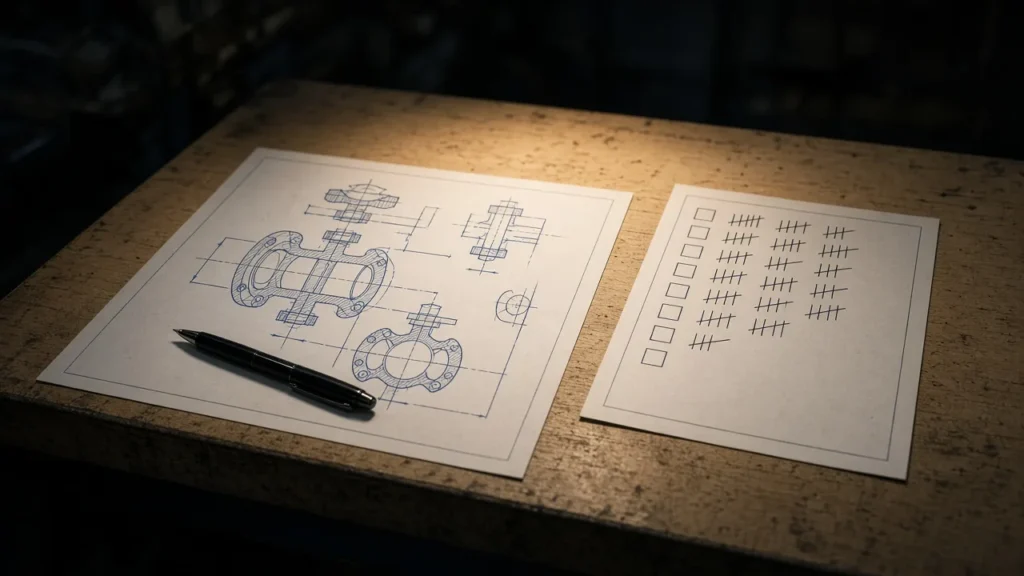
Most quotation delays come from missing information, not from the factory. If your request for quotation covers the ten items below, any manufacturer can price it accurately the first time, and you can compare quotations line by line instead of guessing what each supplier assumed.
| Article | What to state | Why it changes the quote |
|---|---|---|
| Structure de la carrosserie | One-piece, two-piece (threaded or seal-welded), three-piece or flanged | Decides the series, the price band and whether seats can be replaced in the line |
| Taille | Nominal size per line, in inches or DN | Some constructions change at larger sizes, for example the bolted 4 inch V-2B |
| Nuance de matériau | CF8 (304) or CF8M (316) | CF8M costs more; choose it for chlorides, not by default |
| End connection and thread standard | Threaded PT, NPT or PF; socket weld; butt weld; flanged with the flange standard | PT and NPT are not interchangeable; a wrong thread is a wrong valve |
| Pressure and temperature | Working pressure and temperature range of the line | Confirms whether a 1000 WOG rating is enough and whether the seat material suits the temperature |
| Moyen | What flows through, and whether chlorides are present | Drives the grade choice and the seat choice |
| Actionnement | Manual handle, pneumatic or electric actuator; ISO 5211 pad if you mount your own actuator | Actuated valves are a different series with a different lead time |
| Notation | Standard marking, or private label by laser, stamp, label or box | Private label needs artwork approval before production |
| Documents | MTR, dimensional drawing, test report if your project requires them | Documents such as the MTR are supplied on request, and are easier to arrange at order stage than after shipment |
| Quantity and timing | Quantity per line, and whether made-to-order is acceptable | Stock items ship sooner; made-to-order items are scheduled into production |
Five specification mistakes we see, and how to avoid them
The same handful of errors account for most of the valves that arrive and cannot be installed. None of them are hard to prevent once you know to look.
- Specifying 316 everywhere. If there are no chlorides in the medium or the environment, CF8 does the job and costs less. Save CF8M for where it earns its price.
- Mixing PT and NPT. They look alike and are not interchangeable. State the thread standard on every line item, and check it against the fittings already on site.
- Reading 1000 WOG as a temperature rating. WOG is a cold working pressure for water, oil and gas. It says nothing about hot service, and the seat material sets the temperature limit. Our WOG explainer covers what the marking does and does not tell you.
- Welding a seal-welded valve after taking it apart. The valve must stay assembled while it is welded into the line and should be cooled straight afterwards, or the PTFE seats are damaged before the first cycle.
- Ordering by size and grade only. Two valves with the same size and grade can differ in body construction, port, stem design and handle. Name the construction, or send the drawing, so the factory quotes the valve you actually need.
Marking, private label and packaging
The last stage before packing is marking. For OEM and private label orders we offer laser marking, steel stamping, adhesive labels and printed colour boxes with your brand.
Who actually manufactures ball valves? Brand owners, foundries and OEM partners
Three kinds of companies sit behind the ball valves on the market. Brand owners design and sell under their own name, foundries cast bodies and sell castings, and OEM manufacturers cast, machine, assemble and test complete valves for brand owners to sell under the customer’s name. YZNG TRONG is the third kind, an OEM manufacturer with its own factory in Taiwan.
We ship to North America, Europe, Southeast Asia, the Middle East and Australia, and our factory produces more than 20 million pieces a year.
For OEM and ODM buyers, three things are on the table from the first conversation: an NDA, engineering support to modify a design, and dedicated tooling for your own pattern. We also build to customer drawings.
Le about YZNG TRONG page covers the factory, and the full product list shows the standard range that OEM work is built from.
A note on price: we are not the cheapest quote you will get
We will say this plainly, because buyers find it out anyway. If the lowest unit price is the only criterion, another factory will win the order. What we put into the price is inspection: every valve is leak tested and checked before it goes into the carton, not a sample from the batch.
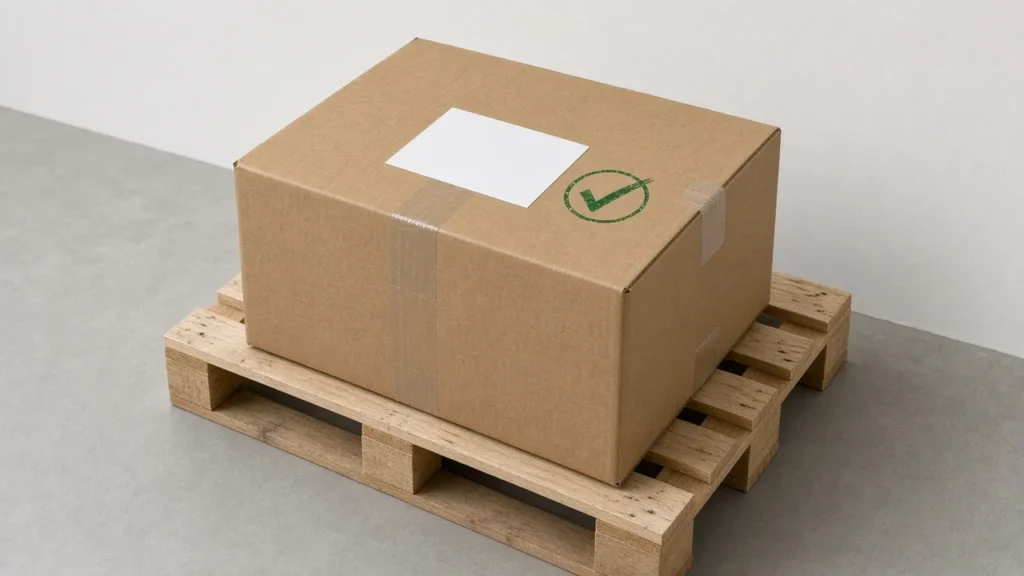
The cost of a cheap valve rarely shows up on the invoice. It shows up when a carton arrives and a share of the pieces leak on the test bench, or worse, in the line, and someone has to sort, return and re-order while the project waits. We would rather lose a quote on price than ship that carton. If your buying decision weighs landed cost, rework and schedule risk together rather than unit price alone, we are worth a quotation.
Lead time and how to get a quote
Regular items ship from stock. Everything else is made to order. Samples are available and are charged. Send us the series, size, material grade, thread standard and quantity and we will come back to you.
Demander un devis — réponse sous 24 heures →
Frequently asked questions
How are stainless steel ball valves made?
The body and end caps are cast, in our case by investment casting in CF8 or CF8M stainless steel. The castings, ball and stem are then CNC machined to form the bore, seat pockets, stem passage and end connections. The valve is assembled with PTFE seats and a blowout-proof stem, the body joint is either welded or bolted depending on the series, and every finished valve is leak tested, using API 598 as the test method, and checked dimensionally before it is marked and packed.
What is the difference between CF8 and CF8M?
CF8 is cast 304 stainless steel and CF8M is cast 316 stainless steel. The difference is molybdenum, which improves resistance to pitting caused by chlorides. Choose CF8M when the medium or the environment contains chlorides, such as seawater, brine, coastal air or chlorinated cleaning solutions. For clean water, air and most oils, CF8 is normally sufficient. Both are specified under ASTM A351, and a material test report is available on request.
What is a seal-welded ball valve?
A seal-welded ball valve is a two-piece valve whose body and end cap are joined by a weld instead of a thread. Removing the threaded body joint removes one leak path to atmosphere. The construction is recognised in MSS SP-110. Our V-2B and V-2C series use it, with one exception: the 4 inch V-2B uses a bolted end cap. The V-2B-SW socket weld series is seal-welded across the full 1/4 to 4 inch range.
What standards apply to ball valve manufacturing?
Different standards cover different parts of the job. ASTM A351 specifies the stainless steel castings, while MSS SP-110 covers the design of threaded and socket-welding ball valves. ISO 5211 defines the actuator mounting pad. For pressure-temperature ratings there is ASME B16.34, and for the factory test itself there is API 598, which defines how finished valves are pressure tested and how much seat leakage is allowed. API 598 is a test method rather than a certification, so a manufacturer states that valves are tested per API 598, not certified to it.
Do you make ball valves to customer drawings or under a private label?
Yes. We build to customer drawings and supply OEM and ODM orders under the customer’s brand. Private label options are laser marking, steel stamping, adhesive labels and printed colour boxes. An NDA, engineering support for design changes and dedicated tooling are available. Regular catalogue items ship from stock and everything else is made to order. Send the drawing or the specification and we will reply.
Summary
A stainless steel ball valve is only as good as the steps nobody sees: the grade that was poured, the joint that was welded or bolted, and the test that every valve passed before it was boxed. Our line runs investment casting in CF8 and CF8M, CNC machining, seal-welded or bolted bodies depending on size, and a leak test and dimensional check on every valve, with a material test report available on request. We are not the cheapest option, and we do not try to be; what we offer is a valve that has been tested before it ships, so what arrives is what you specified. If that is the kind of manufacturing you want behind your brand or your plant, send us the specification.