
Quick Summary: Helium leak testing uses a helium mass spectrometer leak detector (MSLD) to quantify microscopic gas leaks in vacuum-rated valves down to 10-9 mbar·L/s (10-10 Pa·m³/s) and beyond. Unlike a standard bubble leak test—which stops around 10-3 to 10-4 mbar·L/s—helium testing verifies both body (shell) integrity and valve seat leakage for rough-to-high vacuum applications such as KF ball valve forelines and pumping systems.
If you are sourcing a vacuum rated ball valve for a pumping foreline, coating system, degassing chamber, or high-purity gas line, “100% leak tested” on a brochure does not tell you enough. Standard industrial valve leak tests are built for positive pressure, not vacuum. Knowing how a helium mass spectrometer leak test works—and how to write realistic helium leak test acceptance criteria on your RFQ—prevents vacuum pump-down failures, disputed inspections, and unnecessary cost.
Evaluating whether a ball valve fits your vacuum pressure range first? Read our guide on using ball valves in vacuum systems for rough, medium, and high-vacuum selection criteria.
Why Standard Bubble Leak Tests Are Not Enough for Vacuum-Rated Valves
A bubble leak test (air-under-water or soap-solution testing) is reliable for general industrial shut-off valves operating under positive pressure, but it cannot detect molecular-level leaks that degrade a vacuum system.
During a bubble leak test, the valve is pressurized with air or nitrogen and submerged in water. An operator watches for escaping bubbles. Even under careful inspection, the practical sensitivity limit of a bubble test is roughly 10-3 to 10-4 mbar·L/s. A leak smaller than that produces no visible bubbles—yet under vacuum, atmospheric air continuously seeps inward through micro-paths in castings, threaded joints, or stem packings, preventing the chamber from reaching base pressure.
Comparison of Common Vacuum Leak Testing Methods
| Testing Method | Typical Sensitivity Limit (mbar·L/s) | Typical Sensitivity Limit (Pa·m³/s) | Best Suited For | Key Limitation |
|---|---|---|---|---|
| Bubble Leak Test (Air-Under-Water) | 10-3 to 10-4 | 10-4 to 10-5 | Standard industrial water, oil, gas & compressed air valves | Operator-dependent; cannot detect fine vacuum leaks |
| Pressure Decay / Vacuum Decay | 10-2 to 10-4 | 10-3 to 10-5 | Automated gross-leak screening on production lines | Affected by temperature shifts and outgassing; does not pinpoint leak location |
| Helium Sniffer Mode (Detector Probe) | 10-5 to 10-6 | 10-6 to 10-7 | Large pressurized assemblies or field-installed piping | Limited by ambient background helium (~5 ppm in air) |
| Helium Vacuum Mode (Mass Spectrometer) | 10-8 to 10-11 | 10-9 to 10-12 | Vacuum-rated ball valves (KF / ISO-K), forelines & high-purity lines | Higher test time and cost; requires clean, dry test parts |
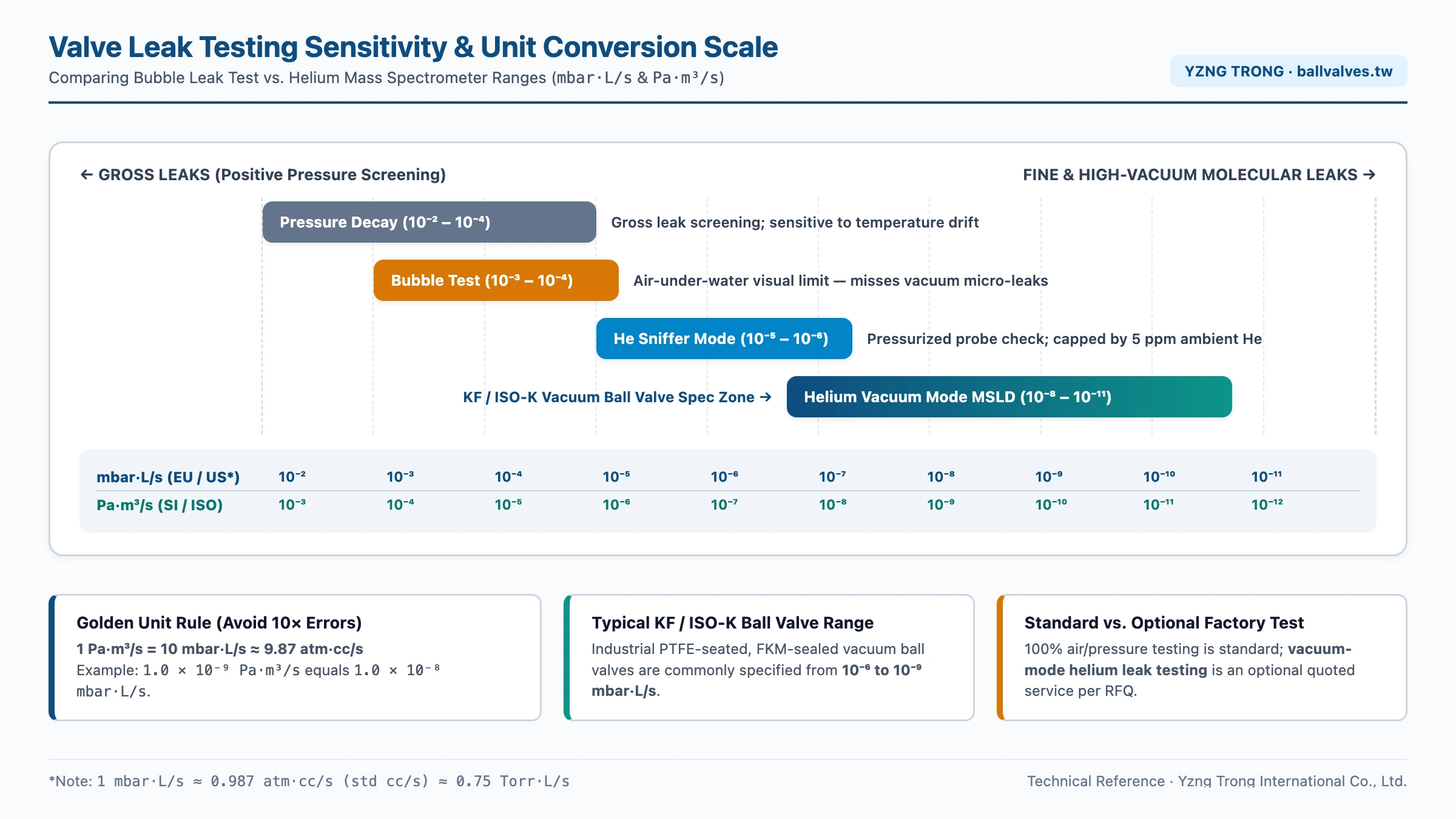
mbar·L/s y Pa·m³/s leak rate units.Helium Leak Test Procedure for Vacuum-Rated Ball Valves
A helium leak test procedure for a vacuum valve uses helium as a tracer gas because helium atoms are tiny (atomic mass 4), inert, non-toxic, and scarce in ambient air. In a factory quality-control setup, vacuum mode (the tracer probe / spray method, aligned with ASTM E498 y ISO 20485) is the standard way to verify vacuum-rated valves.
Step-by-Step Vacuum Mode Procedure
- Pre-Test Preparation & Drying: The valve must be clean and dry. Residual moisture or cutting oil can temporarily plug microscopic leak paths and mask defects, or cause slow outgassing that delays pump-down.
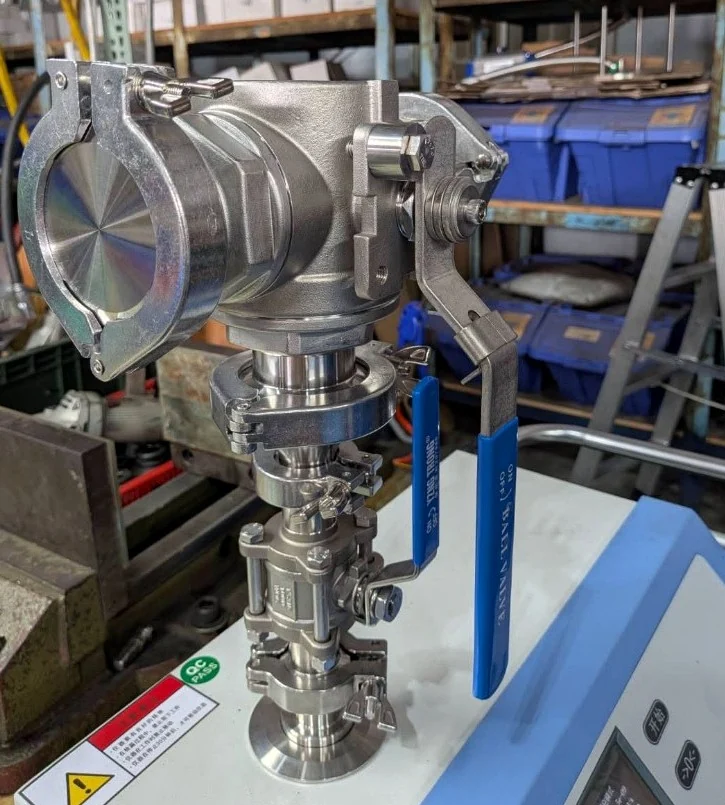
- Flange Mounting to the Leak Detector: The valve (such as a KF ball valve or ISO-K flanged valve) is coupled directly to the test port of a helium mass spectrometer leak detector using clean centering rings, elastomer O-rings, and clamps. Unused ports are sealed with vacuum blank flanges.
- Evacuation & Background Stabilization: The detector’s vacuum pump evacuates the interior of the valve until the system reaches test pressure and the background helium signal stabilizes.
- Helium Spraying (Tracer Probe): While monitoring the spectrometer readout, the technician applies a controlled stream of helium gas around potential external leak paths—working from top to bottom (since helium rises):
- Stem seal / packing gland area
- Body joints and end-cap seals (on 2-piece and 3-piece designs)
- Welds and flange-to-body transitions
- Reading & Verification: If a leak path exists, helium enters the evacuated valve body, reaches the mass spectrometer analyzer cell, and registers as a quantitative helium leak rate on the instrument display.
Shell (Envelope) Leak vs. Valve Seat Leakage Test
When specifying valve leak testing, one of the most common RFQ mistakes is asking for a helium leak rate without stating which boundary is being tested. A valve has two distinct sealing boundaries, and they behave differently under vacuum.
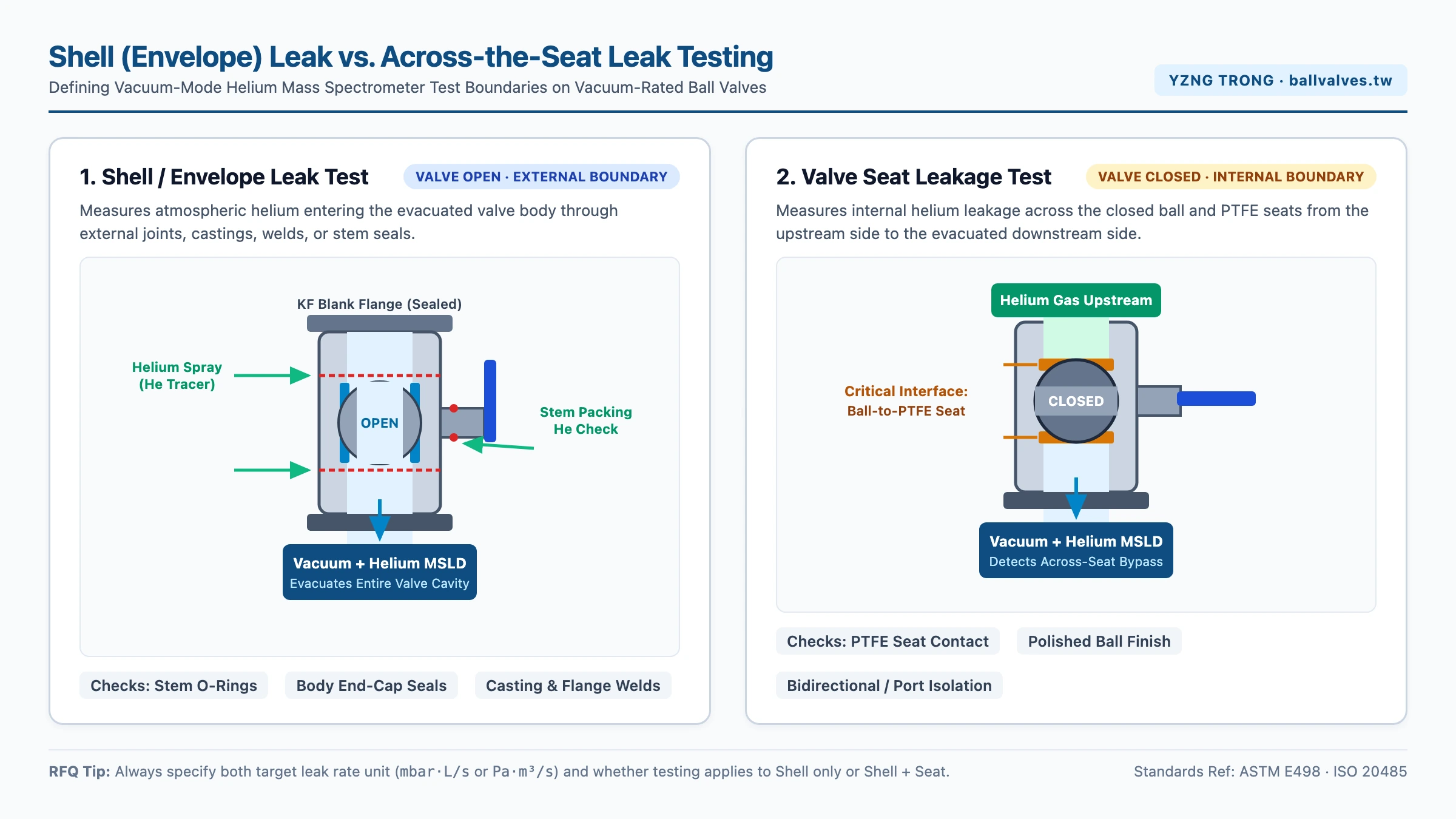
| Test Boundary | What It Measures | Valve Position During Test | Primary Leak Paths Checked |
|---|---|---|---|
| Shell / Envelope Leak Test (External) | Leakage from the outside atmosphere en the evacuated valve interior | Open or half-open (ports blanked off) | Casting porosity, body-to-end-cap gaskets, welds, and stem O-rings/packing |
| Valve Seat Leakage Test (Across-the-Seat / Internal) | Leakage across the closed ball and PTFE seat from one port to the other | Fully closed (one side evacuated, opposite side exposed to helium) | Ball surface finish, PTFE seat contact, seat spring/compression integrity |
Why This Distinction Matters for Ball Valves
- Elastomer & PTFE Reality: Unlike metal-sealed ultra-high-vacuum (UHV) gate valves, vacuum rated ball valves rely on precision-machined PTFE seats and FKM/Viton stem O-rings. They excel in rough-to-high vacuum roughing lines, forelines, and particle-bearing exhaust lines because the quarter-turn ball wipes the seat clean.
- Permeation vs. Real Leaks: Over extended exposure, helium can slowly permeate through soft polymers (PTFE and elastomer O-rings). A proper helium leak test procedure distinguishes between an immediate spike (a real leak path) and a slow, delayed rise (gas permeation through seals).
- Always Specify Both if Needed: If your process requires tight isolation across the closed ball (not just atmospheric tightness), explicitly list both the shell leak rate y el across-the-seat leak rate on your purchase specification.
Understanding Leak Rate Units (Pa·m³/s vs. mbar·L/s vs. atm·cc/s)
Engineers across Asia, Europe, and North America often use different leak rate units, which can cause a 10× misreading during RFQ reviews if units are not converted accurately.
A vacuum leak rate measures gas throughput (Q = pressure × volume / time). The most important conversion to remember is:
1 Pa·m³/s = 10 mbar·L/s ≈ 9.87 atm·cc/s (std cc/s)
Conversely:
1 mbar·L/s = 0.1 Pa·m³/s
Quick Leak Rate Unit Conversion Reference
| Pa·m³/s (SI / Common on Asian & ISO Detectors) | mbar·L/s (Common in Europe) | atm·cc/s or std cc/s (Common in US) | Practical Vacuum Context |
|---|---|---|---|
| 1.0 × 10⁻⁴ | 1.0 × 10⁻³ | ~9.9 × 10⁻⁴ | Upper edge of visible bubble leak test |
| 1.0 × 10⁻⁷ | 1.0 × 10⁻⁶ | ~9.9 × 10⁻⁷ | Commercial / rough-to-medium vacuum valve tier |
| 1.0 × 10⁻⁸ | 1.0 × 10⁻⁷ | ~9.9 × 10⁻⁸ | Fine vacuum isolation & process lines |
| 1.0 × 10⁻⁹ | 1.0 × 10⁻⁸ | ~9.9 × 10⁻⁹ | High-vacuum KF ball valve / ISO-K foreline grade |
| 1.0 × 10⁻¹⁰ | 1.0 × 10⁻⁹ | ~9.9 × 10⁻¹⁰ | Tight high-vacuum elastomer/PTFE assembly verification |
Engineering Tip: Because
mbar·L/s,Torr·L/syatm·cc/sare within ~1–25% of each other, buyers sometimes treat them loosely—butPa·m³/sis 10 times larger per numerical unit thanmbar·L/s. For example, 1.0 × 10⁻⁹ Pa·m³/s equals 1.0 × 10⁻⁸ mbar·L/s. Always check the unit printed on the test certificate.
Setting Realistic Helium Leak Test Acceptance Criteria (And Avoiding Common RFQ Mistakes)
When preparing a technical specification or RFQ for vacuum-rated valves, avoid these three pitfalls:
- Never Write “Zero Leakage”: In vacuum physics, zero leakage is unmeasurable. Every helium leak test standard (such as ASTM E498 or ISO 20485) requires a defined numerical upper threshold—for example, ≤ 1.0 × 10⁻⁸ mbar·L/s or ≤ 1.0 × 10⁻⁹ Pa·m³/s depending on your system requirements.
- Do Not Confuse Detector Sensitivity with Valve Specification: A helium mass spectrometer may be capable of reading down to 10-11 mbar·L/s, but that is the instrument’s lower limit, not automatically the guaranteed leak rate of a PTFE-seated ball valve across every operating cycle.
- Clarify Whether Helium Testing Is Required on Your Order: Standard industrial production valves undergo 100% pressure/air leak testing before shipment. Because vacuum-mode helium mass spectrometer testing requires dedicated setup, pump-down time, and dry handling, in-house helium leak testing at Yzng Trong is offered as an optional, quoted verification service for vacuum-rated and critical orders rather than applied automatically to standard commercial valves. Specifying it upfront ensures accurate pricing, lead time, and test documentation.
RFQ Checklist: What to Include When Requesting Helium-Tested Vacuum Ball Valves
To get an accurate quotation and confirm test feasibility without back-and-forth delays, include these 7 items in your inquiry:
- 1. Valve Configuration: 2-way or 3-way (L-port / T-port); manual handle or pneumatic actuator (Double Acting / Spring Return).
- 2. Connection & Size: ISO-KF (e.g., KF16, KF25, KF40, KF50) or ISO-K flange size, or weld/threaded ends. (Explore our KF & ISO-K vacuum ball valves or product catalog for available sizes.)
- 3. Operating Vacuum & Pressure Range: Target base pressure and any positive overpressure or purge gas conditions.
- 4. Required Helium Leak Rate & Unit: State both the number and the unit (e.g., mbar·L/s or Pa·m³/s).
- 5. Test Boundary: Shell (external envelope) leak only, or both shell leak and across-the-seat (valve seat leakage test).
- 6. Documentation Needed: Whether you require a batch verification or serialized Helium Leak Test Report and Material Test Report (MTR / EN 10204 3.1).
- 7. Quantity & Target Lead Time: Prototype/sample quantity or recurring OEM production schedule.
Need In-House Helium Leak Verification for Your Vacuum Ball Valve Project?
Yzng Trong manufactures stainless steel ball valves, vacuum-flanged KF / ISO-K assemblies, and pneumatic/electric actuation packages in-house in Taichung, Taiwan—with optional in-house helium mass spectrometer leak testing available upon request for vacuum-rated orders.
Send your flange size, target leak rate, and quantity to sales@ballvalves.tw (or via our Contact / RFQ page) and our engineering team will review your specification and reply with a quote.
Preguntas más frecuentes (FAQ)
What is the difference between a bubble leak test and helium leak testing for valves?
A bubble leak test pressurizes a valve with air and submerges it in water to spot visible bubbles, reaching a sensitivity limit of roughly 10-3 to 10-4 mbar·L/s. Helium leak testing uses a helium mass spectrometer under vacuum to quantify microscopic molecular leaks down to 10-8 to 10-11 mbar·L/s—millions of times more sensitive and essential for vacuum-rated valves.
What is a typical helium leak rate for a KF vacuum ball valve?
Depending on valve grade, seat design, and elastomer stem seals, industrial KF ball valves are typically specified in the range of 10-6 to 10-9 mbar·L/s (roughly 10-7 to 10-10 Pa·m³/s). Always confirm both the unit and whether the rating applies to shell leakage or across-the-seat leakage.
How do you convert Pa·m³/s a mbar·L/s?
Multiply the value in Pa·m³/s by 10 to get mbar·L/s. For example, 1.0 × 10⁻⁹ Pa·m³/s = 1.0 × 10⁻⁸ mbar·L/s. Conversely, divide mbar·L/s by 10 to convert to Pa·m³/s.
What standards apply to helium leak testing of valves?
Common reference standards include ASTM E498 (vacuum-mode tracer probe testing using a mass spectrometer leak detector), ASTM E499 (sniffer/detector probe mode), and ISO 20485 (tracer gas leak testing). For industrial fugitive emissions rather than vacuum tightness, ISO 15848-1 is also frequently referenced.
Is every ball valve helium leak tested before shipment?
No. Standard industrial ball valves are 100% pressure/air leak tested at the factory. Because vacuum-mode helium mass spectrometer testing requires specialized vacuum setup and handling, it is offered as an optional, quoted test service for vacuum-rated KF/ISO-K ball valves and projects that explicitly specify helium leak verification on the RFQ.