
I have lost count of how many times a customer has sent me a drawing for a beautiful 316 stainless line, specified the valves down to the last thread, and then written “Y strainer here” with no mesh called out at all. It is the most expensive blank in the whole specification. Pick the wrong Y strainer mesh size and you either let the grit straight through to the pump you were trying to protect, or you choke the line and spend every other week pulling the screen out to clean it. Neither is fun, and both are avoidable.
So in this guide I am going to do the thing the other articles never quite finish: give you a usable mesh-to-micron chart, tell you in plain terms what 20, 60 and 100 mesh actually stop, and walk through how I decide which one goes on a given line. We make our strainers in exactly these three mesh sizes, so this is not theory pulled off a spec sheet, it is how we answer this question for buyers every week. By the end you should be able to fill in that blank yourself, with reasons you can defend in a design review.
Why Y Strainer Mesh Size Is the Decision That Actually Matters
A Y strainer is a simple piece of kit. Fluid comes in, passes through an angled cylindrical screen, the screen catches solids, and clean fluid carries on downstream. The body, the connection, the pressure rating, the material, all of that matters, but none of it changes what the strainer does on a particle level. The screen does that. And the screen is defined almost entirely by one number: its mesh. That is why I treat Y strainer mesh size as the first real engineering decision, not an afterthought.
Think about what the strainer is there to protect. Usually it is sitting just upstream of something you do not want to damage: a pump impeller, a control valve seat, a flow meter, a heat exchanger, a steam trap. Each of those has a different tolerance for debris. A robust ball valve will happily pass a bit of scale that would wreck a precision control valve. So the “right” mesh is not a fixed answer; it is a function of what you are guarding and what is floating in your fluid. Get specific about both and the mesh almost chooses itself.
The cost of getting it wrong is not just the strainer. A screen that is too coarse passes particles that score a pump seal, and now you are replacing a seal, not cleaning a screen. A screen that is too fine clogs fast, the pressure drop climbs, flow falls off, and someone eventually props the cover open or removes the screen entirely “just to keep things moving”. I have seen that more than once, and a removed screen protects nothing. The whole point of this article is to keep you out of both ditches.
Mesh, Micron, and Why People Keep Confusing Them
Before any chart makes sense, we need to be honest about what “mesh” even means, because it is one of the most misread numbers in piping. Mesh is a count, micron is a size, and the relationship between them is not as fixed as most charts pretend. Let me break it down properly, because this is where most specifying mistakes are born.
What “Mesh” Actually Counts
Mesh number is the count of openings per linear inch of screen. A 20 mesh screen has 20 openings in every inch; a 100 mesh screen has 100. So the higher the mesh number, the more wires are packed into that inch, the smaller each opening, and the finer the filtration. That part is intuitive once you say it out loud: bigger mesh number equals smaller holes equals finer screen. The counter-intuitive bit is that the number going up means the particle size going down, which trips people up in conversation constantly. If you want the formal definition, the mesh scale is standardised and worth a read.
Why Mesh Does Not Map Cleanly to Microns
Here is the part the simple charts hide. The actual opening size, the micron rating, depends not just on how many wires per inch but on how thick those wires are. Two screens can both be “60 mesh” and have meaningfully different openings if one uses a heavier wire than the other, because thicker wire eats into the open space. That is why you will see 100 mesh quoted as anything from 140 to 150 microns depending on the source. So when I give you a micron figure, read it as “approximately”, and if a process genuinely hinges on an exact micron cut-off, you have moved past Y strainers and into the territory of rated filtration. I will come back to that honestly later.
The Mesh-to-Micron Chart
With that caveat stated, here is the working conversion I use. These are nominal openings for standard woven wire screens, close enough for selecting a Y strainer mesh size and consistent with published wire-cloth standards such as ASTM E11.
| Mesh | Approx. Opening (microns) | Approx. Opening (mm) | Approx. Opening (inch) |
|---|---|---|---|
| 20 mesh | 840 µm | 0.84 mm | 0.0331″ |
| 40 mesh | 400 µm | 0.40 mm | 0.0165″ |
| 60 mesh | 250 µm | 0.25 mm | 0.0098″ |
| 80 mesh | 180 µm | 0.18 mm | 0.0070″ |
| 100 mesh | 150 µm | 0.15 mm | 0.0059″ |
For quick reference: a human hair is roughly 70 microns, fine beach sand is around 200 to 300 microns, and you stop being able to see an individual particle somewhere near 40 microns. So 100 mesh is catching things slightly larger than fine sand, and 20 mesh is catching small gravel and scale. Keep that physical picture in mind; it makes the next section far less abstract.
The 20, 60 & 100 Mesh Breakdown: What Each Screen Actually Stops
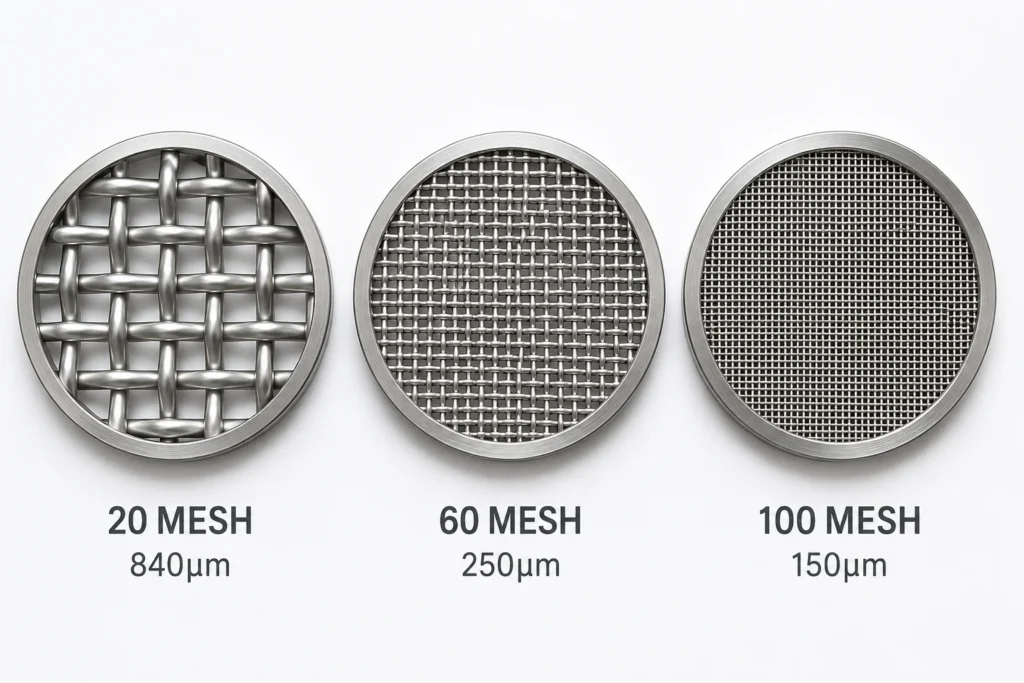
This is the heart of it. We deliberately build our 316 stainless Y strainer in 20, 60 and 100 mesh because, in my experience, those three cover the overwhelming majority of real industrial lines without leaving awkward gaps. Here is how I think about each one.
20 Mesh: The Coarse Workhorse (840 microns)
Twenty mesh is your bodyguard, not your bouncer. At 840 microns it lets a lot through, and that is the point. It is there to catch the things that cause immediate, mechanical damage: weld slag, pipe scale, rust flakes, stray gasket material, the bit of swarf the installer swears was not there. I reach for 20 mesh on large bore lines, on pump suction where I cannot afford pressure drop, on viscous fluids, and on dirty raw-water or cooling lines where finer mesh would blind over in days. If your main worry is “don’t let chunks hit my equipment”, 20 mesh is usually right, and it will run far longer between cleanings than anything finer.
60 Mesh: The All-Rounder (250 microns)
If I had to put one screen on a line blind, it would be 60 mesh. At 250 microns it is the sensible middle: fine enough to protect most pumps, control valves and instruments from the particles that actually cause wear, coarse enough that it does not clog every time the system burps up some sediment. General process water, light oils, compressed air condensate lines, the feed to a reasonably tolerant control valve, this is 60 mesh country. When a customer cannot tell me much about their debris, this is the Y strainer mesh size I steer them toward, because it is the option least likely to cause a callback in either direction.
100 Mesh: The Fine Guard (150 microns)
One hundred mesh is for when downstream equipment is genuinely fussy. Precision control valves with tight seats, spray nozzles, small orifices, certain instrumentation, polished or sanitary service where even fine particulate is a problem. At 150 microns it catches a lot, which is exactly why you have to respect it: it also clogs the fastest and carries the highest pressure drop. I am happy to specify 100 mesh, but only when the fluid is reasonably clean to begin with, or when there is a coarser strainer upstream doing the heavy lifting. Putting 100 mesh on a filthy line is how you end up cleaning a screen daily and cursing whoever picked it.
| Mesh | Opening | Typically Stops | Good For | Watch Out For |
|---|---|---|---|---|
| 20 | 840 µm | Scale, weld slag, rust flakes, gravel | Pump suction, large bore, viscous or dirty fluids | Passes fine grit |
| 60 | 250 µm | Coarse sand, sediment, most damaging particles | General water and oil, control valve protection, unknown debris | Sensible default, few downsides |
| 100 | 150 µm | Fine sand and silt, fine particulate | Precision valves, nozzles, clean or polished service | Clogs fast, higher pressure drop |
Matching Mesh to Your Fluid and Your Contaminant
The chart above tells you what each screen stops; this section is about choosing between them for your actual line. I work through three questions in order, and I will be honest about the trade-off at the end because that is where the real engineering judgement lives.
Start With What You Are Protecting
The downstream equipment sets your ceiling on coarseness. A rugged ball valve or a centrifugal pump with generous clearances tolerates 20 to 60 mesh comfortably. A control valve with a tight trim, a flow meter, a spray nozzle, or a steam trap wants 60 to 100 mesh because small particles do real damage to tight clearances. So I write down the most sensitive thing on the line and let it pull the mesh finer. The strainer exists for that component, not the other way around. If you are protecting a precision valve, do not let a tolerant pump talk you into a coarser screen than the valve can live with.
Then Look at the Fluid and Its Debris
Next, what is actually in the fluid, and how much? A clean closed loop that occasionally sheds a little corrosion product is a very different animal from open cooling water full of sand and biofilm. High debris load pushes me coarser, or toward a basket strainer with more screen area, because a fine screen on a dirty line simply blinds over. Viscosity matters too: thick fluids struggle through fine mesh and the pressure drop punishes you. So heavy debris or high viscosity nudges the Y strainer mesh size toward 20 or 60; clean, thin, low-debris fluid is where 100 mesh earns its place. The Spirax Sarco strainer guidance makes the same point well for steam and condensate lines.
The Over-Meshing Trap, and Honest Alternatives
Here is the risk I flag for every customer who instinctively asks for the finest screen available: finer is not safer. An over-fine Y strainer clogs, the differential pressure rises, flow drops, and the screen gets bypassed or removed in frustration, at which point it protects nothing. If you genuinely need a fine, repeatable micron cut-off, a Y strainer is the wrong tool and I will tell you so. Step up to a basket strainer for more dirt-holding area, a duplex strainer if you cannot shut the line down to clean, or a proper cartridge or bag filter if you need true rated filtration. A Y strainer is a guard, not a polishing filter, and pretending otherwise just leads to maintenance headaches. Honest scoping up front saves everyone money.
Mesh Size vs Pressure Drop: The Trade-off Nobody Mentions
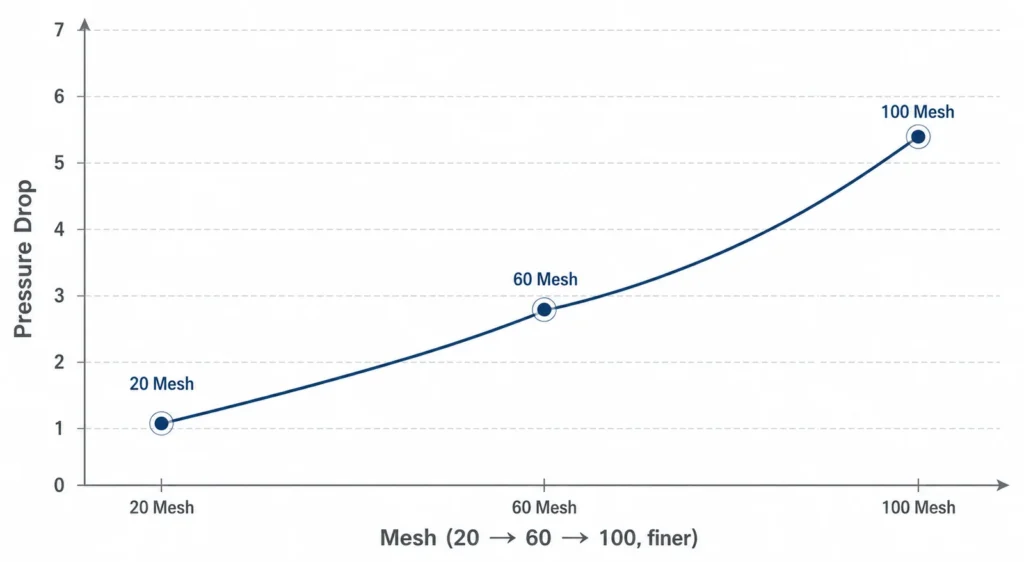
Every conversation about mesh eventually has to meet reality at the pressure gauge. Finer screen means more flow resistance, full stop. When you double the mesh fineness you are reducing open area and adding wires, and the fluid has to squeeze through smaller, more numerous holes. On a clean screen the difference is modest, but it grows quickly as debris accumulates, and that is the number you actually have to design around.
As a general rule of thumb, and this is guidance rather than a product specification, a clean strainer is often sized to sit around 2 to 5 psi of pressure drop, with cleaning triggered somewhere around 10 to 15 psi once debris has built up. Those numbers shift with line size, flow rate, viscosity and how dirty the fluid runs, so treat them as a starting frame and confirm against your own conditions. Organisations like the Hydraulic Institute publish solid background on protecting rotating equipment and the role pressure drop plays. The practical takeaway: a 100 mesh screen on pump suction can starve the pump as it loads up, which is exactly why I push coarser mesh on suction lines and save the fine screen for the discharge side or a clean branch.
This is also why oversizing the strainer body helps. A strainer one size larger than the line gives more screen area, lower velocity through the mesh, lower pressure drop and longer intervals between cleaning, all without changing the Y strainer mesh size at all. If you are stuck between protecting equipment and keeping flow up, upsizing the body is often the move that resolves the tension. It costs a little more upfront and saves a great deal in maintenance and lost throughput.
Material and Build: Why 316 Stainless and 800 WOG Matter to the Screen
The screen does not live in isolation; the body and material around it decide whether your chosen mesh survives the service. We supply our Y strainers in 316 stainless steel as standard, rated to 800 WOG, and both of those choices are deliberate. Let me explain the reasoning, because material selection is another place I see costly assumptions.
On grade, the honest trigger for moving from 304 to 316 stainless is not “is the fluid acidic”, as it is often misquoted. The real driver is chloride exposure and the risk of pitting corrosion. The molybdenum in 316 gives it meaningfully better resistance to chloride-induced pitting, which is why it is the grade I want for seawater-adjacent, brackish, brine, coastal and many chemical services where a 304 screen would develop pinhole pits and eventually fail. If your media or environment carries chlorides, 316 is cheap insurance; the mechanics of pitting corrosion are well documented and worth understanding. A corroded screen sheds its own debris, which rather defeats the purpose, so we keep 316 as our standard stock rather than asking customers to gamble on a lesser grade.
On pressure, the 800 WOG (water, oil, gas) rating tells you the cold non-shock working pressure the body is built for, and that envelope has to comfortably exceed your line conditions with margin for surges. We manufacture under an ISO 9001 quality system and our products carry CE marking, which is the documentation most of our export customers need for their own compliance files. I mention that not as a sales line but because traceable material and a defined pressure rating are exactly what stop a screen failure from becoming an unplanned shutdown. We hold all three mesh sizes in 316 as standard stock; you can see the full body, connection and size details on the Y strainer product page, and the wider range on our قائمة المنتجات.
Installation, Cleaning and When to Re-Mesh
Even the perfect Y strainer mesh size underperforms if the strainer is installed or maintained badly, so a few field notes earn their place here. Orientation first: the strainer must be installed so the screen pocket points down or to the side, never up, so that captured debris falls into the pocket and stays there instead of washing back into the flow. On horizontal lines the cap typically points downward; on vertical down-flow lines it can sit sideways. Get this wrong and the screen empties itself back into your system every time flow fluctuates.
Cleaning is where the mesh choice shows its cost over time. A coarse 20 mesh screen on a clean line might go months untouched; a 100 mesh screen on a marginal line might need attention weekly. Plan for it. Fit isolation valves either side so the screen can be pulled without draining the whole system, and many of our strainers include a blow-down connection on the cap so you can flush accumulated debris without full disassembly. Track the pressure drop if you can; a rising differential is the screen telling you it is loading up, and it is a far better cleaning trigger than a fixed calendar date.
Finally, “re-meshing”. Because the screen is a separate element, you are not stuck with your first choice forever. If you specified 60 mesh and find the line is dirtier than expected and clogging too often, you can step to 20 mesh; if equipment is still seeing wear, you can go finer to 100. This is a real advantage of a reusable stainless screen over a disposable filter, and it is why I tell customers an initial mesh choice is a strong starting point, not an irreversible commitment. Start sensible, watch the line, adjust once with data.
How to Specify and Order the Right Y Strainer
When you come to actually buy, a little structure saves a lot of email back-and-forth. Over the years the requests that get an accurate quote first time always answer the same handful of questions, so here is the checklist I wish every enquiry arrived with. Treat it as your pre-RFQ thinking, whether you order from us or anyone else.
Tell the supplier: the line size and connection type you need; the fluid, its temperature and its working pressure; the material grade required, driven by chloride exposure as discussed; and, crucially, the mesh. If you are not sure of the mesh, describe what you are protecting and what debris you expect, and a competent supplier should be able to recommend a Y strainer mesh size for you. Note that a Y strainer guards rotating and precision equipment, so it pairs naturally with the ball valves, control valves and pumps it sits beside; many of our customers buy strainers alongside our 3-piece stainless ball valves for exactly that reason. If your service is unusual, send the conditions and ask, do not guess. You can reach our engineers through the صفحة الاتصال, and if you want to see typical end-use cases first, the applications section shows where these strainers go to work.
| What To Specify | لماذا هذا مهم | If You Are Unsure |
|---|---|---|
| Line size & connection | Sets body size and fit | State pipe size and thread/weld standard |
| Fluid, temp, pressure | Confirms rating and material | Give the worst-case operating point |
| Material grade | Chlorides drive 304 vs 316; we stock 316 | Coastal/brine/chemical, 316 is the safe pick |
| Mesh (20/60/100) | Defines filtration | Describe equipment and debris, ask for a recommendation |
الأسئلة الشائعة
What mesh size is best for a general water line?
For most general water service I default to 60 mesh, which is 250 microns. It protects pumps, control valves and instruments from the particles that actually cause wear while staying coarse enough to avoid constant clogging. If the water is dirty or full of sand, step to 20 mesh; if you are feeding a precision valve or nozzle from reasonably clean water, step to 100 mesh. Our 316 stainless Y strainer is stocked in all three.
Is a higher mesh number always better?
No, and this is the most common mistake I see. A higher mesh number means finer filtration but also faster clogging and higher pressure drop. An over-fine screen on a dirty or viscous line blinds over quickly, the flow drops, and the screen often gets bypassed or removed, at which point it protects nothing. The best Y strainer mesh size is the coarsest one that still protects your downstream equipment, not the finest one available.
What is the micron rating of 100 mesh?
One hundred mesh is roughly 150 microns, though the exact opening varies a little with the wire diameter used in the screen, so read it as approximate. For comparison, 60 mesh is about 250 microns and 20 mesh is about 840 microns. If your process truly depends on an exact, repeatable micron cut-off, a Y strainer is the wrong tool and you should look at a rated cartridge or bag filter instead.
Can I change the mesh later if I picked wrong?
Yes, and that is a real benefit of a Y strainer with a reusable stainless screen. The screen is a separate element, so if your first choice clogs too often or lets too much through, you can swap it for a coarser or finer mesh without replacing the whole strainer. I usually advise starting with a sensible choice, watching the pressure drop and cleaning frequency, then adjusting once with actual data rather than agonising over the perfect first pick.
Does a Y strainer protect my valves and pumps?
That is exactly its job. A Y strainer sits upstream of the equipment you want to protect and catches solids before they reach pump seals, valve seats and meter internals. It pairs naturally with the components beside it, which is why many buyers order strainers together with ball valves such as our صمام كروي يدوي صحي. Choosing the right mesh is what makes that protection effective rather than nominal.
Final Thoughts
If you take one thing from this guide, let it be this: the right Y strainer mesh size is the coarsest screen that still protects what is downstream. Start from the most sensitive component on the line, factor in how dirty and how thick your fluid is, respect the pressure-drop trade-off, and you will land on 20, 60 or 100 mesh with reasons you can defend. Over-meshing feels cautious but usually backfires; coarse-but-clean beats fine-but-clogged every time.
We supply our strainers in 316 stainless at 800 WOG precisely so the screen you choose survives the service it is in, and we keep all three mesh options in 316 as standard stock because real lines need all three. If you are weighing up a specific service and want a second opinion before you commit, send us the conditions and we will tell you straight which mesh we would fit and why, even if the honest answer is that you need a basket or cartridge filter instead. That is the conversation worth having before the strainer ships, not after.