
Yes, you can use a ball valve for steam, as long as the valve carries a steam rating that covers your line. That rating depends on three things: the seat material, the stem packing, and the pressure and temperature the manufacturer allows together. A WOG rating does not answer the question. It is a cold rating for water, oil and gas, not a steam rating.
This guide is for engineers, maintenance teams and buyers who need to put a quarter-turn valve on a steam line and want to check it properly. We are YZNG TRONG, a stainless steel ball valve manufacturer in Taiwan. For low-pressure steam we make a graphite-seated version of our V-2B ball valve, rated for steam at up to 3 kgf/cm² gauge (kilograms-force per square centimeter, about 2.9 bar or 43 psi) and up to 180 °C. The sections below show how to check any ball valve against your steam conditions, including pressures well above that.
النقاط الرئيسية
- Ball valves are a standard choice for steam isolation. Spirax Sarco notes that in steam applications they have largely replaced butterfly valves.
- For saturated steam, pressure fixes temperature. Steam at 15 psig (pounds per square inch on a gauge) is about 250 °F (121 °C); at 150 psig it is about 366 °F (185 °C).
- Read the steam rating: an SWP or WSP marking (steam working pressure) on the body, or a steam figure in the maker’s pressure-temperature data. The WOG number tells you nothing direct about steam.
- The seats are usually the limiting part. In Valmet’s published data, the steam limit for plain PTFE seats sits well below those for filled PTFE or PEEK, and limits vary from one valve design to another.
- On steam, run a ball valve fully open or fully closed, open it slowly on a cold line, and plan for liquid that can get trapped and heated inside a closed valve.
Can a ball valve be used for steam?
Yes. Ball valves are one of the standard ways to isolate steam and condensate lines. In its guide to rotary isolation valves, Spirax Sarco writes that for steam applications, butterfly valves have largely been superseded by ball valves. So the real question is not whether a ball valve can handle steam in general. It is whether a particular valve is rated for your pressure and temperature.
A quarter-turn ball valve gives a clear open or closed position and, in a full-port design, a straight flow path with little pressure drop when open. Those are good traits for isolation. What limits a ball valve on steam are its soft parts: the two seats the ball presses against, and the packing that seals the stem where it leaves the body. Steam heats both, and a hot polymer seat holds less pressure than a cold one.
Before you put a ball valve on steam, check four points:
- The valve has a steam rating that covers your maximum steam pressure, shown as an SWP or WSP marking or as a steam figure in the manufacturer’s pressure-temperature data.
- The seat material is rated for the saturation temperature at that pressure.
- The stem packing is suited to that temperature.
- You will use the valve for on/off isolation, not to regulate flow.
Why steam pressure and temperature can’t be read separately
Saturated steam, which is what most steam lines carry, has one fixed temperature for every pressure. Raise the pressure and the temperature rises with it. That is why a valve’s steam limit is written as a pressure at a temperature, and why a temperature range on its own cannot tell you whether a valve suits your line.
The table below uses gauge pressure (psig, the figure a pressure gauge on the line shows) and the saturation temperatures in the saturated steam table published by Milwaukee Valve. Metric values are our conversions. The 42.7 psig row is interpolated between the 40 and 45 psig rows of the same table, so treat it as approximate.
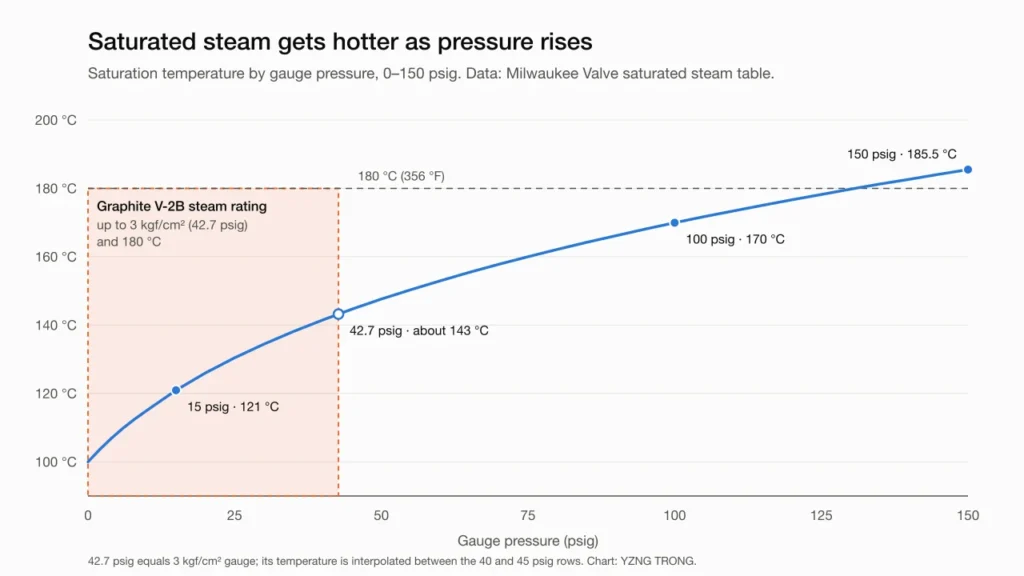
| Gauge pressure | Metric equivalent | Saturation temperature | What it means for the valve |
|---|---|---|---|
| 0 psig | 0 bar g | 212.0 °F (100 °C) | Steam at atmospheric pressure |
| 15 psig | 1.0 bar g (1.05 kgf/cm²) | 249.7 °F (121 °C) | Upper limit for low-pressure steam heating boilers in state rules such as Washington’s |
| 42.7 psig | 2.94 bar g (3 kgf/cm²) | about 290 °F (143 °C) | Steam pressure limit of our graphite-seated V-2B |
| 100 psig | 6.9 bar g (7.0 kgf/cm²) | 337.9 °F (170 °C) | Needs a published steam rating of at least 100 psig |
| 150 psig | 10.3 bar g (10.5 kgf/cm²) | 365.9 °F (185.5 °C) | Hotter than a valve listed only to 180 °C (356 °F) |
Look at the last row. Saturated steam at 150 psig is about 185 °C, so a valve listed only as “−20 °C to +180 °C” cannot be assumed safe there, before you even ask what its seats can hold at that pressure. The reverse is also true. A valve with a generous temperature limit may still carry a low steam pressure rating, because the seat has to hold the pressure difference across a hot, closed ball.
One detail trips people up. Steam tables list both absolute and gauge pressure; Milwaukee’s table, for example, gives 212 °F at both 0 psig and 14.696 psia. Valve steam ratings such as SWP are stated in psig, so compare them with the gauge reading on your line, not with an absolute figure.
How to read a ball valve’s steam rating
Look for a steam figure: an SWP or WSP marking on the valve body, or a steam pressure in the manufacturer’s data sheet or pressure-temperature chart. A WOG or CWP number is a cold working pressure for water, oil and gas. It is a different rating and says nothing direct about steam.
SWP stands for steam working pressure, and WSP for working steam pressure. As an explanation of valve pressure markings from QRFS puts it, a valve marked “100 SWP” can endure 100 psig of pressure from pure steam. The same article notes that the valve marking standard accepts several abbreviations for steam pressure (SWP, WSP, SP and S), while WOG corresponds to a cold working pressure, or CWP.
| Marking or data | What it means | Does it give the steam limit? |
|---|---|---|
| WOG or CWP (for example, 1000 WOG) | Cold working pressure for water, oil and gas | لا يوجد |
| SWP or WSP (for example, 150 SWP) | Maximum working pressure on steam | نعم |
| Pressure-temperature chart | Allowed pressure across the temperature range, sometimes with a separate steam line | Yes, and it is the most complete source |
| Temperature range only (for example, −20 °C to +180 °C) | The range the valve materials are rated for, with no pressure attached | No; it has to be paired with a pressure |
Our standard V-2B, with PTFE seats, is rated 1000 WOG, which means 1000 psi on cold water, oil or gas. That figure does not carry over to steam, and our guide to the تصنيف ضغط WOG explains why. The graphite-seated version is a separate configuration with its own steam rating, which we give in full further down.
If the data sheet for a valve you are considering shows no steam figure at all, ask the manufacturer for one before you install it. A sales description such as “suitable for steam” is not a rating.
Seats and stem packing set the steam limit
On a soft-seated ball valve, the seats are usually the first part to reach their limit on steam. Heat softens polymer seats, and the higher the pressure behind the closed ball, the more load they carry. The stem packing is the other seal to check, because it keeps steam from escaping to atmosphere around the stem.
Published figures show how much seat choice matters. Spirax Sarco’s rotary isolation valve guide lists maximum temperatures for common ball valve seat materials, including PTFE (polytetrafluoroethylene) and PEEK (polyether ether ketone, a high-temperature engineering plastic). Valmet’s steam application guide for its Jamesbury ball valves lists the maximum steam pressure differential each seat material can take in on/off service; across a closed isolation valve, that differential is close to the full line pressure. The figures below come from those two documents. They describe those manufacturers’ own valves, so read them as a sense of scale, not as a rating for any other valve.
| مادة المقعد | Maximum temperature (Spirax Sarco) | Maximum steam pressure differential, on/off service (Valmet example) | Note |
|---|---|---|---|
| PTFE | 200 °C (392 °F) | 150 psi (10 bar) in 1/4″ to 2″ valves | Valmet says PTFE seats may be used but recommends filled PTFE |
| Filled or carbon-reinforced PTFE | 230 °C (446 °F) for carbon-reinforced PTFE | 250 psi (17 bar) for filled PTFE, lower in some larger sizes | The two documents name the grades differently |
| PEEK | 250 °C (482 °F) | Up to 475 psi (33 bar) | Valmet’s limits depend on valve series and size |
| Metal | 1,000 °C (1,832 °F) | Not listed | Spirax lists metal seats among the changes needed for throttling designs |
Two points follow from these numbers. First, the same seat name can carry very different limits from one valve design to the next, so the only figure that counts is the one published for the valve you are buying. Second, temperature alone does not settle it. Spirax lists PTFE to 200 °C, which is above the 185 °C of 150 psig steam, yet Valmet rates its small PTFE-seated valves at 150 psi of steam pressure differential. At that pressure, the seat’s pressure limit is the constraint, not its temperature.
Stem packing deserves the same attention, since a packing that cannot hold the temperature lets steam escape along the stem. Spirax Sarco’s guide to linear isolation valves notes that gland packing is typically a polymer such as PTFE. In the steam version of our V-2B, both the seats and the stem packing are graphite. Valmet’s guide adds that any valve used in steam service should have a 316 stainless steel ball and stem; in the CF8M (cast 316) version of the graphite V-2B, the ball and stem are both 316.
What steam pressure can a ball valve handle?
There is no single figure. A ball valve handles whatever steam pressure its manufacturer has rated it for, and that figure is set mainly by the seat material and the valve design. For low-pressure heating steam at 15 psig or less, a valve rated to about 43 psig, like our graphite-seated V-2B, has room to spare. For plant steam at 100 to 150 psig, you need a valve with a published steam rating at that pressure.
Low-pressure steam is where a threaded stainless ball valve with the right seats is most at home. Washington State’s boiler rules, for example, define a low-pressure heating boiler as a steam boiler that operates at no more than 15 psig, and Connecticut uses the same 15 psig line. At 15 psig, saturated steam is about 250 °F (121 °C).
Our graphite-seated V-2B is rated for steam at up to 3 kgf/cm² gauge and up to 180 °C; both are maximums. Saturated steam at 3 kgf/cm² is about 143 °C (290 °F), so the rating covers low-pressure heating steam and steam lines up to about 43 psig, and the 180 °C maximum sits above the saturation temperature across that range.
Plant steam at higher pressure is a different case. At 100 psig, steam is about 338 °F (170 °C); at 150 psig, about 366 °F (185 °C). A ball valve for those lines needs a published steam rating at that pressure. In Valmet’s data, 150 psig is already at the limit for small valves with plain PTFE seats (150 psi), which is where filled PTFE or PEEK comes in. Whichever valve you choose, compare its steam rating with the highest pressure the line can reach, such as the set pressure of the safety valve protecting it, not only the normal operating pressure.
Ball valve, gate valve or globe valve for steam?
Choose a ball valve for fast, quarter-turn isolation, a gate valve where you want isolation with low pressure drop and don’t mind a multi-turn handwheel, and a globe valve where a tighter seal matters more than pressure drop. None of them suits steam by type alone. Each still needs a steam rating that covers your conditions.
| نوع الصمام | التشغيل | What Spirax Sarco says about it | What to watch |
|---|---|---|---|
| صمام كروي | Quarter turn (90°) | Has largely replaced the butterfly valve in steam applications; full bore costs more but suits lines that need low pressure drop | On/off only; check the seat’s steam rating; plan for trapped liquid in the body cavity |
| Gate valve | Multi-turn handwheel | Specifically intended for isolation | Slower to operate than a quarter-turn valve |
| صمام كروي | Multi-turn handwheel | Less likely to leak than a gate valve | Higher pressure drop than a gate valve |
For small-bore lines that are opened and closed often, a quarter turn and a handle that shows the valve position are practical advantages. For a wider look at the trade-offs outside steam service, see our comparison of a الصمام الكروي مقابل الصمام البوابي.
How to install and operate a ball valve on steam
Run the valve fully open or fully closed, open it slowly on a cold line, and think about what happens to liquid trapped inside a closed valve as it heats up. These three habits deal with the seat erosion, water hammer and cavity pressure problems described in the Valmet, Spirax Sarco and Milwaukee Valve documents cited here.

Use it for on/off service only
A ball valve held part-open on steam wears out its seats. Valmet limits throttling with polymer-seated valves to pressure drops of 50 psi (3.5 bar) or less because of the erosive effect of steam on a partially open ball valve. Spirax Sarco states that ball valves need modifications to the standard design, such as metal seats and hardened coatings, before they can be used for throttling. If you need to regulate steam flow, use a valve designed for control, and keep the ball valve for isolation.
Open it slowly when the line is cold
Spirax Sarco’s guidance on steam mains and drainage lists opening valves too quickly at start-up, when pipes are cold, among the causes of water hammer, which happens when slugs of condensate hit pipe fittings at high velocity. A ball valve goes from closed to fully open in a quarter turn, so the speed is in your hand. On a cold line, crack the lever open a few degrees, let condensate drain through the traps and the pipe warm up, then open fully.
Plan for liquid trapped in the body cavity
When a ball valve is closed, whatever is inside the body cavity is sealed in between the two seats. A technical bulletin from Milwaukee Valve on vented balls explains that if that trapped fluid heats up, the pressure in the cavity can rise sharply, in severe cases enough to damage the valve, and it names steam among the applications where this thermal expansion is a concern. The common remedy is a vented ball, with a relief hole on the upstream side, which makes the valve one-directional, so it has to be installed the right way around. Where you can, avoid placing a closed ball valve at a point where condensate collects and is then heated. We can supply the V-2B with a vented ball on request; if your line has a spot like that, mention it when you order and tell us the flow direction.
Match the threads to your pipe
The V-2B, including the graphite version, is available with female threaded ends in NPT, PT or PF. PT is a tapered thread and PF is a parallel thread. NPT and PT are both tapered but are different thread forms, so order the standard that matches your piping. Our guide to وصلات طرفية للصمامات covers threaded, socket weld and butt weld ends and how they compare.
Common mistakes with ball valves on steam
The six points below sum up the rating checks and operating habits covered in this guide. Check them before any ball valve goes on steam.
- Reading the WOG number as a steam rating. WOG is a cold rating; our standard PTFE-seated V-2B, for example, is 1000 WOG, and that number does not apply on steam.
- A temperature range was checked, but the pressure was not. At 150 psig, saturated steam is about 185 °C, already above a 180 °C limit.
- Treating every PTFE seat as equal. Published steam limits for PTFE-seated valves differ from one design to another.
- The valve is left half open to regulate flow, and steam erodes the seats of a partially open ball valve.
- Snapping the valve open on a cold line, which is one of the causes of water hammer at start-up.
- Nobody thought about the body cavity. Liquid trapped in a closed valve can over-pressurize it when it heats up.
What to tell a supplier when you order a ball valve for steam
Give the supplier your worst-case conditions, not just the pipe size. A steam rating can only be checked against numbers, and the six items below are the ones that decide whether a ball valve fits your steam line. With them, a supplier can check the rating instead of guessing.
| العنصر | مثال | لماذا هذا مهم؟ |
|---|---|---|
| Maximum steam pressure (gauge) | 15 psig or 1 bar g | Sets the steam rating the valve must carry |
| Steam condition and maximum temperature | Saturated, or superheated to a stated temperature | Saturated steam temperature follows the pressure; superheated steam runs hotter |
| Pipe size and thread standard | 1″ NPT | NPT, PT and PF threads are not interchangeable |
| How the valve will be used | Isolation, opened a few times a day | Ball valves are for on/off service, not throttling |
| Where the valve sits in the line | At a low point where condensate can collect | Trapped liquid that heats up raises cavity pressure; a vented ball may be needed |
| مادة الهيكل | Cast 316 (CF8M) | Affects corrosion resistance; on the V-2B, graphite trim is standard in CF8M and made to order in CF8 |
Our graphite-seated V-2B for low-pressure steam
For low-pressure steam lines, our answer is the V-2B with graphite seats and graphite stem packing. In cast 316 (CF8M) it is a standard item from 1/4″ to 3″; the cast 304 (CF8) version is made to order. It is rated for steam at up to 3 kgf/cm² gauge (about 2.9 bar or 43 psi) and up to 180 °C (356 °F).
| العنصر | V-2B, graphite steam version |
|---|---|
| هيكل الجسم | Two-piece body, seal-welded at the body joint |
| مادة الهيكل | CF8M (cast 316): standard item. CF8 (cast 304): made to order |
| Seats and stem packing | Graphite |
| Ball and stem | 316 stainless steel (CF8M version) |
| القطر الداخلي | منفذ كامل |
| المقاسات | 1/4″ to 3″ (DN8 to DN80) |
| وصلات الأطراف | Female threaded: NPT, PT or PF |
| Steam rating | Up to 3 kgf/cm² gauge (about 2.9 bar g, 43 psig) and up to 180 °C (356 °F) |
| خيارات | Vented ball on request |
| Also available | Graphite version of the standard-grade V-2C, made to order |
The V-2B body is seal-welded at the joint between the body and the end cap, so there is no threaded body joint to leak. That reduces one potential external leak path. It does not change how the seats or the stem packing behave, which is why the graphite trim is what makes the difference on steam. Our article on a تسرب صمام كروي explains the different leak points and what causes each one.
Our valves are pressure tested before they ship, and a material test report is available on request. Dimensions and drawings for each size are on the V-2B seal-welded ball valve page. If your steam line runs above 3 kgf/cm², send us the conditions and we will tell you plainly whether one of our valves fits.
الأسئلة الشائعة
Can a ball valve be used for steam?
Yes. Ball valves are widely used to isolate steam, and Spirax Sarco notes that they have largely replaced butterfly valves in steam applications. The condition is that the valve is rated for steam at your pressure and temperature. Check for an SWP or WSP marking or a steam figure in the manufacturer’s pressure-temperature data, make sure the seats and stem packing suit the steam temperature, and use the valve fully open or fully closed rather than to regulate flow.
How do I tell if a ball valve is rated for steam?
Look for a steam pressure, not a WOG number. A steam rating appears either as a marking on the body, such as “150 SWP” (steam working pressure), or as a steam figure in the manufacturer’s pressure-temperature chart or data sheet. A temperature range alone, such as −20 °C to +180 °C, is not a steam rating, because the temperature of saturated steam rises with its pressure. If the data sheet shows no steam figure, ask the manufacturer for one before you install the valve.
What steam pressure can a ball valve handle?
It depends on the valve, mainly its seat material, so there is no single figure for all ball valves. Low-pressure heating steam runs at 15 psig or less, and our graphite-seated V-2B is rated for steam at up to 3 kgf/cm² (about 43 psi) and 180 °C, which covers it. Higher-pressure valves exist: Valmet, for example, lists 150 psi for PTFE seats in its small on/off valves and up to 475 psi for PEEK seats in some series. Compare the published steam rating with the highest pressure your line can reach.
How much heat can a ball valve handle on steam?
The seat material sets most of the limit. Spirax Sarco lists maximum temperatures of 200 °C for PTFE, 230 °C for carbon-reinforced PTFE, 250 °C for PEEK and 1,000 °C for metal seats. Those are material limits. The usable steam temperature also depends on pressure, because saturated steam at 100 psig is already about 170 °C (338 °F) and at 150 psig about 185 °C (366 °F). Go by the valve maker’s combined pressure and temperature rating, not by the seat material alone.
Why is my ball valve leaking on a steam line?
The usual causes are seats softened or eroded by steam, stem packing that cannot hold the temperature, or damage from throttling or water hammer. Where it leaks tells you which. Steam passing a closed valve points to the seats, steam at the stem points to the packing, and a leak at the body joint points to the body seal. Our guide to a ball valve leaking walks through each leak point and its fix. If seat leaks keep coming back, check the valve’s steam rating against the line pressure.
Summary
A ball valve for steam isolation is a sound choice when its steam rating covers your line. Read that rating as a pressure at a temperature, use a steam table to see how hot your steam really is, choose seats and packing for that temperature, and run the valve fully open or fully closed. Open it slowly on a cold line, and plan for liquid that can be trapped inside a closed valve. For low-pressure steam, our graphite-seated V-2B is a standard item in cast 316 from 1/4″ to 3″, rated for steam at up to 3 kgf/cm² (about 43 psi) and 180 °C.
Send us your steam pressure, temperature, pipe size and thread standard, and we will confirm whether the V-2B fits your line.