
For over three and a half decades, my work at Yzng Trong International has taken me from the quiet corridors of manufacturing to the salt-sprayed decks of offshore oil rigs and the humid engine rooms of massive container ships. In these environments, the concept of “reliability” takes on a whole new meaning. When you are hundreds of miles from the nearest port, a valve failure isn’t just a maintenance headache—it is a safety risk and a potential environmental disaster. This is why our focus has always been on the development and perfection of corrosion-resistant stainless steel valves. The ocean is a living laboratory of chemical reactions, and the saltwater environment is perhaps the most aggressive challenge any fluid control system will ever face. I have seen standard valves turn into piles of rusted scrap in just a few months, and I have seen our specialized valves stand firm for decades.
The secret to success in marine engineering lies in understanding that “stainless” does not mean “invincible.” It is a common misconception that any stainless steel valve will perform well at sea. In reality, the difference between a successful installation and a catastrophic failure often comes down to the microscopic level of the alloy’s composition and the precision of its machining. My 35 years in the industry have been a continuous lesson in metallurgy, specifically in how we can enhance the passive oxide layer of the steel to repel chloride ions. Choosing corrosion-resistant stainless steel valves is about choosing a partner that understands the grit, the salt, and the pressure of the deep blue. At Yzng Trong, we don’t just provide hardware; we provide a frontline defense for the world’s maritime infrastructure. This guide is a synthesis of that experience, intended for those who demand nothing less than absolute resilience from their flow control systems.
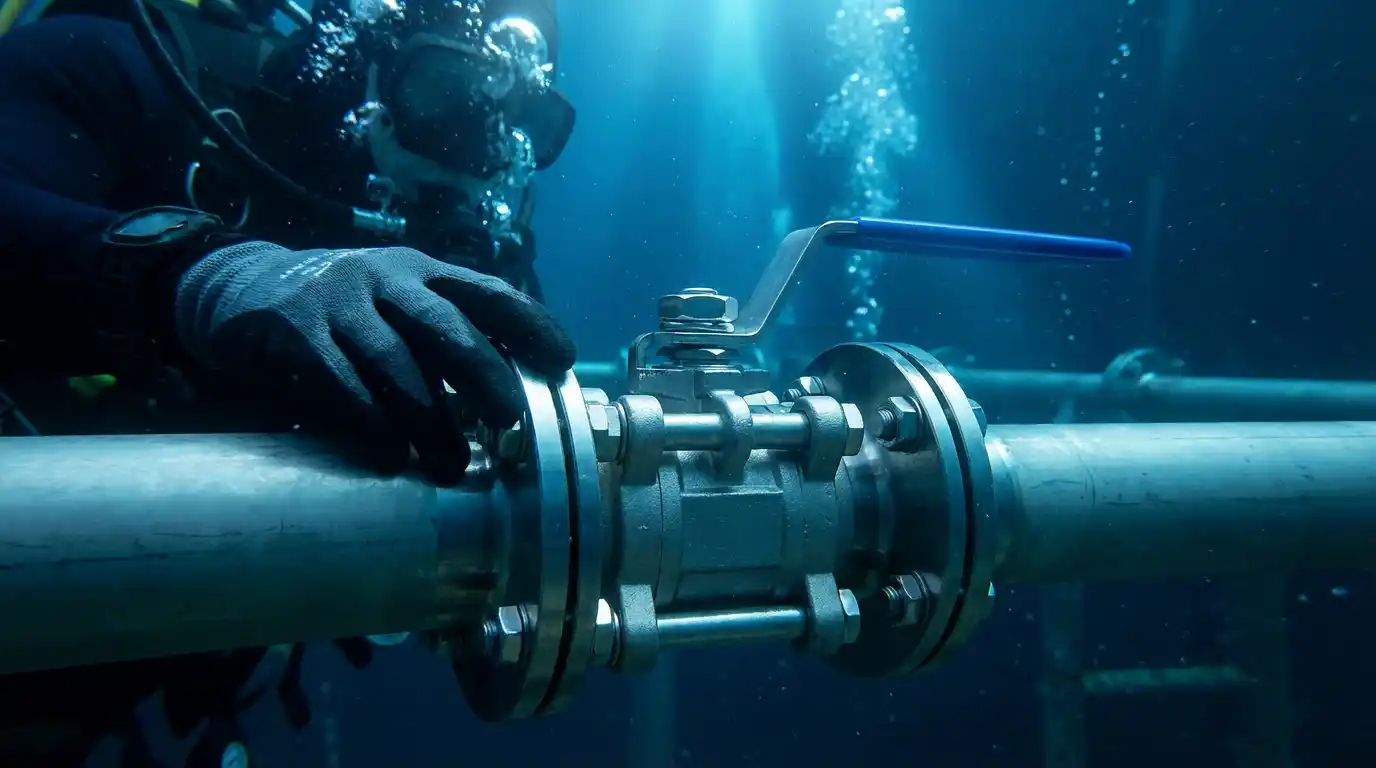
The Battle Against the Sea: My Experience with Corrosion-Resistant Stainless Steel Valves
When I reflect on the thousands of projects I’ve overseen, the ones that stand out are the marine applications. Saltwater is a complex electrolyte, and its ability to initiate galvanic and pitting corrosion is legendary in the engineering community. Early in my career, I visited a coastal desalination plant where they were using lower-grade corrosion-resistant stainless steel valves in their intake system. The valves looked perfect on the outside, but when we opened them up, the internal seats were completely pitted, and the stems had begun to “gall” due to salt crystal buildup. This was a turning point for Yzng Trong. We realized that for marine and offshore use, we had to go beyond the industry standard. We had to ensure that every surface of our valve—from the ball to the smallest bolt—was engineered to resist the specific electrochemical profile of the sea.
The key to longevity in these settings is the integrity of the chromium-oxide film that naturally forms on the surface of the steel. In a high-chloride environment, this film is under constant attack. If the film is broken and cannot self-heal, corrosion begins immediately. Our 35 years of manufacturing experience have taught us that the surface finish of the metal is just as important as the alloy itself. A rough surface provides “nooks and crannies” where salt can concentrate and moisture can linger, accelerating the decay. That is why our corrosion-resistant stainless steel valves undergo a rigorous passivation process to ensure that the protective layer is as thick and uniform as possible. When I see a Yzng Trong valve being lowered into a subsea manifold or installed on a vessel’s ballast system, I feel a sense of confidence because I know we have accounted for every variable that the ocean can throw at it.
Understanding the Chemistry of Marine-Grade Alloys
To truly master the selection of corrosion-resistant stainless steel valves, one must dive into the periodic table. The presence of specific elements like Chromium, Nickel, and Molybdenum is what grants these valves their “superpowers.” In the marine industry, we often talk about the Pitting Resistance Equivalent Number (PREN). A higher PREN indicates a better ability to resist localized attack in chloride environments. Through 35 years of testing and feedback, Yzng Trong has optimized our alloy sourcing to ensure that our Grade 316 and 316L valves consistently hit the high end of the performance spectrum. It’s not just about meeting the minimum standard; it’s about providing a safety margin for those extreme cases where the salinity or temperature exceeds the typical norms.
The Vital Role of Molybdenum in Grade 316 and 316L
The primary reason we recommend Grade 316 for our corrosion-resistant stainless steel valves in marine settings is the addition of 2% to 3% Molybdenum. This single element is the hero of the story. It specifically targets and neutralizes the threat of chloride-induced pitting—a form of corrosion that creates small, deep holes in the metal that are often invisible to the naked eye until it’s too late. In my experience, using Grade 304 in an offshore environment is a gamble that rarely pays off. I remember a client in the North Sea who insisted on Grade 304 for their non-critical water lines to save on costs. Within two years, we were back on-site replacing those valves because of “pinhole leaks.” By switching them to our Molybdenum-rich 316 corrosion-resistant stainless steel valves, we eliminated the problem. It’s a classic example of how a small change in chemistry can result in a massive change in operational lifespan.
Advanced Alloys and Coatings for Extreme Offshore Salinity
Sometimes, even Grade 316 is not enough. In the most extreme offshore environments—such as high-temperature subsea oil extraction or chemical tankers—we look toward “Super Austenitic” or Duplex stainless steels. These materials offer nearly double the strength and significantly higher PREN values. At Yzng Trong, we have expanded our capability to provide corrosion-resistant stainless steel valves in these premium alloys for projects that demand the absolute peak of performance. Furthermore, we often combine these high-end alloys with specialized external coatings or “Cladding” techniques for the valve bodies. I’ve worked on projects where we applied a fusion-bonded epoxy coating over the stainless steel to provide a dual-layer barrier. This is the kind of “belt and suspenders” engineering that I advocate for in the marine world. When you are dealing with the raw power of the ocean, there is no such thing as being too prepared.
Engineering Design for High-Pressure Subsea Applications
Designing corrosion-resistant stainless steel valves for subsea use adds another layer of complexity: external pressure. When a valve is submerged hundreds of meters deep, the ocean itself is trying to crush the valve body and push water into the internal cavities. This requires a completely different approach to seal design. Our 35 years of engineering have led us to develop “pressure-balanced” designs where the internal and external forces are accounted for in the wall thickness and the stem seal geometry. In subsea manifolds, the valve must be able to operate reliably after years of sitting idle in freezing temperatures and crushing pressures. This is why we use high-performance thermoplastic seats that don’t become brittle in the cold and don’t deform under the immense weight of the water column.
I recall a deep-water project in the Gulf of Mexico where our corrosion-resistant stainless steel valves were part of a backup control system. The valves had to be “ROV-operable” (Remote Operated Vehicle), meaning the handle and the body had to be designed so that a robotic arm could easily turn them under thousands of feet of water. This required us to rethink the torque requirements and the mechanical interfaces of the valve. We used specialized low-friction coatings on the ball and stem to ensure that even after five years of inactivity, the ROV could cycle the valve with minimal effort. This level of specialized engineering is what Yzng Trong brings to the table. We don’t just see a valve as a static object; we see it as a functional part of a complex subsea ecosystem that must perform perfectly on its one and only mission.
Maintenance and Inspection Protocols for Offshore Flow Control
Maintenance at sea is difficult, dangerous, and expensive. Therefore, the maintenance strategy for corrosion-resistant stainless steel valves on an offshore platform must be focused on “Prevention and Early Detection.” In my 35 years, I have seen maintenance teams struggle with seized valves because they ignored the signs of salt accumulation. A proactive maintenance schedule doesn’t just involve fixing what is broken; it involves a regular regimen of fresh-water rinsing and lubrication of the exposed mechanical parts. Even though the valve body is made of high-grade 316 stainless steel, the handle, the stem nut, and the actuator can still fall victim to “atmospheric” corrosion if they are constantly blanketed in salt spray.
Identifying Early Signs of Crevice and Pitting Corrosion
The most dangerous forms of corrosion in corrosion-resistant stainless steel valves are the ones you can’t see. Crevice corrosion occurs in the tiny gaps between the valve body and the pipe flange, or under the stem packing. In these tight spaces, oxygen is depleted, and chloride ions become concentrated, creating a highly acidic environment that eats the metal from the inside out. I always instruct offshore technicians to look for “bleeding”—the appearance of reddish-brown stains coming from a joint or a seal. This is the first sign that the passive layer has failed inside a crevice. By catching this early and performing a “bolt-tightening” or a seal replacement, you can prevent a major leak. My experience has shown that a well-trained eye and a simple flashlight are often more valuable than the most expensive diagnostic sensors when it comes to the daily reality of marine valve maintenance.
Cleaning and Protection Strategies for Exposed Valve Components
A simple but often overlooked maintenance task for corrosion-resistant stainless steel valves is the “Fresh Water Washdown.” On an offshore rig, salt accumulates on every surface. When the water evaporates, it leaves behind a concentrated crust of salt that is incredibly corrosive. I’ve seen valves that were designed to last 20 years fail in 5 because they were never rinsed. We recommend that our marine clients integrate valve rinsing into their daily deck-wash routines. Furthermore, applying a “Marine Grade” lanolin or silicone-based spray to the stem and handle area can provide a temporary hydrophobic barrier that repels salt spray. At Yzng Trong, we even offer specialized “Stem Shields” for our corrosion-resistant stainless steel valves to protect the moving parts from the direct environment. It’s these small, practical steps that ensure the “integrity of the seal” is maintained throughout the life of the vessel.
Strategic Comparison: Marine Valve Specifications
To assist maritime engineers and procurement officers, I have compiled a comparison table that highlights the critical specifications for corrosion-resistant stainless steel valves in various marine zones. Not every part of a ship or platform requires the same level of protection. By strategically selecting the material and design based on the “Zone of Exposure,” you can optimize your budget without compromising safety. This table is based on thousands of hours of field data and our 35 years of manufacturing excellence. I always tell my team: “The best valve is the one that is perfectly matched to its environment—nothing more, nothing less.”
| Exposure Zone | Recommended Material | Connection Type | Typical Valve | Key Requirement |
| Engine Room (Internal) | SS304 / SS316 | Threaded / Flanged | 2-PC Ball Valve | General flow control, heat resistance |
| Open Deck (Salt Spray) | SS316 / 316L | Flanged / Socket Weld | 3-PC Ball Valve | High PREN value, easy maintenance |
| Ballast System (Seawater) | SS316L / Duplex | Flanged | Butterfly / Check Valve | Resistance to biofouling & pitting |
| Subsea (High Pressure) | Duplex / Super Duplex | Butt Weld | High-Pressure Ball | Crush resistance, long-term seal |
| Fire Main (Safety) | SS316 (Nickel Coated) | Flanged | Gate / Globe Valve | Reliability under high vibration |
| Desalination Intake | SS316L / Titanium | Flanged | Ball / Y-Strainer | High-velocity chloride resistance |
When reviewing these specs for corrosion-resistant stainless steel valves, it is vital to consider the “Velocity” of the fluid. High-velocity seawater can cause “Erosion-Corrosion,” where the physical force of the water strips away the protective oxide layer, allowing the chemical corrosion to work faster. In these cases, we often recommend moving to a higher-grade alloy or increasing the wall thickness of the valve body. At Yzng Trong, we pride ourselves on being able to customize our valves to these specific edge cases. Whether you are dealing with the stagnant water of a ballast tank or the high-speed flow of a fire protection system, we have the technical data to back up our recommendations. We don’t just guess; we engineer based on 35 years of maritime success.
The Yzng Trong Commitment to Marine Infrastructure
As we conclude this guide, I want to emphasize that corrosion-resistant stainless steel valves are more than just an engineering requirement; they are a legacy of trust. At Yzng Trong International, we understand that our valves are the “gatekeepers” of the world’s oceans. Whether they are preventing a spill in the North Sea or ensuring the safe transport of goods across the Pacific, our products carry a heavy burden of responsibility. Our 35 years of “Commercial Integrity” mean that when we say a valve is “Marine Grade,” it has been tested and certified to the highest international standards. We are one of the few manufacturers that still prioritizes the long-term health of our clients’ systems over short-term profit margins.
Looking ahead, we are excited to continue our research into even more advanced corrosion-resistant stainless steel valves. We are exploring the use of ceramic inserts for abrasive marine slurries and integrating smart sensors that can monitor the “health” of the passive oxide layer in real-time. But regardless of how high-tech the industry becomes, the foundational principles of quality metallurgy and precision machining will never change. We are honored to be the technical partner for so many global maritime leaders, from Brazil to the USA and beyond. Thank you for trusting Yzng Trong to protect your fleet and your platforms. As the “surgeons” of the industrial world, we are ready to take on the challenges of the next 35 years, ensuring that the blood of the global economy—fluid and gas—continues to flow safely and reliably through the harshest oceans on Earth.